Chapter 07 · 911 – 609 BCE
Neo-Assyrian
Empire, library, terror, scholarship.
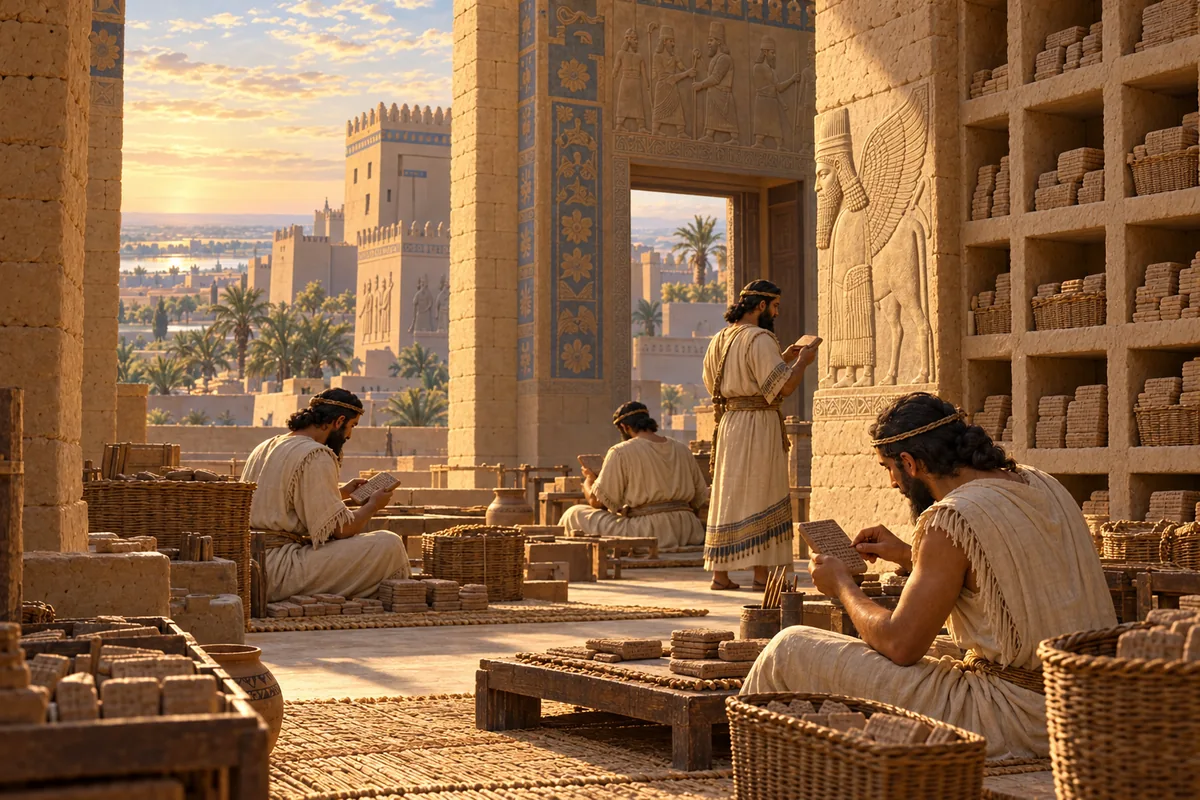
~730 BCE · Reconstructed composite — see ORACC entry for manuscript witnesses
SAA 19 010. Crown Prince Ululayu Sending Bales of Reed of the Magnates (CTN 5 p. 195)
“(1) [To] the king, [my] lord: yo[ur serva]nt Ululayu. The best of health to the kin[g], my lord! Assyria is well, the temples are well, all the king's forts are well. The king, my lord, can be glad indeed. (11) I am herewith sending to the king, my lord, 20 bales from the household of the commander-in-chief, 40 (bales) from the t[reasurer], 30 (bales) from the [chi]ef cupbearer, in all 90 b[al]es of reed. I took off the water-skin raft (on which the reed was shipped) on the 3rd of Iyyar (II).”
Source: Luukko, M. 2012. The Correspondence of Tiglath-pileser III and Sargon II from Calah/Nimrud. SAA 19. Helsinki: Helsinki University Press. https://oracc.museum.upenn.edu/saao/saa19/P393608/
Read the full tablet entry~730 BCE · Reconstructed composite — see ORACC entry for manuscript witnesses
SAA 19 011. All is Well (CTN 5 p. 194)
“(1) [To] the king, my lo[r]d: your [servant Ulu]layu. The best of health to the king, my lord! Assyria is well, the temples are well, all the [kin]g's forts are well. [The king, my lord], can be glad [indeed].”
Source: Luukko, M. 2012. The Correspondence of Tiglath-pileser III and Sargon II from Calah/Nimrud. SAA 19. Helsinki: Helsinki University Press. https://oracc.museum.upenn.edu/saao/saa19/P224394/
Read the full tablet entry~730 BCE · Reconstructed composite — see ORACC entry for manuscript witnesses
SAA 19 012. Arabs Removed from Hindanu (CTN 5 p. 87)
“(1) [To the kin]g, my lord: [your servant] Šarru-duri. [Good heal]th to the king, my lord! (4) I have [persona]lly brought [the people] of Sin-šabši [in]to the king, my lord's presence: once to the Review Palace and once to Nineveh. (10) [May] the ki[ng], my lord, [do] me justice [......]. (Break) (r 1) [...] has not do[ne]. (r 2) [As t]o the Arabs [about whom the kin]g, my lord, said: "The Hindanean has brought them over to this [sid]e (of the river)." (r 6) [But] not [all of] them have crossed over. They [keep w]atch at the highest point [on] the other [sid]e (of the river and) thei[r ...] are trading in the desert. [Let them le]ave [their ... in] Hindanu.”
Source: Luukko, M. 2012. The Correspondence of Tiglath-pileser III and Sargon II from Calah/Nimrud. SAA 19. Helsinki: Helsinki University Press. https://oracc.museum.upenn.edu/saao/saa19/P224438/
Read the full tablet entry~730 BCE · Reconstructed composite — see ORACC entry for manuscript witnesses
SAA 19 013. Šarru-duri to the Palace Scribe (CTN 5 p. 241)
“(1) A tablet of Šarru-d[uri] to the palace scribe. Good health to my lord! (4) I sent Nabû-nadin-ahhe to my lord; afterwards [......]. (Break) (r 1) Let the Gurreans perform [...] this [...].”
Source: Luukko, M. 2012. The Correspondence of Tiglath-pileser III and Sargon II from Calah/Nimrud. SAA 19. Helsinki: Helsinki University Press. https://oracc.museum.upenn.edu/saao/saa19/P224389/
Read the full tablet entry~730 BCE · Reconstructed composite — see ORACC entry for manuscript witnesses
SAA 19 014. Palace Scribe’s Business in Assur (CTN 5 p. 202)
“(1) To the pala[ce] scribe, my lord: your servant Bel-abu'a. Good health to [m]y lord! The house is very well. The Inner City is well. (7) We have fed your house. All the delegates are rejoicing and have blessed my lord. (12) (As to) the waist-be[lts about which m]y lord s]a[id]: "You have not g[iven] (any of them)." There are no waist-belts that my lord likes, the ordinary waist-belts sell for half a mina of silver each. (r 7) As to that waste land, we have not yet got hold of the (purchase) document, (but) Urdu-Allaya [will gi]ve it to you.”
Source: Luukko, M. 2012. The Correspondence of Tiglath-pileser III and Sargon II from Calah/Nimrud. SAA 19. Helsinki: Helsinki University Press. https://oracc.museum.upenn.edu/saao/saa19/P224484/
Read the full tablet entry~730 BCE · Reconstructed composite — see ORACC entry for manuscript witnesses
SAA 19 015. Farmers of the Town of Aššur-nirka-uṣur (CTN 5 p. 196)
“(1) To the king, my lord: your servant Aššur-šimanni. (3) As to the farmers of the town of Aššur-nirka-uṣur who appealed to the king, saying: "Our sown field has been flooded" - now their harvest has come out exceedingly well. The king knows that 10 ho[mers] of seed is cu[ltivated] annually. (12) [......] (13) an estate of 40 [homers of sown land] (14) [......] (r 1) has cultiv[ated] 10 homers of s[eed]. (r 3) [They have] utili[zed the la]nd of [th]is sust[enance field]. The k[ing] should have them watched more strictly. They say: "It is our own sown field." (r 9) I will now place harvesters…”
Source: Luukko, M. 2012. The Correspondence of Tiglath-pileser III and Sargon II from Calah/Nimrud. SAA 19. Helsinki: Helsinki University Press. https://oracc.museum.upenn.edu/saao/saa19/P393609/
Read the full tablet entry~730 BCE · Reconstructed composite — see ORACC entry for manuscript witnesses
SAA 19 016. Aššur-šimanni Reporting on People (CTN 5 p. 267)
“(1) [T]o the king, my lord: your servant Aššur-šimanni. (3) As to the people about whom the king, my lord, wrote to me, Remute, his brother, the son of Nabû-reši (and) Nabê-rumu are in my presence. Nabû-šarhi-ilani, [...] ... of [...] (Break) (r 2) They are not in m[y presence].”
Source: Luukko, M. 2012. The Correspondence of Tiglath-pileser III and Sargon II from Calah/Nimrud. SAA 19. Helsinki: Helsinki University Press. https://oracc.museum.upenn.edu/saao/saa19/P393610/
Read the full tablet entry~730 BCE · Reconstructed composite — see ORACC entry for manuscript witnesses
SAA 19 017. Provisioning Aramean Troops (CTN 5 p. 281)
“(1) To the king, my lord: your servant Aššur-matka-tera. Good health to the king, my lord! (5) As to the Aramean troops about whom the king, my lord, wrote to me: "Equip them! They are going on a campaign." I will give them their (travel) provisions, sackcloth, leather bags, sandals and oil. (r 5) I have no donkey stallions available, but if I did have donkey stallions available, I would offer my carts too for the campaign.”
Source: Luukko, M. 2012. The Correspondence of Tiglath-pileser III and Sargon II from Calah/Nimrud. SAA 19. Helsinki: Helsinki University Press. https://oracc.museum.upenn.edu/saao/saa19/P224445/
Read the full tablet entry