Chapter 07 · 911 – 609 BCE
Neo-Assyrian
Empire, library, terror, scholarship.
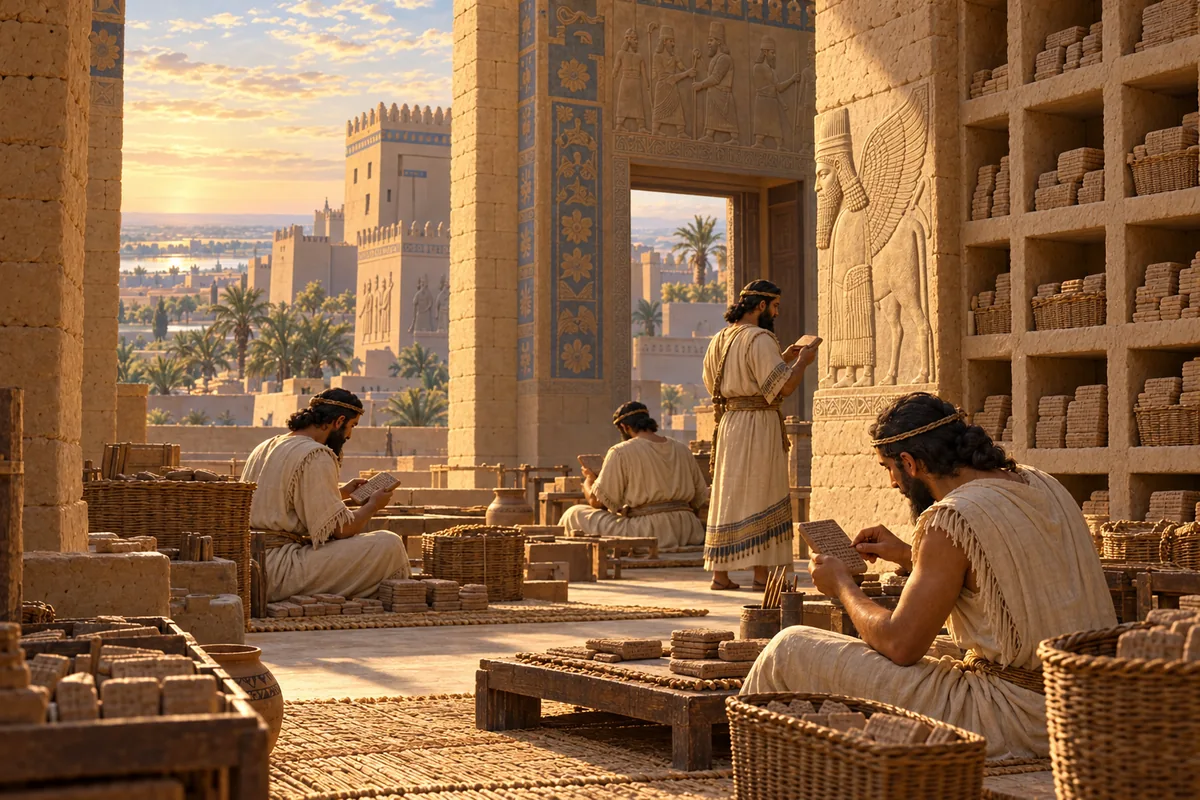
~730 BCE · Reconstructed composite — see ORACC entry for manuscript witnesses
SAA 19 018. Wives for Aramean Troops (CTN 5 p. 92)
“(1) To the king, my lord: your servant Aššur-matka-tera. Good health to the king, my lord! (4) As to the Arameans about whom the king said: "They should be made to marry wives," [I] have seen women in great numbers (there) but the[ir fath]ers re[fuse] to g[ive them], saying: "(Not) until they give m[one]y to us." (r 5) Let money be given to them (the Arameans) so they can marry.”
Source: Luukko, M. 2012. The Correspondence of Tiglath-pileser III and Sargon II from Calah/Nimrud. SAA 19. Helsinki: Helsinki University Press. https://oracc.museum.upenn.edu/saao/saa19/P224476/
Read the full tablet entry~730 BCE · Reconstructed composite — see ORACC entry for manuscript witnesses
SAA 19 019. Favourable Exchange Rate (CTN 5 p. 193)
“(1) [To the k]in[g, my lord: yo]ur [servant] Aššur-ma[tka-tera. Good] health to the king, [my lo]rd! (4) The land of the ki[ng] is well; the royal sustenance fields have been harvested. The exchange rate is extremely favourable in the land: one homer of barley goes for one mina of copper in Nineveh, one homer and 5 seahs (go for one mina of copper) in Halahhu, two homers (go for one mina of copper) in the steppe. 40 minas of wool (go for) one mina of co[pper ......]. (Rest destroyed)”
Source: Luukko, M. 2012. The Correspondence of Tiglath-pileser III and Sargon II from Calah/Nimrud. SAA 19. Helsinki: Helsinki University Press. https://oracc.museum.upenn.edu/saao/saa19/P393679/
Read the full tablet entry~730 BCE · Reconstructed composite — see ORACC entry for manuscript witnesses
SAA 19 020. Construction Works (CTN 5 p. 287)
“(Beginning destroyed) (3) [As to the order] that the king, my lord, gave me: "Break the [f]allow [g]round and [c]ut the hay" - [the f]allow ground has been broke[n] and two cubits high hay has been cut. All the corn and rice has been harv[ested. Real]ly, I ...[......] (10) one homer of sesame oil to [......]... (11) Ṣabu-d[amqu ...] the fo[r]t [...]... (12) [... o]f the Arsazaeans [......] (13) each [x] cubits to the four directions. (14) 6 depots of broad bricks for 6 towers, 10 brick (depots of) broad bricks for 4 tow[er]s (and) 10 (depots of) bricks before the city wall for ... each 20…”
Source: Luukko, M. 2012. The Correspondence of Tiglath-pileser III and Sargon II from Calah/Nimrud. SAA 19. Helsinki: Helsinki University Press. https://oracc.museum.upenn.edu/saao/saa19/P224459/
Read the full tablet entry~730 BCE · Reconstructed composite — see ORACC entry for manuscript witnesses
SAA 19 021. Works in Turmuna (CTN 5 p. 257)
“(1) To the ki[ng], m[y lord]: your servant [...n]i. (3) The city Turmuna where the king appointed me is well. The land has been subjugated. They are cultivating the fields and plastering roofs. We are sta[nd]ing [in the cit]y like one (family). [Wher]e there were criminals, [there are ...s; w]here there were [......] (Break) (r 1) [...] ... ra[in o]n it [...] (r 3) [... occ]urred. They have not got [..., an] ox, (or) anything.”
Source: Luukko, M. 2012. The Correspondence of Tiglath-pileser III and Sargon II from Calah/Nimrud. SAA 19. Helsinki: Helsinki University Press. https://oracc.museum.upenn.edu/saao/saa19/P393696/
Read the full tablet entry~730 BCE · Reconstructed composite — see ORACC entry for manuscript witnesses
SAA 19 022. Restricted Trade in Tyre and Sidon (CTN 5 p. 155)
“(1) To the king, my lord: your servant Qurdi-Aššur-lamur. (3) Concerning the Tyrean (king) about whom the king said: "Speak kindly with him!" (5) All the ports of trade have been released to him; his servants go in and out of the trading posts and sell and buy as they wish. Mount Lebanon is at his disposal, and they go up and down as they wish and bring down the wood. (10) I collect a tax from anyone who brings down wood, and I have appointed tax-collectors over the ports of trade of the entire Mount Lebanon. They are keeping watch over the mountain. (14) The Sidonites chased away the…”
Source: Luukko, M. 2012. The Correspondence of Tiglath-pileser III and Sargon II from Calah/Nimrud. SAA 19. Helsinki: Helsinki University Press. https://oracc.museum.upenn.edu/saao/saa19/P224471/
Read the full tablet entry~730 BCE · Reconstructed composite — see ORACC entry for manuscript witnesses
SAA 19 023. Hiram Deported after Sacrilegious Act (CTN 5 p. 154)
“(1) [To the k]ing, my lord: you[r] serva[nt] Qurdi-Aššur-lamur. (3) Nabû-šezib from Tyre has sent me this sealed Aramaic document, saying: "Let it be sent to the Palace." I have sent it to the Palace. (8) [H]i[r]am cut down the sacred tree of his temple on the acropolis of Sidon planning to transport it to Tyre, but I had him deported. The sacred tree that he felled is at the foot of the mountain; it has been smothered [(...)]. (r 1) Nabû-šezib [...] (r 2) [... H]iram has fallen [into the hands of] his (Nabû-šezib's) [servant]s. (r 4) N[ow] the [...] official has brought out these [...]s. (r 6) Let the captives who are coming to Immiha set out and come. Their seed is cultivated; they should come to their sickles.”
Source: Luukko, M. 2012. The Correspondence of Tiglath-pileser III and Sargon II from Calah/Nimrud. SAA 19. Helsinki: Helsinki University Press. https://oracc.museum.upenn.edu/saao/saa19/P224463/
Read the full tablet entry~730 BCE · Reconstructed composite — see ORACC entry for manuscript witnesses
SAA 19 024. Matenni of Tyre Pays Tribute (CTN 5 p. 152)
“(Beginning destroyed) (2) [On ...], Matenni [of Tyre had written] to the (ruler of) Danab[u, saying]: 'Let us r[aise] the king's money [and give it to him!]' (6) When he had sent t[his] word to [NN], his brother, the royal [delegate NN], showed up, saying: "Give me [the tribute]." He (Matenni) [spoke] with the (ruler of) Danab[u] and told him to give the tribute. [Now then] let all the Sidonites who came w[ith him immediately] com[e] to me with the [delegate, and I shall as]sign [the tribute] and [send it] to the king. (15) The delegate says: "When I heard [this matter I wrote] to the k[ing…”
Source: Luukko, M. 2012. The Correspondence of Tiglath-pileser III and Sargon II from Calah/Nimrud. SAA 19. Helsinki: Helsinki University Press. https://oracc.museum.upenn.edu/saao/saa19/P224412/
Read the full tablet entry~730 BCE · Reconstructed composite — see ORACC entry for manuscript witnesses
SAA 19 025. Ionian Raids on Levant (CTN 5 p. 164)
“(1) To the king, my lord: your servant Qurdi-ili-lamur. (3) The Ionians came and gave battle in Samsim[uruna], Hariṣû and [GN]. (6) A cav[al]ry[man] came to Daman[...]; I [t]ook the free men and went away. (9) They (= the Ionians) did [n]ot take anyth[ing] (and) when [they sa]w [my] tr[oops they embarked] th[eir] boats and [fled] into the midst of the sea. (13) [...] after me (Break) (r 2) [say]ing: "He/It is [at the p]ort of Io[nia]." (r 3) I myself shall bui[ld] (in) Danab[u] before I go up to [...]. I shall sett[le] there the lone Itu'ean at my disposal and the Itu'[ean] ...[...].”
Source: Luukko, M. 2012. The Correspondence of Tiglath-pileser III and Sargon II from Calah/Nimrud. SAA 19. Helsinki: Helsinki University Press. https://oracc.museum.upenn.edu/saao/saa19/P393612/
Read the full tablet entry