Chapter 07 · 911 – 609 BCE
Neo-Assyrian
Empire, library, terror, scholarship.
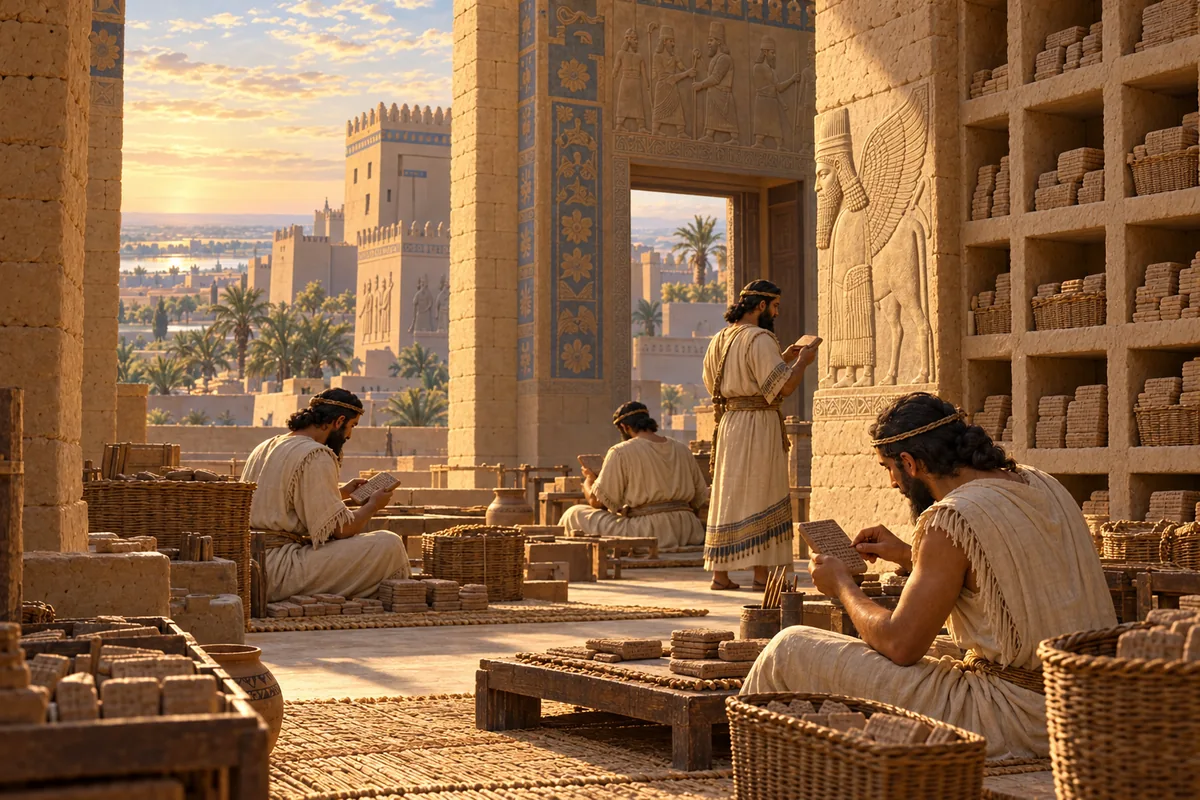
~730 BCE · Reconstructed composite — see ORACC entry for manuscript witnesses
SAA 19 001. Soothing Babylon (CTN 5 p. 13)
“(1) The king's word to the clergymen, the congrega[ti]on, the leaders of [Babylon] (and) to the citizens of Babylon: I am well, Assyria is well – you can be glad. (9) Don't be afraid because of the news you heard; watch the city, seize the streets (and) take care of yourself! (14) Now I am approaching you again (since) the bodyguard Na'di-ilu told me: "They are trembling in fea[r]." Bel and Na[bû] know and the great god himself knows that, verily, when I previously heard that your brothers were killed, for three days nobody entered into my presence, my heart broke. (r 8) Now you are afraid…”
Source: Luukko, M. 2012. The Correspondence of Tiglath-pileser III and Sargon II from Calah/Nimrud. SAA 19. Helsinki: Helsinki University Press. https://oracc.museum.upenn.edu/saao/saa19/P393604/
Read the full tablet entry~730 BCE · Reconstructed composite — see ORACC entry for manuscript witnesses
SAA 19 002. “You Are my Deputy” (CTN 5 p. 240)
“(1) [The king's word to the] commander-in-[chief]: (2) My forts, my [...] (and) my horses [are well]. (4) [Day and] night during my reign, you shall be my magnate (and) my deputy. You shall stand in my place; guarding you is for guarding me. (7) [Don't be neg]ligent but keep watch for me. (8) [...] ... The day [you se]e [this letter ......] (Rest destroyed or too broken for translation)”
Source: Luukko, M. 2012. The Correspondence of Tiglath-pileser III and Sargon II from Calah/Nimrud. SAA 19. Helsinki: Helsinki University Press. https://oracc.museum.upenn.edu/saao/saa19/P393605/
Read the full tablet entry~730 BCE · Reconstructed composite — see ORACC entry for manuscript witnesses
SAA 19 003. The Commander-In-Chief Defeated the Arabs (CTN 5 p. 175)
“(1) The [k]in[g]'s word to Inurta-belu-uṣur. (3) Check and receive all the ca[me]ls that the commander-in-chief will give to you. [...] Badi'-Il is with you; entrust them to him and let them be grazed in the midst of the land. (9) The commander-in-chief has now defeated these Arabs but let your guard of the steppe be as strong as previously. Your rams [from] the steppe [to] the midst of the land have been left on their own but they must be shepherded until ... (r 3) (As to) the campaign against the Tabalean(s), they will explain to you how [to ...] between [GN an]d Apamea (and) between Qadeš…”
Source: Luukko, M. 2012. The Correspondence of Tiglath-pileser III and Sargon II from Calah/Nimrud. SAA 19. Helsinki: Helsinki University Press. https://oracc.museum.upenn.edu/saao/saa19/P224446/
Read the full tablet entry~730 BCE · Reconstructed composite — see ORACC entry for manuscript witnesses
SAA 19 004. The King Encourages Amurru-šumu-iškun (CTN 5 p. 80)
“(1) Say to Amurru-šumu-iškun: thus says the king: (3) Let your guard be strong (over) Kihudaksi! (5) You have feared Mišaru-naṣir for the sake of Assyria and he frightens (you). But fear not and don't be afraid of him. You will bear the responsibility for the land. (11) Now, the troops of the chief cupbearer (and) Aššur-eṭir have sent 100 horses, two chariots, and 300 oxen and they [a]re at your disposal. (r 2) [...] is harvesting [...] and they have sent the crop to you. (r 5) My messengers, who are coming up to you fr[o]m Dummal, are entrusted to you. Guard them, but they should not take…”
Source: Luukko, M. 2012. The Correspondence of Tiglath-pileser III and Sargon II from Calah/Nimrud. SAA 19. Helsinki: Helsinki University Press. https://oracc.museum.upenn.edu/saao/saa19/P224415/
Read the full tablet entry~730 BCE · Reconstructed composite — see ORACC entry for manuscript witnesses
SAA 19 005. Madayu to Meet the King in Urzuhina with 30 Riding Horses (CTN 5 p. 252)
“(1) The king's [word] to Madayu: (3) You must be in my [prese]nce in [U]rzuhina on the first of Tammuz (IV) together with 30 riding horses. One [...]... [......] (r 1) let [...] (r 2) as [...] (r 3) I have writ[ten to yo]u; [d]on't be [ne]gligent [wi]th your cavalry, although I may be delayed in the (home)land.”
Source: Luukko, M. 2012. The Correspondence of Tiglath-pileser III and Sargon II from Calah/Nimrud. SAA 19. Helsinki: Helsinki University Press. https://oracc.museum.upenn.edu/saao/saa19/P393606/
Read the full tablet entry~730 BCE · Reconstructed composite — see ORACC entry for manuscript witnesses
SAA 19 007. Equipment from the Palace (CTN 5 p. 321)
“(1) The king's [word t]o Belu-lu-dari. (3) A Babylonian messenger came, saying: "Ahu-nuri with the king [......] (Break) (r 1) ask [...], take the (necessary) equipment from the Palace, find out in detail what the matter is (and) write me quickly. (r 7) The 24th of Adar (XII).”
Source: Luukko, M. 2012. The Correspondence of Tiglath-pileser III and Sargon II from Calah/Nimrud. SAA 19. Helsinki: Helsinki University Press. https://oracc.museum.upenn.edu/saao/saa19/P393707/
Read the full tablet entry~730 BCE · Reconstructed composite — see ORACC entry for manuscript witnesses
SAA 19 008. Emissaries from the West (CTN 5 p. 182)
“(1) To the king, my lord: yo[ur] servant Ululayu. The b[e]st of he[a]lth to the [k]i[ng], my lord! Ass[yria] is well, the temples are well, all the king's forts are well. The king, my lord, can be glad indeed. (9) The emissaries of Commagene, Carc[hem]ish, Ma[r]qasa, Sam'al, Ashdod and Moab have come, but they have passed through Til-Barsip and Guzana without my permission. (16) I sent (word) to detain th[em] in Kubana[še]. They say: "[......] (r 2) [......] (r 3) I wrote to the [commander-in-chief] that the emissari[e]s should not proceed but they had been let to cross over (the river).…”
Source: Luukko, M. 2012. The Correspondence of Tiglath-pileser III and Sargon II from Calah/Nimrud. SAA 19. Helsinki: Helsinki University Press. https://oracc.museum.upenn.edu/saao/saa19/P393607/
Read the full tablet entry~730 BCE · Reconstructed composite — see ORACC entry for manuscript witnesses
SAA 19 009. Crown Prince Ululayu Sending Bales of Reed (CTN 5 p. 204)
“(1) To the king, my lord: your servant Ululayu. The best of health to the king, my lord! Assyria is well, the temples are well, all the king's forts are well. The king, my lord, can be glad indeed. (8) 36 bales of reed – I personally went down to the river bank, and they crushed and collected it in my presence. I am (now) sending it to the king, my lord, with the royal bodyguard Ubru-Nergal.”
Source: Luukko, M. 2012. The Correspondence of Tiglath-pileser III and Sargon II from Calah/Nimrud. SAA 19. Helsinki: Helsinki University Press. https://oracc.museum.upenn.edu/saao/saa19/P224498/
Read the full tablet entry