Chapter 07 · 911 – 609 BCE
Neo-Assyrian
Empire, library, terror, scholarship.
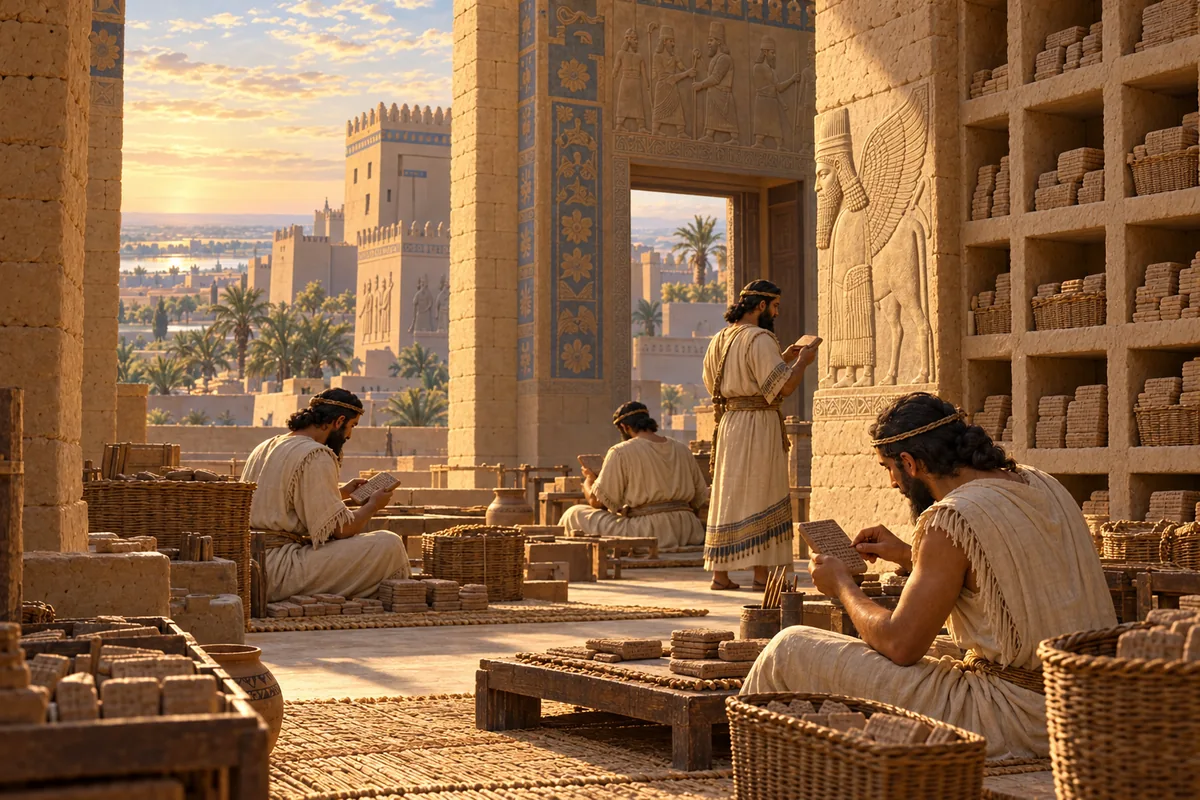
~735 BCE · Reconstructed composite — see ORACC entry for manuscript witnesses
Tiglath-pileser III 59
“(1) Tiglath-pileser (III), great king, mighty king, king of the world, king of Assyria: (this brick) belongs to the pedestal (under) the bulls of the gateway of the temple of the god Adad.”
Source: Tadmor, H. & Yamada, S. 2011. The Royal Inscriptions of Tiglath-pileser III (744–727 BC) and Shalmaneser V (726–722 BC), Kings of Assyria. RINAP 1. University Park, PA: Eisenbrauns. https://oracc.museum.upenn.edu/rinap/rinap1/Q003472/
Read the full tablet entry~735 BCE · Reconstructed composite — see ORACC entry for manuscript witnesses
Tiglath-pileser III 60
“(1) [(Palace of) Tiglath-pileser (III), great king, mi]ghty [king], king of the world, king of Assyria: (this brick) [belongs to the ped]estal (under) the bulls [of] the gateway of the temple of the god Adad.”
Source: Tadmor, H. & Yamada, S. 2011. The Royal Inscriptions of Tiglath-pileser III (744–727 BC) and Shalmaneser V (726–722 BC), Kings of Assyria. RINAP 1. University Park, PA: Eisenbrauns. https://oracc.museum.upenn.edu/rinap/rinap1/Q003473/
Read the full tablet entry~735 BCE · Reconstructed composite — see ORACC entry for manuscript witnesses
Tiglath-pileser III 61
“(1) Palace of Tiglath-pileser (III), king of the world, king of Assy[ria].”
Source: Tadmor, H. & Yamada, S. 2011. The Royal Inscriptions of Tiglath-pileser III (744–727 BC) and Shalmaneser V (726–722 BC), Kings of Assyria. RINAP 1. University Park, PA: Eisenbrauns. https://oracc.museum.upenn.edu/rinap/rinap1/Q003474/
Read the full tablet entry~735 BCE · Reconstructed composite — see ORACC entry for manuscript witnesses
Tiglath-pileser III 62
“(1) Palace of Tiglath-pileser (III), great king, mighty king, king of the world, king of Assyria: fifteen minas.”
Source: Tadmor, H. & Yamada, S. 2011. The Royal Inscriptions of Tiglath-pileser III (744–727 BC) and Shalmaneser V (726–722 BC), Kings of Assyria. RINAP 1. University Park, PA: Eisenbrauns. https://oracc.museum.upenn.edu/rinap/rinap1/Q003608/
Read the full tablet entry~735 BCE · Reconstructed composite — see ORACC entry for manuscript witnesses
Tiglath-pileser III 63
“(1) Palace of Tiglath-pileser (III), king of Assyria: two minas of the king.”
Source: Tadmor, H. & Yamada, S. 2011. The Royal Inscriptions of Tiglath-pileser III (744–727 BC) and Shalmaneser V (726–722 BC), Kings of Assyria. RINAP 1. University Park, PA: Eisenbrauns. https://oracc.museum.upenn.edu/rinap/rinap1/Q003609/
Read the full tablet entry~735 BCE · Reconstructed composite — see ORACC entry for manuscript witnesses
Tiglath-pileser III 64
“(1) Palace of Tiglath-piles[er] (III), great king, mighty king, king of the world, king of [Assyria].”
Source: Tadmor, H. & Yamada, S. 2011. The Royal Inscriptions of Tiglath-pileser III (744–727 BC) and Shalmaneser V (726–722 BC), Kings of Assyria. RINAP 1. University Park, PA: Eisenbrauns. https://oracc.museum.upenn.edu/rinap/rinap1/Q004177/
Read the full tablet entry~735 BCE · Reconstructed composite — see ORACC entry for manuscript witnesses
Tiglath-pileser III Series A Annals
“Beginning of the Annals missing (Frgm._A1 1) Precious scion of Baltil (Aššur), beloved of the god(dess) [(DN and) Šē]rūa, ..., creation of the goddess Ninmena, who [(...)] ... for the dominion of the lands, (...) who grew up to be king, ... [(...)] governor, [(...)] ..., the one who increases voluntary offerings for ..., ... [(...)] of emblems, (5) powerful male, light of all of his people, lord of [(...) all] rulers ..., the one who overwhelms his foes, valiant man, the one who destroys [(...)] enemies, who cuts (straight) through interlocking mountains like a (taut) string and ... [...] ...…”
Source: Tadmor, H. & Yamada, S. 2011. The Royal Inscriptions of Tiglath-pileser III (744–727 BC) and Shalmaneser V (726–722 BC), Kings of Assyria. RINAP 1. University Park, PA: Eisenbrauns. https://oracc.museum.upenn.edu/rinap/rinap1/Q006329/
Read the full tablet entry~735 BCE · Reconstructed composite — see ORACC entry for manuscript witnesses
Tiglath-pileser III Series B Annals
“Beginning of the Annals missing (Frgm._1 1) [... I] adorned them (statues of the gods) and they (the gods) went (back) to their land. I rebuilt th[ose] cities. I built a city on top of a tell (lit. “a heaped-up ruin mound”) called [Ḫumut]. I b[uilt (and) co]mpleted (it) from its foundations to its parapets. [Inside (it), I founded] a palace for my royal residence. I named it Kār-Aššur, set up the weapon of (the god) Aššur, my lord, therein, (and) settled the people [of (foreign) lands] conquered by me therein. [I] imposed upon them [tax (and) tribute], (and) considered them as inhabitants of…”
Source: Tadmor, H. & Yamada, S. 2011. The Royal Inscriptions of Tiglath-pileser III (744–727 BC) and Shalmaneser V (726–722 BC), Kings of Assyria. RINAP 1. University Park, PA: Eisenbrauns. https://oracc.museum.upenn.edu/rinap/rinap1/Q006330/
Read the full tablet entry