Chapter 07 · 911 – 609 BCE
Neo-Assyrian
Empire, library, terror, scholarship.
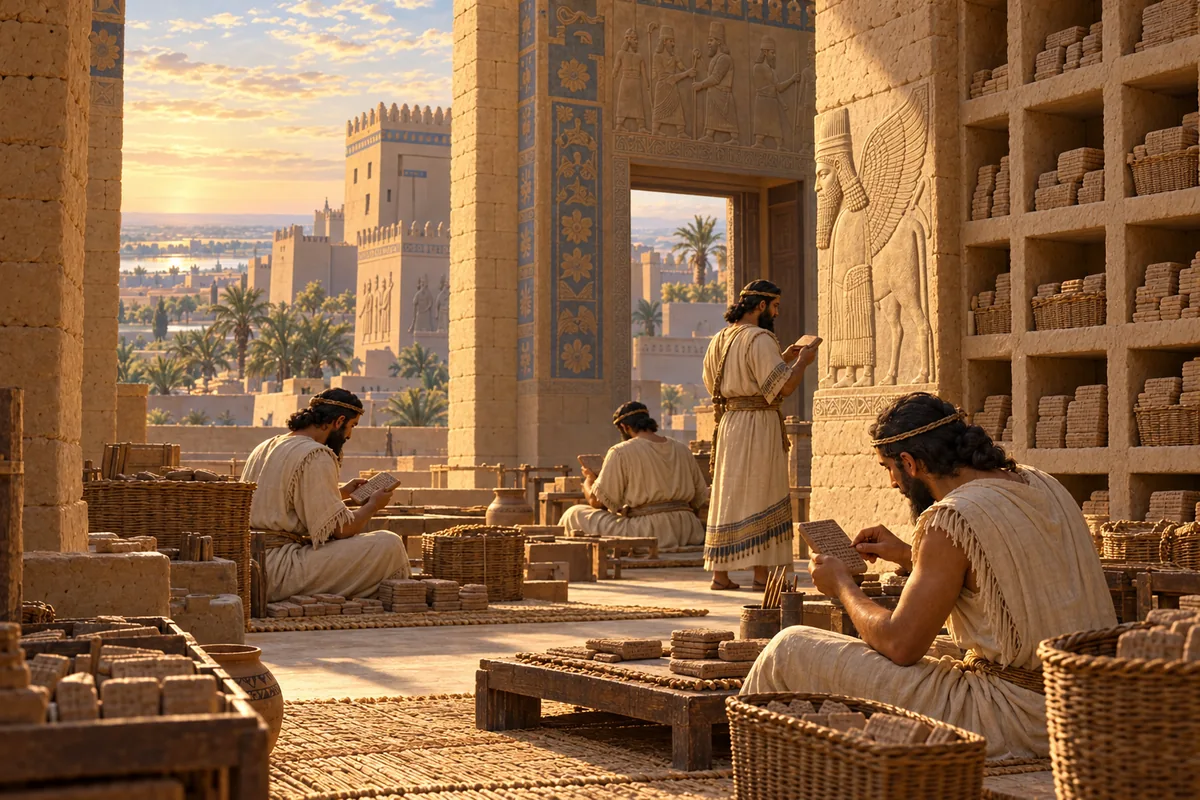
~735 BCE · Reconstructed composite — see ORACC entry for manuscript witnesses
Tiglath-pileser III 48
“(1') [...] ... [...] his [...] ... on dry land [...] I made (them) lay down [their lives. ...] that city, to[gether with ... in] the midst of the sea I swept over them and anni[hilated (them). (5´) ... As for him, terror of my battle array fe]ll [upon him] and his heart pounded. He put on sackcloth ... [... of] ivory, ebony, inlaid with (precious) stones (and) gold, together with ... [...], ivory, fine oil, all types of aromatics, E[gyptian] horses, [... I est]ablished [... I exercised authority] from the city Kašpūna, which is on the shore of the [Upper] Sea, [as far as ... (and) I placed]…”
Source: Tadmor, H. & Yamada, S. 2011. The Royal Inscriptions of Tiglath-pileser III (744–727 BC) and Shalmaneser V (726–722 BC), Kings of Assyria. RINAP 1. University Park, PA: Eisenbrauns. https://oracc.museum.upenn.edu/rinap/rinap1/Q003461/
Read the full tablet entry~735 BCE · Reconstructed composite — see ORACC entry for manuscript witnesses
Tiglath-pileser III 49
“(1') [I ut]terly [defeated him and took his entire camp away from him. He became frightened of the terrifying radiance of my weapons], mounted [a mare in order to save his life, escaped during the night] <to> Mount Sizir, a [rugged] mountain, [and ascended] (it). (3') I confined [Sarduri of the land Urarṭu to the city Ṭurušpâ, his city], and [inflicted] a gre[at] defeat upon him [before his city gates. I fashioned my royal image and erected] (it) in front of the city Ṭuru[špâ]. (5') [For a distance of seventy leagues], I proudly march[ed through the extensive land of Urarṭu, from] one end to…”
Source: Tadmor, H. & Yamada, S. 2011. The Royal Inscriptions of Tiglath-pileser III (744–727 BC) and Shalmaneser V (726–722 BC), Kings of Assyria. RINAP 1. University Park, PA: Eisenbrauns. https://oracc.museum.upenn.edu/rinap/rinap1/Q003462/
Read the full tablet entry~735 BCE · Reconstructed composite — see ORACC entry for manuscript witnesses
Tiglath-pileser III 50
Records Tiglath-pileser III's annexation of Unqi, Ḫatarikka, and Damascus into directly governed Assyrian provinces — the administrative mechanism behind the destruction of the Aramaean states attested in 2 Kings 15–16.
“(1') [I conquered the land Unqi to its full extent (and) I brought to Assyria twenty talents of gold, ...], property, [... I annexed to Assyria the land Unqi (and) placed] a eunuch [of mine as provincial governor over them]. (r 1) [I annexed the city Ḫatarikka, as far as Mount Saue, the city] Kašpūna, which is on the shore of the Upper (text: “Lower”) Sea, (and) [the cities Ṣimirra (and) Arqâ to Assyria (and) I placed] two eunuchs of mine as provincial governor[s over them]. (r 3) I annexed [to Assyria the extensive land of Bīt-Ḫazā-il (Damascus) in its entirety, from Mount Leb]anon as far as…”
Source: Tadmor, H. & Yamada, S. 2011. The Royal Inscriptions of Tiglath-pileser III (744–727 BC) and Shalmaneser V (726–722 BC), Kings of Assyria. RINAP 1. University Park, PA: Eisenbrauns. https://oracc.museum.upenn.edu/rinap/rinap1/Q003463/
Read the full tablet entry~735 BCE · Reconstructed composite — see ORACC entry for manuscript witnesses
Tiglath-pileser III 51
Claims dominion from the Persian Gulf to Mount Damāvand, mapping the farthest eastern reach Tiglath-pileser III asserted over the Neo-Assyrian empire at its mid-8th-century territorial peak.
“(1) [Palace of Tiglath-pil]eser (III), great king, mighty king, king of the world, king of Assyria, king of Babylon, king of Sumer and Akkad, king of the four quarters (of the world); [valiant man who, with the hel]p of (the god) Aššur, his lord, smashed like pots all who were unsubmissive to him, swept over (them) like the Deluge, (and) considered (them) as (mere) ghosts; [the king who] marched about [at the command of the gods Aššur], Šamaš, and Marduk, the great gods, and exercised authority over lands from the Bitter Sea of Bīt-Yakīn, as far as Mount Bikni in the east, [up to the Sea of…”
Source: Tadmor, H. & Yamada, S. 2011. The Royal Inscriptions of Tiglath-pileser III (744–727 BC) and Shalmaneser V (726–722 BC), Kings of Assyria. RINAP 1. University Park, PA: Eisenbrauns. https://oracc.museum.upenn.edu/rinap/rinap1/Q003464/
Read the full tablet entry~735 BCE · Reconstructed composite — see ORACC entry for manuscript witnesses
Tiglath-pileser III 52
“(1) [Palace of Tiglath-pileser (III), great king, mighty king, king of the world, king of Assyria, king of Bab]ylon, king of Sumer and Akkad, king of the four quarters (of the world); [valiant man who, with the help of (the god) Aššur, his lord], smashed [like pots all who were unsubmissive to him], swept over (them) like the Deluge, (and) considered (them) as (mere) ghosts; [the king who marched about at the command of the gods Aššur, Šamaš, and Marduk, the great gods, and] exercised authority over lands [from the Bitter] Sea of Bīt-Yakīn, as far as Mount Bikni in the east, [up to the Sea of…”
Source: Tadmor, H. & Yamada, S. 2011. The Royal Inscriptions of Tiglath-pileser III (744–727 BC) and Shalmaneser V (726–722 BC), Kings of Assyria. RINAP 1. University Park, PA: Eisenbrauns. https://oracc.museum.upenn.edu/rinap/rinap1/Q003465/
Read the full tablet entry~735 BCE · Reconstructed composite — see ORACC entry for manuscript witnesses
Tiglath-pileser III 53
“(1) Tiglath-[pilese]r (III), [great] king, [...], conqueror of [...], con[queror of the (tribes) It]uʾu, Rubuʾu, [...]. I defeated [...] (5) (No translation possible) (14) I filled Mount Ḫauranu (Hauran) with [...]. (15) I carried off [...] (and) ... thousand sheep. I conquered [...]. Moreover, as for her (Samsi?), the terrifying radiance of (the god) [Aššur, my lord, overwhelmed her and ...]. I spared her so (she would) praise (the victory of the god Aššur). [... I set up ...] as governors. (18b) At that time, [I ...] Ninurta-ilāya, the provincial governor of [...]. I built (and) completed…”
Source: Tadmor, H. & Yamada, S. 2011. The Royal Inscriptions of Tiglath-pileser III (744–727 BC) and Shalmaneser V (726–722 BC), Kings of Assyria. RINAP 1. University Park, PA: Eisenbrauns. https://oracc.museum.upenn.edu/rinap/rinap1/Q003466/
Read the full tablet entry~735 BCE · Reconstructed composite — see ORACC entry for manuscript witnesses
Tiglath-pileser III 54
“(1) [...] ... them and [...]. I ordered their [...]. I forced open their locked ga[tes] and [...] ... I carried off the people [liv]ing inside it. [...] ... [...] whom [I had] appointed. The kings (of) (5) [...] my [...] from the land Nanpigi (Nippigi) [...] ... [... I annex]ed [to Assyria. I] carried off [...] ... (8) [...] thirteen kings of the land Ḫatti (Syria-Palestine), [...] ..., Raḫiānu (Rezin), (10) [...] ... (and) chariots of Sulumal, [...] ... [...] ... Mount ...ri [...] I left behind ... and [...] together with his land. [...] ... [...] ...”
Source: Tadmor, H. & Yamada, S. 2011. The Royal Inscriptions of Tiglath-pileser III (744–727 BC) and Shalmaneser V (726–722 BC), Kings of Assyria. RINAP 1. University Park, PA: Eisenbrauns. https://oracc.museum.upenn.edu/rinap/rinap1/Q003467/
Read the full tablet entry~735 BCE · Reconstructed composite — see ORACC entry for manuscript witnesses
Tiglath-pileser III 58
“(1) Palace of Tiglath-pileser (III), king of Assyria, son of Adad-nārārī (III), king of Assyria: (this brick) belongs to the platform of the temple of (the god) Aššur.”
Source: Tadmor, H. & Yamada, S. 2011. The Royal Inscriptions of Tiglath-pileser III (744–727 BC) and Shalmaneser V (726–722 BC), Kings of Assyria. RINAP 1. University Park, PA: Eisenbrauns. https://oracc.museum.upenn.edu/rinap/rinap1/Q003471/
Read the full tablet entry