Chapter 07 · 911 – 609 BCE
Neo-Assyrian
Empire, library, terror, scholarship.
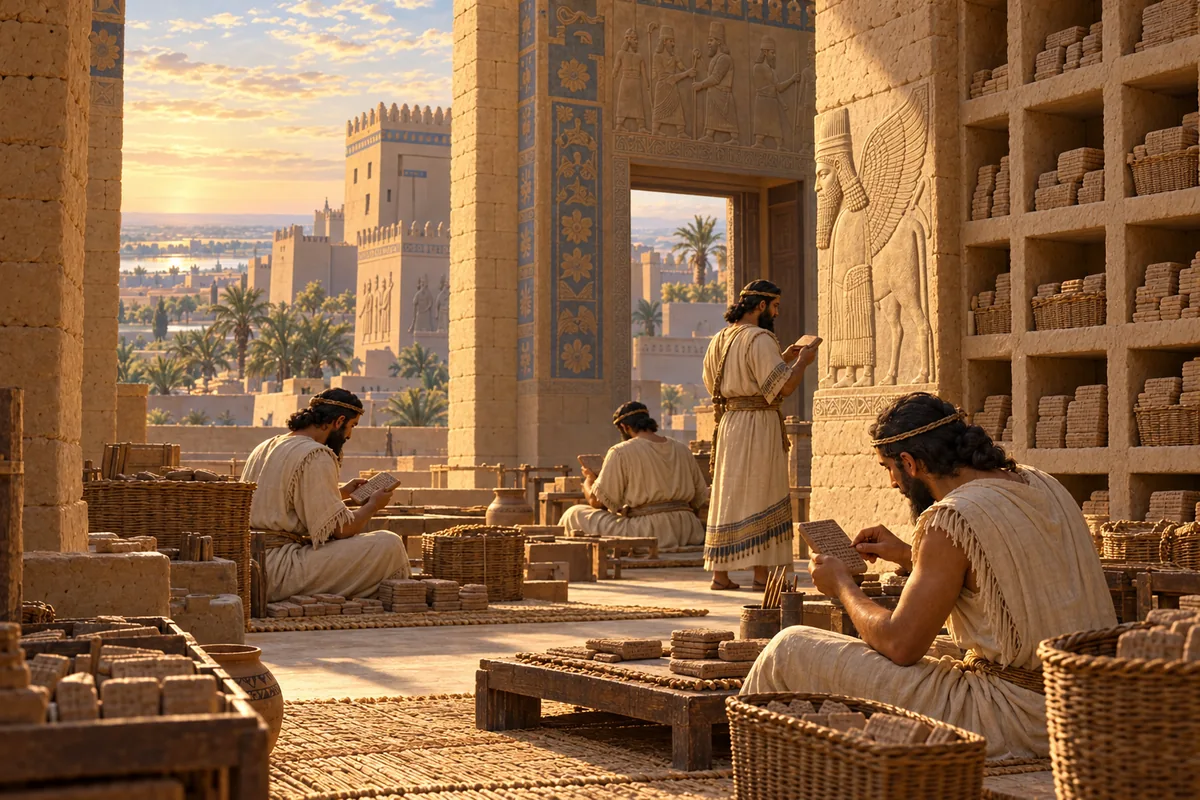
~735 BCE · Reconstructed composite — see ORACC entry for manuscript witnesses
Tiglath-pileser III 40
“(1) Palace of Tiglath-pileser (III), great king, mighty king, king of the world, king of Assyria, king of Babylon, king of Sumer and Akkad, king of the fou[r] quarters (of the world), the one chosen by the glance of the god Enlil. (3b) From the beginning of my reign until my seventeenth palû, I captured the (tribes) Ituʾu, Rubuʾu, Ḫamarānu (Ḫamrānu), Luḫuʾātu, (5) Nabātu, Ḫindiru (Ḫindaru), Ruʾuʾa, Liʾtaʾu, Marusu, Puqudu, [Ara]means, as many as there were on the banks of the Tigris, [Euph]rates, Surappu, (and) Uqnû Rivers, [as far as the] Lower [S]ea of the Rising Sun. (10) I annexed (those…”
Source: Tadmor, H. & Yamada, S. 2011. The Royal Inscriptions of Tiglath-pileser III (744–727 BC) and Shalmaneser V (726–722 BC), Kings of Assyria. RINAP 1. University Park, PA: Eisenbrauns. https://oracc.museum.upenn.edu/rinap/rinap1/Q003453/
Read the full tablet entry~735 BCE · Reconstructed composite — see ORACC entry for manuscript witnesses
Tiglath-pileser III 41
“(1') [I destroyed the cities Sarrabānu] (and) Dūr-[Balīḫāya, their large cities, (making them) like a mound of ruins. I brought all of their people t]o Assyria. (2'b) [I entered Babylon (and) offered pure sacrifices before the god Marduk, my lord]. (3') [I exercised authority over] Karduniaš (Babylonia), [...], (and) firmly established [tribute (and) pay]ment [on the chieftains of Chaldea]. (4'b) I annex[ed] to Assyria the lands Bīt-Ḫam[ban], Sumurzu, [Bīt-Barrūa (Bīt-Barrû)], Bīt-Zualzaš, (and) Bīt-Matti, [the city Niqqu of] the land [Tup]liy[aš], the lands Bīt-Taranzāya, Parsua, (and)…”
Source: Tadmor, H. & Yamada, S. 2011. The Royal Inscriptions of Tiglath-pileser III (744–727 BC) and Shalmaneser V (726–722 BC), Kings of Assyria. RINAP 1. University Park, PA: Eisenbrauns. https://oracc.museum.upenn.edu/rinap/rinap1/Q003454/
Read the full tablet entry~735 BCE · Reconstructed composite — see ORACC entry for manuscript witnesses
Tiglath-pileser III 42
“(1') I exercised authority over [..., ...] ..., which [...], the city Ḫatarikka, as far as Mount Sau[e, ...], the cities Gub[la (Gabala), ..., Ṣi]mirra, Arqâ, Zimar[ra, ...], Usnû, [Siʾannu, Ma]ʾarabâ, Riʾisi-ṣu[rri, ...], cities, [the empor]ium(s) ... [...] of the Upper [Sea]. I placed six eunuchs [of mine as provincial governors over] them. (5'b) I annexed to Assyria [..., the city Kaš]pūna, which is on the shore of the Upper (text: “Lower”) Sea, the cities [...]nite, Gil[ead, and] Abil-šiṭṭi, which are the border of the land Bīt-Ḫumrî (Israel), the extensive [land of Bīt-Ḫazā-i]l…”
Source: Tadmor, H. & Yamada, S. 2011. The Royal Inscriptions of Tiglath-pileser III (744–727 BC) and Shalmaneser V (726–722 BC), Kings of Assyria. RINAP 1. University Park, PA: Eisenbrauns. https://oracc.museum.upenn.edu/rinap/rinap1/Q003455/
Read the full tablet entry~735 BCE · Reconstructed composite — see ORACC entry for manuscript witnesses
Tiglath-pileser III 43
“Continued from the previous slab (not preserved) (i 1) [The cities ..., ...]anšu, [..., ...]au, [..., ...]ariṣa, [..., ...]anu, (i 5) [...], Urmuše, [..., Eli]zanšu, [..., Luqad]anšu, [..., ...]tanšu, [..., ...]esanšu, (i 10) [(and) ... — cities that] are on (the shore of) the Sea [of the land Naʾiri]. (i 11b) [The cities ...]anšu, [..., ...]tuarizu, [..., ...]nistu, [...], Lupsua (Lupsa), (i 15) [..., Danz]iun, [..., ...]mezaya, [..., Ez]zēda, [..., Bir]dāša (Birdanša), [...], Zinia, (i 20) [..., ...]ḫuli, [..., ...]lianša, [..., Par]īsu, [(and) ... — cities of] the lands Enzi, [..., and…”
Source: Tadmor, H. & Yamada, S. 2011. The Royal Inscriptions of Tiglath-pileser III (744–727 BC) and Shalmaneser V (726–722 BC), Kings of Assyria. RINAP 1. University Park, PA: Eisenbrauns. https://oracc.museum.upenn.edu/rinap/rinap1/Q003456/
Read the full tablet entry~735 BCE · Reconstructed composite — see ORACC entry for manuscript witnesses
Tiglath-pileser III 44
“(1') [...] ... [... he sent ...] to Kalḫu, befo[re me, to do obeisance. ...]. (3') [As for Samsi, queen of] the Arabs, at Mount Sa[qurri, I ...] her [en]tire camp [...]. (5') [Moreover, she, who had] become startled [by] my (mighty) [weapons, brought ... to Assy]ria, b[efore me. I pl]aced [a representative (of mine) over her] and [...] <10,000> soldie[rs ...]. I made [...] bow [down at] my [feet]. (8'b) The people of the cities [Masʾa (and) Tema, the (tribe) Sab]a, the people of the cities Ḫaya[ppa, (10´) Badanu, (and) Ḫat]te, (and) the (tribes) I[dibaʾilu, ..., who are on the bor]der of the…”
Source: Tadmor, H. & Yamada, S. 2011. The Royal Inscriptions of Tiglath-pileser III (744–727 BC) and Shalmaneser V (726–722 BC), Kings of Assyria. RINAP 1. University Park, PA: Eisenbrauns. https://oracc.museum.upenn.edu/rinap/rinap1/Q003457/
Read the full tablet entry~735 BCE · Reconstructed composite — see ORACC entry for manuscript witnesses
Tiglath-pileser III 45
“(1') [... (and) the (tribe) Puqu]du, Ara[means, as many as there were on the banks of the Tigris, Euphrates, Surappu], (and) Uqnû [Rivers, ... I placed a] eunuch [of mine as provincial governor over them. ...]”
Source: Tadmor, H. & Yamada, S. 2011. The Royal Inscriptions of Tiglath-pileser III (744–727 BC) and Shalmaneser V (726–722 BC), Kings of Assyria. RINAP 1. University Park, PA: Eisenbrauns. https://oracc.museum.upenn.edu/rinap/rinap1/Q003458/
Read the full tablet entry~735 BCE · Reconstructed composite — see ORACC entry for manuscript witnesses
Tiglath-pileser III 46
Chronicles Tiglath-pileser III's systematic absorption of Aramean tribes along the Tigris and Euphrates — the demographic and territorial pressure that reshaped the Levantine political map in the 730s BCE.
“(1) [Palace of Tiglath-pileser (III), great king, mighty king], king of the world, king of Assyria, [..., chosen by the glance of] the god Enlil, [...] the one who restores sanctuaries, [whom (5) (the god) Aššur, his lord, commissioned to ..., to wi]den (the borders of) Assyria, (and) to lay flat the land(s) of his enemies. (5b) [From the beginning of my reign until my ... palû, I captured ... (... and) the (tribe) Ḫa]tallu, the land Labdudu, [..., (and) Arameans, as many as there were on the banks of the Tigris and] Euphrates [Rivers. ... I built a city on top of a tell (lit. “a heaped-up…”
Source: Tadmor, H. & Yamada, S. 2011. The Royal Inscriptions of Tiglath-pileser III (744–727 BC) and Shalmaneser V (726–722 BC), Kings of Assyria. RINAP 1. University Park, PA: Eisenbrauns. https://oracc.museum.upenn.edu/rinap/rinap1/Q003459/
Read the full tablet entry~735 BCE · Reconstructed composite — see ORACC entry for manuscript witnesses
Tiglath-pileser III 47
“(1) Palace of Tiglath-piles[er (III), great king, mighty king, king of the world, king of Assyria, king of Babylon, king of] Sumer and Akkad, king of the four quarters (of the world); valiant man who, with the help of (the god) Aššur, his lord, [smashed like pots] all [who were unsubmissive to him], swept over (them) like [the] Deluge, and considered (them) as (mere) ghosts; the king who [marched about] at the command of the gods Aššur, Šamaš, and Marduk, the great gods, [and] exercised authority over lands fr[om the Bi]tter Sea of Bīt-Yakīn, as far as Mount Bikni in the east, up to the Sea…”
Source: Tadmor, H. & Yamada, S. 2011. The Royal Inscriptions of Tiglath-pileser III (744–727 BC) and Shalmaneser V (726–722 BC), Kings of Assyria. RINAP 1. University Park, PA: Eisenbrauns. https://oracc.museum.upenn.edu/rinap/rinap1/Q003460/
Read the full tablet entry