Chapter 07 · 911 – 609 BCE
Neo-Assyrian
Empire, library, terror, scholarship.
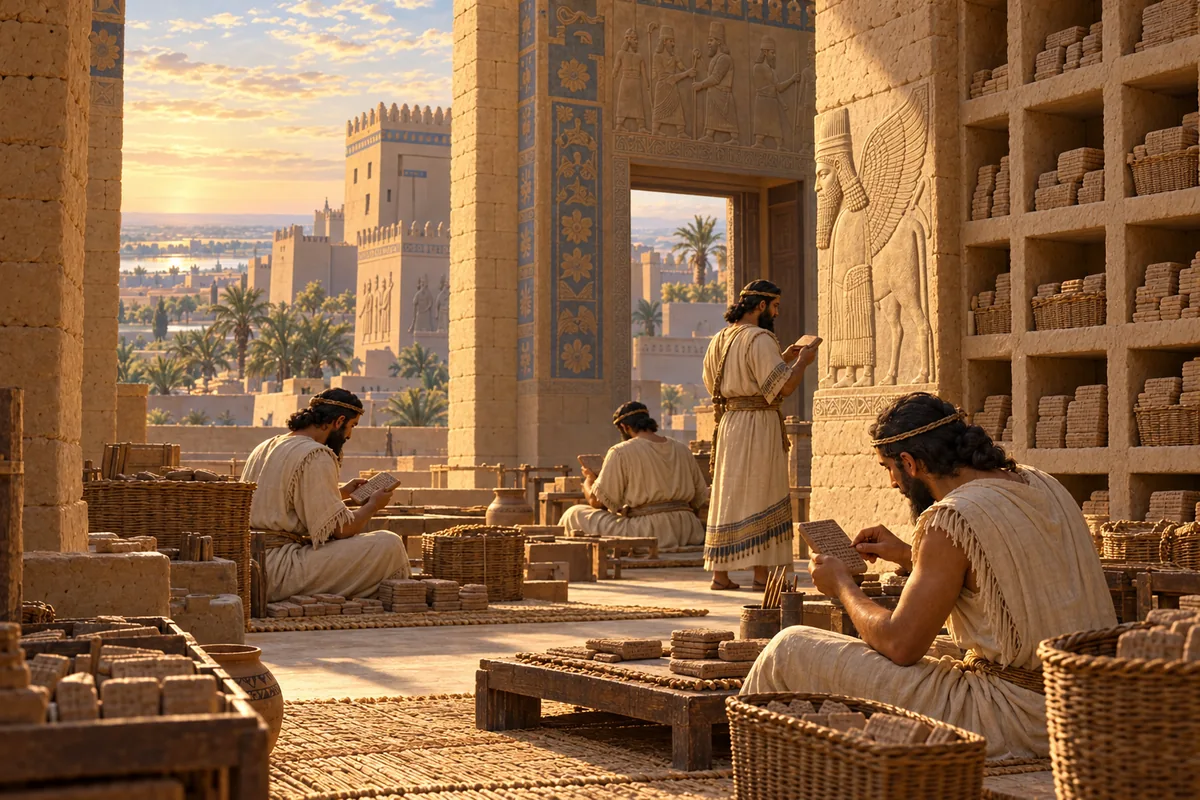
~730 BCE · Reconstructed composite — see ORACC entry for manuscript witnesses
SAA 19 188. Six Criminals Terrorizing the Town of Nashur-Bel (CTN 5 p. 223)
“(Beginning destroyed) (2) [NN] (and) Muq[alli]l-kabti, total two servants of the chief cupbearer from Našmedi; (7) Adad-killanni (and) his son, total two servants of the priest of Dur-Illil; (11) Tatû from Kapar-Ilu-bani, a servant of the recruitment officer Ambatî; (r 3) Ahu-iddina [fr]om Singara, a servant of the chief cupbearer. (r 6) In all six criminals, they have terrorized the town of Nashur-Bel.”
Source: Luukko, M. 2012. The Correspondence of Tiglath-pileser III and Sargon II from Calah/Nimrud. SAA 19. Helsinki: Helsinki University Press. https://oracc.museum.upenn.edu/saao/saa19/P224404/
Read the full tablet entry~730 BCE · Reconstructed composite — see ORACC entry for manuscript witnesses
SAA 19 189. The Troops of Mazamua (CTN 5 p. 128; SAA 05 215)
“(1) [To the ki]ng, my lord: [your servant] Adad-issiya. [Good] health to the king, my lord! (4) As to the order that the king, my lord, gave me: "Review the troops of Mazamua and write me!" – (here are the facts): (6) <x> 10 chariots, 20 large-wheeled chariots, 10 (of them) horse-drawn, 10 mule-drawn; in all 20 teams. (9) 97 riding horses; 11 chariot drivers; 12 ‘third men'; [3]0 chariot fighters; 53 grooms of the teams, in all 106 men and [30] chariots. (13) 161 cavalrymen, 130 grooms, 52 ...; in all 343 grooms. (15) 8 lackeys, 12 tailors, 20 cupbearers, 12 confectioners, 7 bakers, 10 cooks:…”
Source: Luukko, M. 2012. The Correspondence of Tiglath-pileser III and Sargon II from Calah/Nimrud. SAA 19. Helsinki: Helsinki University Press. https://oracc.museum.upenn.edu/saao/saa19/X190189/
Read the full tablet entry~730 BCE · Reconstructed composite — see ORACC entry for manuscript witnesses
SAA 19 190. Sending Horses to Calah, Snow Blocking the Roads (CTN 5 p. 102 and p. 316; SAA 15 83)
“(1) To the king, my lord: your servant Nabû-belu-ka''in. The very best of health to the king, my lord! (5) Concerning what the king, my lord, wrote to me: "Be at Calah on the 1st of Nisan (I)" – we are clearing the roads, but it is snowing and snow is filling them up. There is very much snow. (11) [...] the 3rd of Shebat (XI) (12) [...] ... (14) [...] he se[n]t the first 20 horses. (16) The year before last, (when) there was as much snow, rivers were frozen and the men and horses who were with me died in the snow. I shall be in the king my lord's presence on the 6th or 7th of Nisan. (r 3) As…”
Source: Luukko, M. 2012. The Correspondence of Tiglath-pileser III and Sargon II from Calah/Nimrud. SAA 19. Helsinki: Helsinki University Press. https://oracc.museum.upenn.edu/saao/saa19/X190190/
Read the full tablet entry~730 BCE · Reconstructed composite — see ORACC entry for manuscript witnesses
SAA 19 191. Receiving Tribute Horses; Constructing Kar-Šarruken (CTN 5 p. 134; SAA 15 84)
“(Beginning destroyed) (2) They will [bring] the h[ors]es and come. (3) As to the news of Daltâ, he is not leaving (his) house and nobody is entering into his presence. I have heard that he is collecting the rest of the tribute and delivering his tax. (6) I have taken the released Medes who are i[n] my [prese]nce (and) 30 horses. The remaining people are with me. (8) [I have re]ceived the tribute of the land of Zakrutu, 40 horses. They promised to give the rest [of the tribute]. (10) The king, my lord, [should send] (word) to the magnates that they may [proc]eed against Kuluman. Elam [...],…”
Source: Luukko, M. 2012. The Correspondence of Tiglath-pileser III and Sargon II from Calah/Nimrud. SAA 19. Helsinki: Helsinki University Press. https://oracc.museum.upenn.edu/saao/saa19/X190191/
Read the full tablet entry~730 BCE · Reconstructed composite — see ORACC entry for manuscript witnesses
SAA 19 192. Problem with Dalta (CTN 5 p. 106)
“(1) [To the king, my lord: your servant Nabû-belu-ka''in]. The very be[st] of heal[th] to the king, [my lo]rd! (6) As to what the king, my lord, w[r]ot[e] to me: "Why did you lay your hands on Daltâ?" (10) How could I la[y my] han[ds] o[n] him without the [ki]ng's permission? (13) Is it [cr]ime [to ......?] (15) not to [...] (16) [the ki]ng, [my] lord [...] (r 1) [......] (r 2) [...]...[...] (r 3) [I] went [t]o the land of Bit-[...] and after my departure h[e] m[a]de [him]se[lf] to take an oath by the (gods of) the king but burnt 5 towns. Moreover, he killed the guards of the towns and pl[unde]red 200 sheep [......] (Rest destroyed)”
Source: Luukko, M. 2012. The Correspondence of Tiglath-pileser III and Sargon II from Calah/Nimrud. SAA 19. Helsinki: Helsinki University Press. https://oracc.museum.upenn.edu/saao/saa19/P224397/
Read the full tablet entry~730 BCE · Reconstructed composite — see ORACC entry for manuscript witnesses
SAA 19 193. Tribute of Horses and Mules (CTN 5 p. 93)
“(1) [To the kin]g, my lord: [your servant] Nabû-belu-[ka''in]. The very bes[t of he]alth t[o] the k[i]ng, [my] lo[rd]! (5) The emissaries of [GN] are now comi[ng] with Marduk-iddina; one team of horse[s] and one team of mules is all they [have brought] to me. (10) I spoke to them as follows about the palace servant: "The fie[ld ......] your neighbour [... the ...] around you is [...]." (14) "When a eunuch (or) a [...] are not loyal with me, [they will die]. If they see (disloyalty) but do not [tell me, they will die as well]. I have heard that ind[eed ...] palace servants [have ...] oxen in a…”
Source: Luukko, M. 2012. The Correspondence of Tiglath-pileser III and Sargon II from Calah/Nimrud. SAA 19. Helsinki: Helsinki University Press. https://oracc.museum.upenn.edu/saao/saa19/P224496/
Read the full tablet entry~730 BCE · Reconstructed composite — see ORACC entry for manuscript witnesses
SAA 19 194. Providing Road Stations with Horses (CTN 5 p. 142)
“(1) To the king, m[y] lord: your servant Nabû-belu-ka''in. The very best of he[al]th to the king, my lord! (5) As to what the kin[g], my lord, wrote to me: "Harass the road stations which have your horses, and come!" (9) The horses [...] accordingly (10) [......] early (Break) (r 1) ...... (r 2) they are hungry, [...] was/were not given (to them) in Durtunu. (r 4) The caravans before me are taken, the Babylonian merchants have been delayed by one stage [...]. (r 8) Bel-le'i and about 90 mares of M[u]šeṣi are eating in the presence of [Ašš]ur-da''inanni. I did not see him and his son is (not) coming either. (Side too broken for translation)”
Source: Luukko, M. 2012. The Correspondence of Tiglath-pileser III and Sargon II from Calah/Nimrud. SAA 19. Helsinki: Helsinki University Press. https://oracc.museum.upenn.edu/saao/saa19/P393674/
Read the full tablet entry~730 BCE · Reconstructed composite — see ORACC entry for manuscript witnesses
SAA 19 195. Wayward Gurreans and Eunuchs (CTN 5 p. 130)
“(1) To the king, m[y] lord: your servant Nabû-ahhe-[...]. Good health to the kin[g], m[y] lord! (4) Concerning the son of Attua about whom I sai[d] to the king, my lord: "He will come." He came out but tur[ne]d back; his father is coming. (7) The 40 Gur[r]eans who have been serving the king, my lord, have not been a problem ever after the year that they went to Hardu until now. Now they have not come out to go along with their colleagues. Attua has said: "You are not going. You are my servants." (15) Concerning the towns about which the king, my lord, wrote to Nabâ, he has not given them…”
Source: Luukko, M. 2012. The Correspondence of Tiglath-pileser III and Sargon II from Calah/Nimrud. SAA 19. Helsinki: Helsinki University Press. https://oracc.museum.upenn.edu/saao/saa19/P393682/
Read the full tablet entry