Chapter 07 · 911 – 609 BCE
Neo-Assyrian
Empire, library, terror, scholarship.
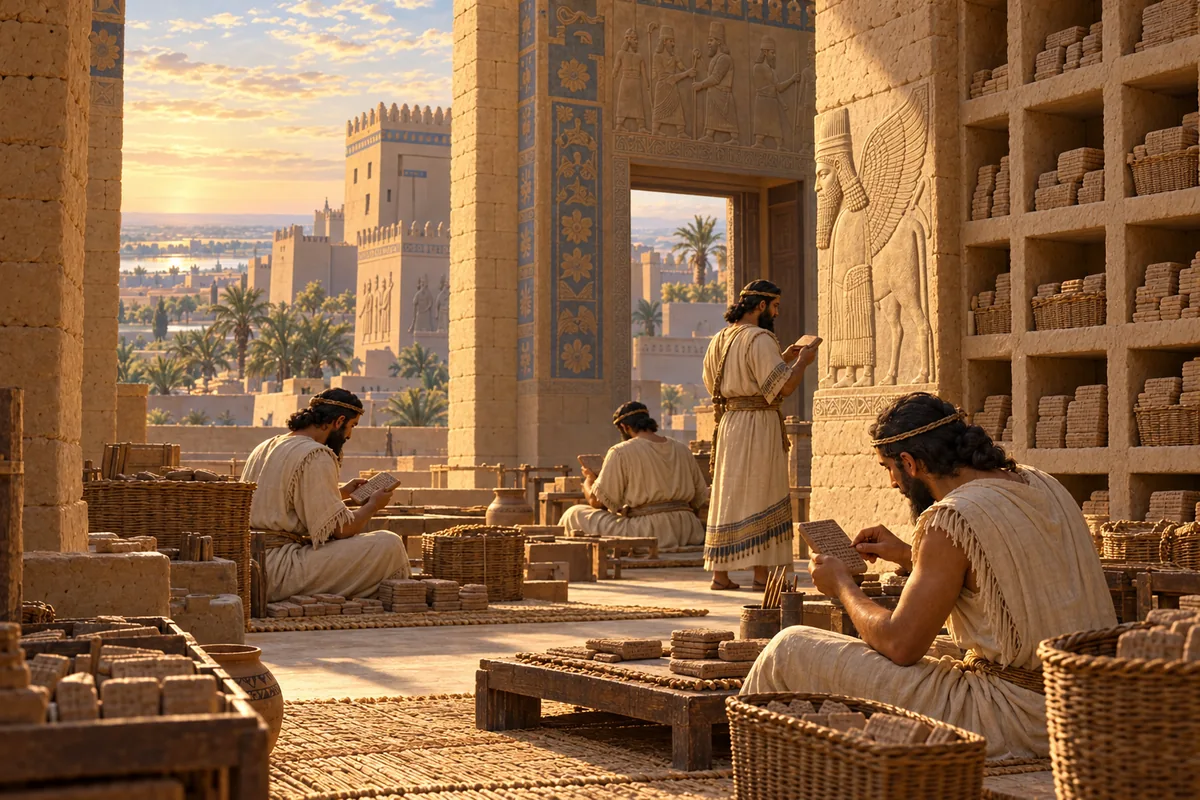
~730 BCE · Reconstructed composite — see ORACC entry for manuscript witnesses
SAA 19 180. Land Dispute with the Governor of Guzana (CTN 5 p. 319)
“(1) [T]o the king, my lord: your servant Aš[šur-mat]ka-pahhir. Good health to the king, my lord! (4) Concerning the fields which the governor of Guzana appropriated (and) about which the king, my lord, wrote to me: "Had the fields previously been purchased?" (Rest destroyed)”
Source: Luukko, M. 2012. The Correspondence of Tiglath-pileser III and Sargon II from Calah/Nimrud. SAA 19. Helsinki: Helsinki University Press. https://oracc.museum.upenn.edu/saao/saa19/P224501/
Read the full tablet entry~730 BCE · Reconstructed composite — see ORACC entry for manuscript witnesses
SAA 19 181. Officials Inspecting Samaria (CTN 5 p. 151)
“(Beginning destroyed) (2) I [sent x me]n before me [and went] to Samaria. (4) In the mountain, four ...[......] (5) the messenger of the [......] (6) with the vice-governor of the city [...] (7) the official of [......] (8) went ...[......] (9) in the city, the cella[s of ......] (10) behin[d ......] (11) surro[unded ......] (12) ...[... ......] (13) Now [......] (r 2) [c]am[e ......] (r 3) saying, "[......] (r 4) who ... [......] (r 5) the city [......] (r 6) wine ...[......] (r 7) I [......] (Break) (e. 1) [......] all the [...]s”
Source: Luukko, M. 2012. The Correspondence of Tiglath-pileser III and Sargon II from Calah/Nimrud. SAA 19. Helsinki: Helsinki University Press. https://oracc.museum.upenn.edu/saao/saa19/P393670/
Read the full tablet entry~730 BCE · Reconstructed composite — see ORACC entry for manuscript witnesses
SAA 19 182. The People of Arza Plundered my Sheep (CTN 5 p. 163)
“(Beginning destroyed) (3) NN [......] (4) has come [.... Perhaps the king, my lord], will say: "[...] (6) to letter[s ......] (7) are empty ...[ ...] (8) concerni[ng t]he horse[s ...] (9) on the bo[rder o]f [...] (10) in the city of [......] (11) I [......] (12) I am waiting for ...[... ...] ...[.... Perhaps the king, my lord], will say: "[......] (Break) (r 1) [t]he messe[nger and ......] (r 2) bot[h ...] (r 3) killed [...] (r 4) surround[ed ...] (r 5) saying: "They were not the people of Dannaya [who] plundered my sheep but the people of Arzâ plund[er]ed them." The king my lord kn[ows that] until I have called the harve[sters, ...].”
Source: Luukko, M. 2012. The Correspondence of Tiglath-pileser III and Sargon II from Calah/Nimrud. SAA 19. Helsinki: Helsinki University Press. https://oracc.museum.upenn.edu/saao/saa19/P224488/
Read the full tablet entry~730 BCE · Reconstructed composite — see ORACC entry for manuscript witnesses
SAA 19 183. Building Works on the Urarṭian Border (CTN 5 p. 120)
“(1) To the king, m[y] lord: your servant Nabû-uṣalla. Good health to the king, my lord! (4) As to what the king, my lord, wrote to me: "Glaze bricks in Sardu[r]iani ti[ll the 5th] of Ab (V) and then drop it! Appoint Ukkaeans and scouts to supervise the work and let them guard the bricks! You yourselves go glaze bricks in Elizkun for ten days! If the Urarṭian[s] come [t]o Sarduriani to cru[s]h the bricks, let an express messe[nger] come and tell you: 'Revert from Elizkun and overwhelm them!'" (15) I sent spies to reconnoit[re]: Three [go]vernors with their forces are encamped opposite us.…”
Source: Luukko, M. 2012. The Correspondence of Tiglath-pileser III and Sargon II from Calah/Nimrud. SAA 19. Helsinki: Helsinki University Press. https://oracc.museum.upenn.edu/saao/saa19/P393663/
Read the full tablet entry~730 BCE · Reconstructed composite — see ORACC entry for manuscript witnesses
SAA 19 184. Hu-Tešub’s Brother Making Trouble (CTN 5 p. 113)
“(1) Good health to [the king], m[y lord]: your servant Hu-Teššub. (3) The king, my lord, knows my brother Mušeṣi, who made peace. He has gone to [the presence] of the king, my lord [...] (Break) (8) there is [...] (9) the It[u]'eans [......] (10) Let a [messen]ger of the king, my lord, come (11) [......] his i[š]kā[r]u dues (12) [...... m]y heart (13) during [...], he has set his mind on my governorship. (16) Indeed, the king, my lord, knows that he has been keeping an eye on me since the day before yesterday. (r 2) Now, my broth[er] has again gone to make trouble. I (too) shall go, I shall not leave it at that. I am going to the towns Argue and Kinnili; the king may do as he deems best.”
Source: Luukko, M. 2012. The Correspondence of Tiglath-pileser III and Sargon II from Calah/Nimrud. SAA 19. Helsinki: Helsinki University Press. https://oracc.museum.upenn.edu/saao/saa19/P224418/
Read the full tablet entry~730 BCE · Reconstructed composite — see ORACC entry for manuscript witnesses
SAA 19 185. Urarṭian Fort Commanders in Arbela (CTN 5 p. 107)
“(1) To the king, [m]y lord: your servant Šulmu-beli. Good health to the king, my lord! (4) The Urarṭian fort commanders, whom the governor of Calah brought, are (now) in Arbela. Will they stay there, (or) shall we bring them to Calah? What are the king [m]y [lord's ord]ers? (Break) (r 1) Now [what] are the king my lord's orders?”
Source: Luukko, M. 2012. The Correspondence of Tiglath-pileser III and Sargon II from Calah/Nimrud. SAA 19. Helsinki: Helsinki University Press. https://oracc.museum.upenn.edu/saao/saa19/P393671/
Read the full tablet entry~730 BCE · Reconstructed composite — see ORACC entry for manuscript witnesses
SAA 19 186. Šubrian King Protecting Deserters (CTN 5 p. 100)
“(1) To the king, [my] lord: your servant [DN-...]. Good health to the kin[g, my lord]! (4) The village manager [of ...] with a couple of king's men helped [NN] and Hallusu, (two) servants of Nabû-kenu-[uṣu]r, [gove]rnor [o]f Tillê, to run away, and took them to Upumu. (12) After I had asked around and investigated a bit, a tracker guided me (on their tracks). I arrested the person who had arranged his trip to Šubria and gave the tracker a messenger, saying: "Go and have a look, and I'll report to the king ac[cor]dingly; in negative case, I'll search for him here." (r 3) The Šubrian (king)…”
Source: Luukko, M. 2012. The Correspondence of Tiglath-pileser III and Sargon II from Calah/Nimrud. SAA 19. Helsinki: Helsinki University Press. https://oracc.museum.upenn.edu/saao/saa19/P224383/
Read the full tablet entry~730 BCE · Reconstructed composite — see ORACC entry for manuscript witnesses
SAA 19 187. Fragment Mentioning the Chief Cupbearer and Nashur-Bel in Šubria (CTN 5 p. 59)
“(Beginning destroyed) (1) Those who [..., ... i]n Šubr[ia but] those who [..., will] not [...] in the land of the ki[ng, my lord]. (r 1) The chief cupb[earer ...] (r 2) with the troops [of ...] (r 3) I and Nashur-Be[l ...] (r 4) with the troops o[f ...] (r 5) we were unite[d] with one anoth[er ...] (r 7) opposite him [...] (r 8) we shall do [...] (Rest destroyed)”
Source: Luukko, M. 2012. The Correspondence of Tiglath-pileser III and Sargon II from Calah/Nimrud. SAA 19. Helsinki: Helsinki University Press. https://oracc.museum.upenn.edu/saao/saa19/P393672/
Read the full tablet entry