Chapter 05 · 2000 – 1600 BCE
Old Babylonian
Hammurabi, the Epic of Gilgamesh, mathematics.
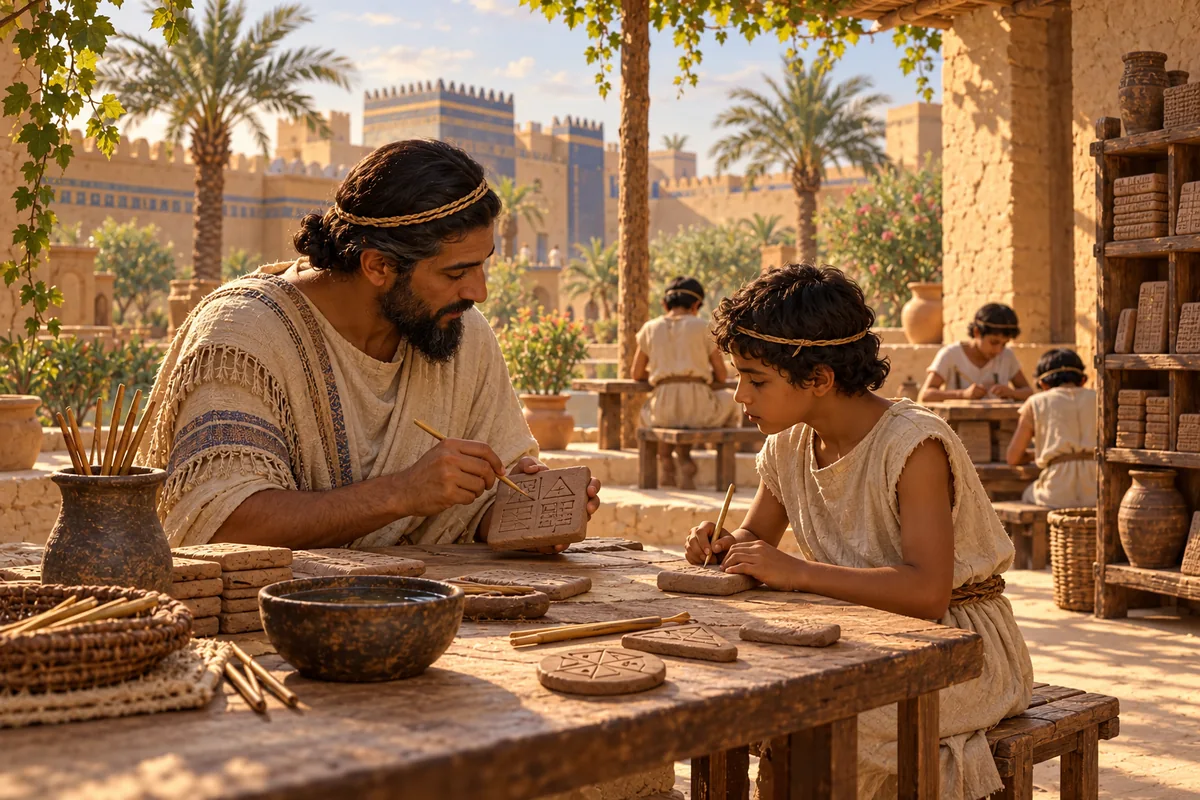
~1800 BCE · Multiple manuscripts across collections; see ETCSL bibliography for witnesses
A shir-namgala to Ninisina for Lipit-Eshtar (Lipit-Eshtar E)
In plain English
Enlil addressed Ninisina — great daughter of An, great daughter-in-law — and declared that Lipit-Eshtar was to be her provider; so it would be. Ninisina heard Enlil's words and answered him humbly: 'Father Enlil, god whose name is manifest — your divine powers are supreme, your instructions beyond price. For the trustworthy shepherd Lipit-Eshtar —' two lines follow but are too unclear to render — 'he has settled the people and brought contentment to the land. You have looked upon him with your life-giving gaze; now decree him a true fate.'
AI-generated reading paraphrase; compare with the translation below.
“He (probably Enlil) told her, Ninisina, the great daughter of An, the great daughter-in-law, ...... : "That Lipit-Ectar should be your provider -- so let it be!" Cagbatuku. Ninisina (?) paid attention to Enlil's utterance. She answered with humility: "Father Enlil, god whose name is manifest, ......, Enlil; lord ......, your divine powers are the most ......, your instructions are the most precious (?). For the trustworthy shepherd ......, ...... lord Lipit-Ectar 2 lines unclear He has settled the people ......, he (?) has made the Land feel content. You looked upon him with your life-giving gaze: now decree him a true fate!”
Source: ETCSL c.2.5.5.5: A shir-namgala to Ninisina for Lipit-Eshtar (Lipit-Eshtar E). Black, J.A., Cunningham, G., Robson, E. & Zólyomi, G. (eds.), The Electronic Text Corpus of Sumerian Literature, Faculty of Oriental Studies, University of Oxford. https://etcsl.orinst.ox.ac.uk/cgi-bin/etcsl.cgi?text=c.2.5.5.5
Read the full tablet entry~1800 BCE · Multiple manuscripts across collections; see ETCSL bibliography for witnesses
A shir-namshub to Inana (Inana G)
In plain English
Inana speaks in her own voice, listing every sacred place she is heading toward: the abzu, the holy city of Eridu, the shrines E-engura and E-ana, the temple of Enlil, the place where great offering bowls stand open to the sky, and the places where lord Enki, Damgalnuna, and Asarluhi are honored — though several of those destinations are too damaged to read. When she makes this journey, she brings a dog, what may be a lion, boxwood, and halub wood with her. At the end, she receives something — the object is lost to a crack in the surface — as she arrives.
AI-generated reading paraphrase; compare with the translation below.
“When I go, when I go -- the mighty queen who ......, who ......; when I, the queen, go to the abzu, when I, Inana, go to the abzu, when I go to the abzu, the shrine, when I go to Eridug the good, when I go to E-engura, when I go to E-ana, the temple of Enlil, when I go to ......, when I go to where the great offering bowls stand in the open air, when I go to where the ...... pure ...... bowls, when I go to where ...... is honoured, when I go to where lord Enki is honoured, when I go to where Damgalnuna ...... is honoured, when I go to where Asarluhi ...... is honoured -- then I bring a dog with me, I bring a lion (?) with me, I bring boxwood with me, I bring halub wood with me. I, Inana, receive the little ......, when I travel there, when I travel there.”
Source: ETCSL c.4.07.7: A shir-namshub to Inana (Inana G). Black, J.A., Cunningham, G., Robson, E. & Zólyomi, G. (eds.), The Electronic Text Corpus of Sumerian Literature, Faculty of Oriental Studies, University of Oxford. https://etcsl.orinst.ox.ac.uk/cgi-bin/etcsl.cgi?text=c.4.07.7
Read the full tablet entry~1800 BCE · Multiple manuscripts across collections; see ETCSL bibliography for witnesses
A shir-namshub to Inana (Inana I)
In plain English
Inana speaks in the first person: as she travels by boat toward the abzu and enters Enlil's house, she is the queen who stands supreme over all mountains. Before Enlil's face she shines as pure emanating light. At the front of a battle she is the foremost power in all lands; in its thick she is the raw gut-force and heroic strength of combat itself. Moving along the rear of the battle she becomes a flood — what she carries there is lost, the line is too damaged to read — and taking her final stand behind the fighting, she is the woman who comes, though the exact force of that last phrase is uncertain in the original.
AI-generated reading paraphrase; compare with the translation below.
“When I ...... as I travel by boat, when I ...... as I travel by boat, when I, the queen, journey to the abzu, when I enter the house of Enlil, I am indeed the queen who is pre-eminent in the mountains. When I stand before the face of Enlil, I am indeed the emanating light. When I stand in the mouth of the battle, I am indeed also the foremost one of all lands. When I stand in the thick of the battle, I am indeed also the very guts of battle, the heroic strength. When I walk about at the rear of the battle, I am indeed also the flood bearing ....... When I take my stand behind the battle, I am the woman who comes (?).”
Source: ETCSL c.4.07.9: A shir-namshub to Inana (Inana I). Black, J.A., Cunningham, G., Robson, E. & Zólyomi, G. (eds.), The Electronic Text Corpus of Sumerian Literature, Faculty of Oriental Studies, University of Oxford. https://etcsl.orinst.ox.ac.uk/cgi-bin/etcsl.cgi?text=c.4.07.9
Read the full tablet entry~1800 BCE · Multiple manuscripts across collections; see ETCSL bibliography for witnesses
A shir-namshub to Nanna for Ur-Namma (Ur-Namma E)
In plain English
Everyone who passes out through its gate is like a flood no one can stop. The shrine of Ur is a mountain of abundance inside and a hill of plenty outside, and no one can fathom the inner depths of the E-kish-nugal, that artfully built holy mountain. Its place of wonder involves cedar — the surface is unclear at that point — and its very name fills the land with joy. Its lord is called the beautiful lord, son of Ninsun, ornament of all the lands. Ur's great divine power is the gods' own shackle on the land. Its gate is the blue sky charged with awe, and only when that gate opens does Utu rise and light the world from the horizon. Its platform is where the gods determine fates and just verdicts are made — and for all of this, the tablet says, its name deserves to be praised.
AI-generated reading paraphrase; compare with the translation below.
“Those who leave through your gate are an uncontrollable flood. Shrine Urim, your interior is a mountain of abundance, your exterior a hill of plenty. No one can learn the interior of the E-kic-nujal, the artfully fashioned mountain. Your place of marvel is ...... of cedar, your name makes the Land rejoice. Your lord is the one called as the beautiful lord, the child of Nin-sun, the ornament of all the lands. Urim, your great divine power is the gods's shackle on the Land. Your name be praised indeed! Your gate is the blue sky imbued with fearsomeness; only when it is open does Utu illuminate from the horizon. Your platform is where the fates are determined by the gods; you make just decisions. Your name be praised indeed!”
Source: ETCSL c.2.4.1.5: A shir-namshub to Nanna for Ur-Namma (Ur-Namma E). Black, J.A., Cunningham, G., Robson, E. & Zólyomi, G. (eds.), The Electronic Text Corpus of Sumerian Literature, Faculty of Oriental Studies, University of Oxford. https://etcsl.orinst.ox.ac.uk/cgi-bin/etcsl.cgi?text=c.2.4.1.5
Read the full tablet entry~1800 BCE · Multiple manuscripts across collections; see ETCSL bibliography for witnesses
A shir-namshub to Nanna for Ur-Namma (Ur-Namma F)
In plain English
Ur, gleaming from its rooftops, is built on abundance. The city's lord, Ur-Namma — adorned with a lapis-lazuli beard — rides high in triumph, the tallest and most distinguished of all lords. Those who pour out through its gates are like an unstoppable flood. Ur's interior is a mountain of riches, its outer face a hill of plenty, and no one can fathom the inner depths of the E-kish-nugal, that intricately made shrine. The temple itself shimmers like a mountain, and the city's very name carries mercy. Ur-Namma, child of Ninsun and ornament of all lands, is called the beautiful lord.
AI-generated reading paraphrase; compare with the translation below.
“Imbued with allure from the shining rooftops, Urim, your foundation rests on abundance. City, your lord rides high in joy, Ur-Namma rides high indeed; the one adorned with a lapis-lazuli beard rides high indeed! He is the tallest among all the lords, appearing as the noblest among them. Those who leave through your gate are an uncontrollable flood. Shrine Urim, your interior is a mountain of abundance, your exterior a hill of plenty. No one can learn the interior of the E-kic-nujal, the artfully fashioned hill. Your temple is a shimmering mountain; your very name is merciful. Your lord is the one called as the beautiful lord, the child of Ninsun, the ornament of all the lands.”
Source: ETCSL c.2.4.1.6: A shir-namshub to Nanna for Ur-Namma (Ur-Namma F). Black, J.A., Cunningham, G., Robson, E. & Zólyomi, G. (eds.), The Electronic Text Corpus of Sumerian Literature, Faculty of Oriental Studies, University of Oxford. https://etcsl.orinst.ox.ac.uk/cgi-bin/etcsl.cgi?text=c.2.4.1.6
Read the full tablet entry~1800 BCE · Multiple manuscripts across collections; see ETCSL bibliography for witnesses
A shir-namshub to Nanna (Nanna K)
In plain English
Lord Nanna — called here also Acimbabbar and Suen — is as remote as heaven and as vast as the earth, though a line repeating that image is too damaged to complete. He tends his herds like a cowherd with countless cows and calves, and he moves among the people in the pens, though the details of several lines are broken beyond reading. He has butter; a figure named Iterda has milk; cheese is compared somehow to milk, but the surface is cracked and the comparisons break off. Then Ningal, his wife, speaks directly to him — calling him her lover, her Suen, her ritually bathed man — but each of her tender lines is damaged at the end, and an unknown number of lines after them are gone entirely.
AI-generated reading paraphrase; compare with the translation below.
“As remote as heaven, ...... as the earth! Lord Nanna, as remote as heaven, ...... as the earth! Lord Acimbabbar, as remote as heaven, ...... as the earth! A cowherd with his numerous cows, Suen ...... the men in (?) the pens. A ...... with his numerous calves, Suen ...... the men in (?) the pens. Suen ....... Nanna ....... 1 line fragmentary Suen ....... The spouse ....... Ningal ....... He has butter, ....... Iterda milk ....... Cheese ...... like milk. Mother Ningal addresses him: "My ...... man, my lover, .......! My ...... man, my Suen, ......! My man who has ritually bathed, ......! My ......! unknown no. of lines missing”
Source: ETCSL c.4.13.11: A shir-namshub to Nanna (Nanna K). Black, J.A., Cunningham, G., Robson, E. & Zólyomi, G. (eds.), The Electronic Text Corpus of Sumerian Literature, Faculty of Oriental Studies, University of Oxford. https://etcsl.orinst.ox.ac.uk/cgi-bin/etcsl.cgi?text=c.4.13.11
Read the full tablet entry~1800 BCE · Multiple manuscripts across collections; see ETCSL bibliography for witnesses
A shir-namshub to Nininsina (Nininsina B)
In plain English
Bring the finest oils — let them be poured out for her, so she can be anointed and softened. For the beautiful one who is luxuriance herself, for Lady Ninsirsir, for Ama-ugu-kuku, for Lady Nininsina seated in wine, who bathes like a swallow and makes fire blaze in the sky — bring cedar oil and cypress oil, the aromatic beloved of the gods, cimgig oil, a further oil whose name is damaged, holy butter and fresh milk from the sacred cattle-pen, ghee from the holy herd, milk from the sheepfold, ligidba plant oil, and white cedar oil, all of them rising into the heart of heaven like burning resins. Let every one of them glisten on her skin.
AI-generated reading paraphrase; compare with the translation below.
“Softened with the finest oils, softened with the finest oils -- for her let the finest oils be brought! So that she can be softened with the finest oils, let flowing oil be brought for her. For my beautiful ......, who is luxuriance, for my lady Ninsirsir, Ama-ugu-kuku, for my lady sitting in wine, for Nininsina sitting in wine, to make the fire blaze in the sky; for my lady bathing like a swallow, let cedar oil and cypress oil, and cedar oil, the aromatic which is beloved of the gods, and cimgig oil, and ...... oil, and holy cow's butter and dairy cow's milk, and ghee brought from the holy cattle-pen and milk brought from (?) the sheepfold, oils wafting up into the heart of heaven like aromatic resins, and ligidba plant oil and white cedar oil -- let them all glisten on her!”
Source: ETCSL c.4.22.2: A shir-namshub to Nininsina (Nininsina B). Black, J.A., Cunningham, G., Robson, E. & Zólyomi, G. (eds.), The Electronic Text Corpus of Sumerian Literature, Faculty of Oriental Studies, University of Oxford. https://etcsl.orinst.ox.ac.uk/cgi-bin/etcsl.cgi?text=c.4.22.2
Read the full tablet entry~1800 BCE · Multiple manuscripts across collections; see ETCSL bibliography for witnesses
A shir-namshub to Ninurta (Ninurta G)
In plain English
Ninurta is addressed directly: Enlil's great hero, gatherer of divine powers, whose kingship blazes in unmistakable glory. The combs holding back his neck-hair are loosened — an image repeated for his identities as Pabilsaj and Ninjirsu — and his kingship holds sway across both heaven and earth. He sits beside Enki on the sacred throne-dais. He is the devastator of mountains, the pillager of cities, the one who hammers against rebel lands — and then the tablet breaks off mid-line, just as his name is invoked a final time.
AI-generated reading paraphrase; compare with the translation below.
“Hero, Enlil's gatherer of the numerous divine powers, great hero, consummately your kingship is gloriously manifest! Hero Ninurta, the combs of your neck-hair are loosened! Hero Pabilsaj, the combs of your neck-hair are loosened! Hero Ninjirsu, the combs of your neck-hair are loosened; your kingship is gloriously manifest! Your kingship exists in the heavens, exists on the earth. You sit with Enki upon the holy throne-dais. The hero, devastator of the mountains, pillager of cities, batters at the rebel lands. The hero Ninurta, devastator of the mountains, pillager of cities, the hero…”
Source: ETCSL c.4.27.07: A shir-namshub to Ninurta (Ninurta G). Black, J.A., Cunningham, G., Robson, E. & Zólyomi, G. (eds.), The Electronic Text Corpus of Sumerian Literature, Faculty of Oriental Studies, University of Oxford. https://etcsl.orinst.ox.ac.uk/cgi-bin/etcsl.cgi?text=c.4.27.07
Read the full tablet entry