Chapter 05 · 2000 – 1600 BCE
Old Babylonian
Hammurabi, the Epic of Gilgamesh, mathematics.
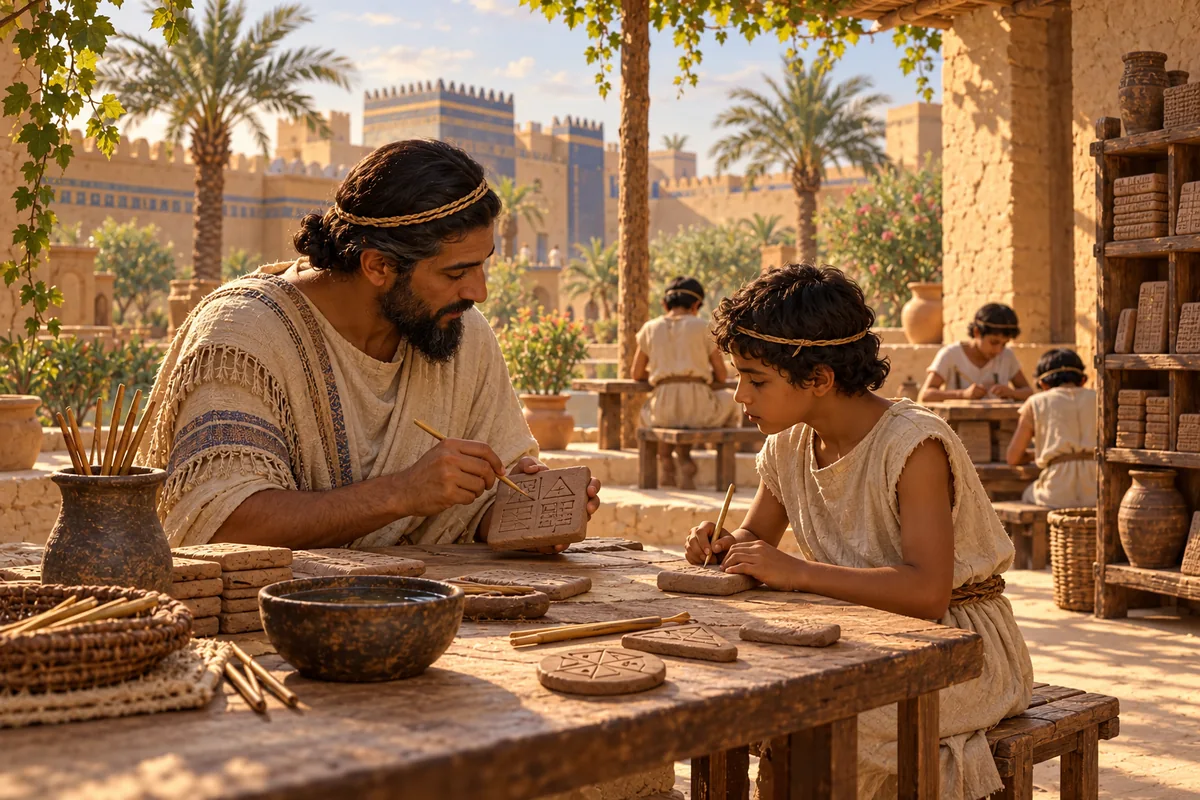
~1800 BCE · Multiple manuscripts across collections; see ETCSL bibliography for witnesses
A shir-namshub to Nisaba (Nisaba B)
In plain English
Shrine after shrine is gone — the house of Nisaba, keeper of the tablets, is destroyed; the house of Nunbarcegunu is destroyed; the E-hamun is destroyed. Where the walls once stood, long grass and cumunda grass have pushed through, and willow trees have spread across the ruins. The anger of An and the malice of Enlil hang over everything. Then Nisaba speaks, asking that moonlight enter her house — but the tablet breaks off there, and the rest of her words are lost.
AI-generated reading paraphrase; compare with the translation below.
“...... is destroyed. ...... is destroyed. It is destroyed. ...... of Nisaba is destroyed. The house of Nisaba, her of the tablets, is destroyed. The house of ...... is destroyed. The house of Nunbarcegunu is destroyed. ......, the E-hamun is destroyed. The plants of lamentation have sprouted; the cumunda grass has sprouted. By the walls the long grass has sprouted. Amongst them, the willow trees are everywhere. As for the word of An and the word of Enlil, the angry heart of great An is everywhere, and the malign heart of Enlil is everywhere. (Nisaba speaks:) "In my house, may the moonlight in…”
Source: ETCSL c.4.16.2: A shir-namshub to Nisaba (Nisaba B). Black, J.A., Cunningham, G., Robson, E. & Zólyomi, G. (eds.), The Electronic Text Corpus of Sumerian Literature, Faculty of Oriental Studies, University of Oxford. https://etcsl.orinst.ox.ac.uk/cgi-bin/etcsl.cgi?text=c.4.16.2
Read the full tablet entry~1800 BCE · Multiple manuscripts across collections; see ETCSL bibliography for witnesses
A shir-shag-hula to Damgalnuna
In plain English
The great prince Enki, who spans heaven and earth, cherishes Damgalnuna. She is the bride of Enki, the one who determines fates for the good — a great wild cow, unmatched in beauty, supreme without end. Her husband Nudimmud, the great lord who perfects the borders of the Land, has been granted perceptiveness by An the king; he is a wise counsellor, a majestic leader who pleases Enlil's heart, whose divine powers no one can resist, who bears an auspicious name, whose understanding runs deep, and who holds knowledge of birth and creation. The text breaks off here, with an unknown number of lines lost.
AI-generated reading paraphrase; compare with the translation below.
“The great prince Enki, ...... heaven and earth, ...... cherishes you. Bride of Enki who determines fates favourably, great wild cow, exceptional in appearance, pre-eminent forever! Your husband, the great lord Nudimmud who makes perfect the borders of the Land, the lord on whom An the king has bestowed perceptiveness; the wise adviser, the sage lord whose command is foremost, who is skilful in everything, the majestic leader who pleases (?) Enlil's heart; whose divine powers cannot be withstood, he of deep understanding, called by an auspicious name, reaching decisions ...... who is knowledgeable about giving birth, ......, unknown no. of lines missing”
Source: ETCSL c.4.03.1: A shir-shag-hula to Damgalnuna. Black, J.A., Cunningham, G., Robson, E. & Zólyomi, G. (eds.), The Electronic Text Corpus of Sumerian Literature, Faculty of Oriental Studies, University of Oxford. https://etcsl.orinst.ox.ac.uk/cgi-bin/etcsl.cgi?text=c.4.03.1
Read the full tablet entry~1800 BCE · Multiple manuscripts across collections; see ETCSL bibliography for witnesses
A shirgida to Nuska (Nuska A)
In plain English
The opening two lines are missing or too damaged to read. What follows praises Nuska as the one who bundles the divine powers together, gives instruction across the whole breadth of heaven and earth, and serves as adviser to the Land. Enlil, the Great Mountain, has summoned Nuska to his divine powers, and has granted him a glorious long life in heaven and earth — for Nuska was fathered by lord Nunamnir and is his beloved son. Enlil has entrusted to Nuska the princely divine powers of the E-kur, its august and holy offices, its most complex powers — though the passage breaks off before the full list is given.
AI-generated reading paraphrase; compare with the translation below.
“2 lines missing or fragmentary You who bundle together the divine powers, ...... the divine powers, articulate ...... house of the king ......, who give instruction throughout the breadth of heaven and earth, adviser of the Land, Nuska! The Great Mountain Enlil has summoned you to his divine powers. He has made long life issue gloriously in heaven and earth for you who were fathered by lord Nunamnir; you are his beloved lord. He has entrusted the princely divine powers of the E-kur, the august shrine, the holy divine powers, the august and most complex divine powers, the divine powers of the…”
Source: ETCSL c.4.29.1: A shirgida to Nuska (Nuska A). Black, J.A., Cunningham, G., Robson, E. & Zólyomi, G. (eds.), The Electronic Text Corpus of Sumerian Literature, Faculty of Oriental Studies, University of Oxford. https://etcsl.orinst.ox.ac.uk/cgi-bin/etcsl.cgi?text=c.4.29.1
Read the full tablet entry~1800 BCE · Multiple manuscripts across collections; see ETCSL bibliography for witnesses
A shirnamshub to Inana (Dumuzid-Inana M)
In plain English
A song addressed to Inana, invoking her as gatherer of divine powers, as a good young woman, and by her titles Ninegala and Ucumgal-ana. The names Dumuzid and several divine epithets appear, along with the word for plenty, but the lines surrounding them are badly damaged. Roughly six lines are entirely lost, and four more are too broken to read. The closing lines identify the piece as a shirnamshub — the surface is cracked there too, and whatever followed the genre label is gone.
AI-generated reading paraphrase; compare with the translation below.
“1 line unclear Belonging to Inana ....... Belonging to the gatherer (?) of divine powers ....... Belonging to my good woman ....... My good young woman ....... Plenty ...... Dumuzid ....... Ucumgal-ana ....... Belonging to the lady ....... Ninegala ....... 1 line fragmentary approx. 6 lines missing 4 lines fragmentary A cirnamcub. A cirnamcub of (?) .......”
Source: ETCSL c.4.08.13: A shirnamshub to Inana (Dumuzid-Inana M). Black, J.A., Cunningham, G., Robson, E. & Zólyomi, G. (eds.), The Electronic Text Corpus of Sumerian Literature, Faculty of Oriental Studies, University of Oxford. https://etcsl.orinst.ox.ac.uk/cgi-bin/etcsl.cgi?text=c.4.08.13
Read the full tablet entry~1800 BCE · Multiple manuscripts across collections; see ETCSL bibliography for witnesses
A song of Inana and Dumuzi (Dumuzi-Inana W)
In plain English
The opening four lines are missing and two more are only partially legible. What follows is a repeated, incantatory wish: let my sheep eat whatever is growing in my fields — the camel-thorn, the winnowed barley, the stubble, the cakir plants, the colocynth, the marsh reeds, the reed shoots, the rising reeds. The list expands with each line: let them eat what sustains orphans and widows, the beer wort mixed with honey, the calves walking alongside their bulls, the blossoming apple orchard.
AI-generated reading paraphrase; compare with the translation below.
“4 lines missing 2 lines fragmentary May my sheep eat my ...... which is growing in the fields, my plants, my camel-thorn. May my sheep eat my ......, my plants, my winnowed barley. May my sheep eat my life of the Land which is growing in the fields, my plants, my stubble. May my sheep eat my support of orphans and sustenance of widows, my plants, my cakir plants. May my sheep eat my string of clay balls (?) which is growing in the fields, my plants, my colocynth. May my sheep eat my beer wort mixed with honey, my plants, my marsh reeds. May my sheep eat my calves going together with their bulls, my plants, my reed shoots. May my sheep eat my blossoming garden of apple trees, my plants, my rising reeds.”
Source: ETCSL c.4.08.23: A song of Inana and Dumuzi (Dumuzi-Inana W). Black, J.A., Cunningham, G., Robson, E. & Zólyomi, G. (eds.), The Electronic Text Corpus of Sumerian Literature, Faculty of Oriental Studies, University of Oxford. https://etcsl.orinst.ox.ac.uk/cgi-bin/etcsl.cgi?text=c.4.08.23
Read the full tablet entry~1800 BCE · Multiple manuscripts across collections; see ETCSL bibliography for witnesses
A song of Inana and Dumuzid (Dumuzid-Inana B1)
In plain English
In a time of abundance and plenty, of luxuriant months and joyful years, the shepherd Dumuzid resolved in his heart to lift his own spirits and tend to his domain. He spoke to the queen of heaven and earth — Ama-ucumgal-ana addressing her directly — and told her his plans: he was going to bring water to the dry land, check on his spacious cattle-pen, inspect the condition of the holy sheepfold, feed his sheep, and find a source of fresh drinking water. The last destination is partly illegible on the tablet.
AI-generated reading paraphrase; compare with the translation below.
“It was in the days of abundance, it was in the nights of plenty; it was in the months of luxuriance, it was in the years of rejoicing. In those days the shepherd, the shepherd Dumuzid decided in his holy heart to make his heart joyful, to go to the cattle-pen, to brighten its mood, to make the holy sheepfold shine like the day. He of decision and resolve spoke to the queen of heaven, the queen of earth. Ama-ucumgal-ana addressed words to her: "Wife, I am going to bring flowing water to the arid (?) place. I am going to look after my spacious cattle-pen. I am going to find out the condition of the holy sheepfold. I am going to feed my sheep. I am going to seek out the ...... of fresh water for drinking."”
Source: ETCSL c.4.08.28: A song of Inana and Dumuzid (Dumuzid-Inana B1). Black, J.A., Cunningham, G., Robson, E. & Zólyomi, G. (eds.), The Electronic Text Corpus of Sumerian Literature, Faculty of Oriental Studies, University of Oxford. https://etcsl.orinst.ox.ac.uk/cgi-bin/etcsl.cgi?text=c.4.08.28
Read the full tablet entry~1800 BCE · Multiple manuscripts across collections; see ETCSL bibliography for witnesses
A song of Inana and Dumuzid (Dumuzid-Inana C1)
In plain English
The opening lines are too damaged to read clearly, but Ninegala — Inana — is being addressed: her wedding ushers are lords, and among them stand a fowler and a fisherman from the reed-beds. Then Inana speaks: she will send word to the shepherd, demanding his finest butter and milk; to her farmer, demanding wine and other provisions the damaged text won't quite yield; to the fowler whose nets are spread across the land, demanding fine birds; and to the fisherman whose nets are already set in the reed-beds, demanding fat carp.
AI-generated reading paraphrase; compare with the translation below.
“2 lines fragmentary Ninegala, your wedding ushers are lords! ...... like someone cracking eggs ....... Inana, your ushers are lords! ...... is first, ...... is second, 1 line fragmentary the fowler ......, and the fisherman from the depths of the reed-beds. "I will send a messenger to the shepherd: let him treat me to the best butter and the best milk! I will send a messenger to my farmer: let him treat me to ...... and wine! I, the lady, will send a messenger to the fowler, whose bird-nets are spread out: let him treat me to fine birds! I, Inana, will send a messenger to the fisherman too whose nets are set up in the reed-beds: let him treat me to fat carp!"”
Source: ETCSL c.4.08.29: A song of Inana and Dumuzid (Dumuzid-Inana C1). Black, J.A., Cunningham, G., Robson, E. & Zólyomi, G. (eds.), The Electronic Text Corpus of Sumerian Literature, Faculty of Oriental Studies, University of Oxford. https://etcsl.orinst.ox.ac.uk/cgi-bin/etcsl.cgi?text=c.4.08.29
Read the full tablet entry~1800 BCE · Multiple manuscripts across collections; see ETCSL bibliography for witnesses
A song of Inana and Dumuzid (Dumuzid-Inana D1)
In plain English
The sacred emblems of E-temen-ni-guru, the ordered household of Eridug, the radiance of Suen's temple, and the raised banners of the E-ana have all been presented as gifts to the house. The good house floats like a cloud, and its very name is a sign of good fortune. He who excels at the rites of queenship has lined with straw the flower-adorned couch inlaid with lapis lazuli — the couch that Gibil purified for you in the Iri-gal shrine — and in the house he has consecrated for you with his sweet reeds, he is performing the purification rites. On the night of the new moon — the appointed day, the day the couch will be inspected, the day the lord will make love — grant life to the lord, and give him the staff and the crook.
AI-generated reading paraphrase; compare with the translation below.
“The ...... of E-temen-ni-guru, the organisation of the house of Eridug, the radiance of the house of Suen, and the erected banners of the E-ana were all given as gifts to the house. My good house floats like a cloud; its name too is a favourable omen. He who excels at the ceremonies of queenship has lined with his straw the flowered couch, inlaid with lapis lazuli, which Gibil has purified for you in the Iri-gal shrine and, in the house which he has sanctified for you with his sweet reeds, he is performing the purification rites for you. On the day of the moon's disappearance, the day appointed (?), the day when the couch will be inspected, the day when the lord will make love, grant life to the lord and give the staff and the crook to the lord!”
Source: ETCSL c.4.08.30: A song of Inana and Dumuzid (Dumuzid-Inana D1). Black, J.A., Cunningham, G., Robson, E. & Zólyomi, G. (eds.), The Electronic Text Corpus of Sumerian Literature, Faculty of Oriental Studies, University of Oxford. https://etcsl.orinst.ox.ac.uk/cgi-bin/etcsl.cgi?text=c.4.08.30
Read the full tablet entry