Chapter 05 · 2000 – 1600 BCE
Old Babylonian
Hammurabi, the Epic of Gilgamesh, mathematics.
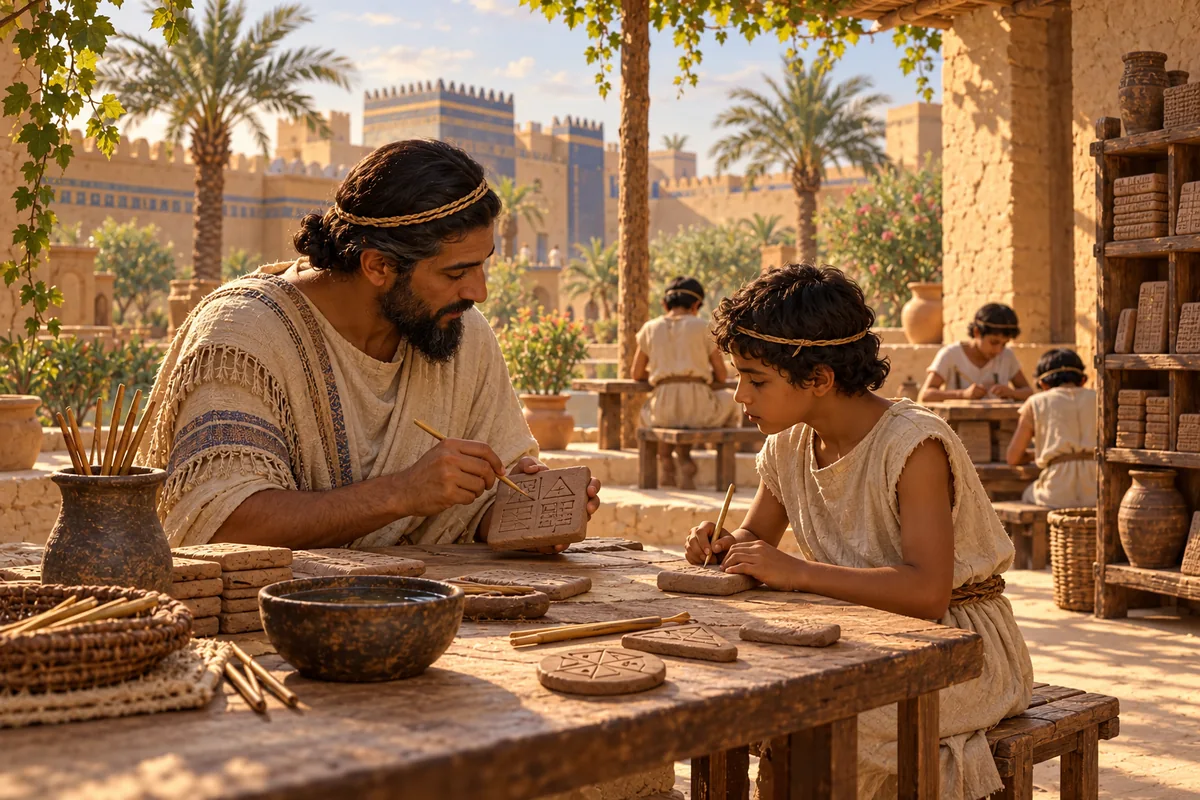
~1800 BCE · Multiple manuscripts across collections; see ETCSL bibliography for witnesses
A song of Inana and Dumuzid (Dumuzid-Inana F1)
In plain English
A voice — almost certainly a woman's — describes lying beside her lover on a honey-drenched bed, hand in hand, foot to foot, her lips on his mouth. Two lines are too damaged to read. She compares him to a bracelet on her hand and lapis lazuli at her throat, and calls him precious, bright as silver. He has brought her into his garden, and the poem lingers on two trees — one standing, one lying down — before he lays her down among the dates. Among the apple trees, the fig trees, and what may be willow trees, someone speaks to her, and each time she responds with the same phrase — 'my precious sweet' — though the surface is too cracked to recover what follows.
AI-generated reading paraphrase; compare with the translation below.
“...... my side. ...... on a bed dripping with honey. ...... his hand in my hand. ...... his foot by my foot. ...... my lips on his mouth. 2 lines fragmentary ...... like a bracelet on my hand. ...... lapis lazuli on my neck. ...... like silver ...... of my bridegroom. The brother ...... in his garden. ...... stand ...... his standing tree. ...... lie down ...... his recumbent tree. He laid me down ....... ...... dates. The ...... spoke to me among the apple trees. My precious sweet ...... my head. The ...... spoke to me among the fig trees. My precious sweet ...... my ....... The ...... spoke to me among the willow (?) trees. My precious sweet ....... The ...... spoke to me ....... My precious sweet ...... my .......”
Source: ETCSL c.4.08.32: A song of Inana and Dumuzid (Dumuzid-Inana F1). Black, J.A., Cunningham, G., Robson, E. & Zólyomi, G. (eds.), The Electronic Text Corpus of Sumerian Literature, Faculty of Oriental Studies, University of Oxford. https://etcsl.orinst.ox.ac.uk/cgi-bin/etcsl.cgi?text=c.4.08.32
Read the full tablet entry~1800 BCE · Multiple manuscripts across collections; see ETCSL bibliography for witnesses
A song of Inana and Dumuzid (Dumuzid-Inana J)
In plain English
Dumuzid's beloved sister — also beloved of Durtur and born of a good bull's seed, a true lady by birth — filled the cattle-pen with butter and cream and kept the sheepfold supplied with milk. On the high plain she is Jectin-ana, though several phrases around her name are too damaged to read. Then grief for her brother overtook her: the girl tore at her eyes, her mouth, and her buttocks — a part of the body the text says is not spoken of to men. She made her way to the palace tavern and stopped a minister coming out to question him.
AI-generated reading paraphrase; compare with the translation below.
“"...... beloved sister of Dumuzid, beloved ...... of Durtur, ...... seed implanted into the womb by a good bull, my lady, born to ladyship! With her aid the cattle-pen was filled with butter and cream, with her aid the sheepfold was long provided with milk. On the high plain, my ......, you are Jectin-ana. O girl, ...... indeed! Your little ones ...... indeed! Unug ...... indeed! Kulaba ...... indeed! ...... you are ......." Because of her brother, the girl lacerated her eyes and lacerated her mouth; she lacerated her buttocks, the place not spoken of to men. She made her way towards the tavern of the palace. The girl questioned a minister who was coming out of the palace.”
Source: ETCSL c.4.08.10: A song of Inana and Dumuzid (Dumuzid-Inana J). Black, J.A., Cunningham, G., Robson, E. & Zólyomi, G. (eds.), The Electronic Text Corpus of Sumerian Literature, Faculty of Oriental Studies, University of Oxford. https://etcsl.orinst.ox.ac.uk/cgi-bin/etcsl.cgi?text=c.4.08.10
Read the full tablet entry~1800 BCE · Multiple manuscripts across collections; see ETCSL bibliography for witnesses
A song of Inana and Dumuzid (Dumuzid-Inana L)
In plain English
The speaker addresses Nanna, calling him valiant and dear, and declares that he loves her — joy follows, but the line breaks off before it can be completed. Bau loves him too, the text says, and then three more fragmentary lines trail away into illegibility. An unknown number of lines are lost entirely after that.
AI-generated reading paraphrase; compare with the translation below.
“My valiant Nanna, who ......, my dear one, you love me; joy ....... ...... Bau loves you. 3 lines fragmentary unknown no. of lines missing”
Source: ETCSL c.4.08.12: A song of Inana and Dumuzid (Dumuzid-Inana L). Black, J.A., Cunningham, G., Robson, E. & Zólyomi, G. (eds.), The Electronic Text Corpus of Sumerian Literature, Faculty of Oriental Studies, University of Oxford. https://etcsl.orinst.ox.ac.uk/cgi-bin/etcsl.cgi?text=c.4.08.12
Read the full tablet entry~1800 BCE · Multiple manuscripts across collections; see ETCSL bibliography for witnesses
A song of Inana and Dumuzid (Dumuzid-Inana R)
In plain English
Inana is praised in cascading refrains: she has a glossy, flowing mane, the crest of an ibex, and the shimmering colour of a heaped pile of grain — beautiful enough for a king, beautiful enough for Dumuzid. She is a full-grown shock of two-row barley, ripened to perfection. Then her own voice breaks in: she is queen, she is maiden, she is seed brought forth by An himself, she is fine oil and sweet perfume — all lines that trail off into damaged sections too broken to read. The passage closes with a repeated image of someone mooring a boat, but both lines are too fragmentary to recover their full meaning.
AI-generated reading paraphrase; compare with the translation below.
“Maiden, glossy mane, lovely beauty, Inana, glossy mane, lovely beauty! Maiden, mane of the ibex, ...... red deer, ...... red deer, Inana, mane of the ibex, ...... red deer, ...... red deer! Maiden, colourful as a pile of grain, fit for the king, Inana, colourful as a pile of grain, fit for Dumuzid! Maiden, you are a shock of two-row barley, fully developed in loveliness, Inana, you are a shock of two-row barley, fully developed in loveliness! I am the queen, I am the queen, I am ...... full of loveliness! I am the maiden, I am the queen, I am ...... full of loveliness! I am the queen, seed engendered by An, I am ...... full of loveliness! I am good oil, good oil, ...... sweet perfume! ...... may he moor the boat ....... ...... may he moor the boat .......”
Source: ETCSL c.4.08.18: A song of Inana and Dumuzid (Dumuzid-Inana R). Black, J.A., Cunningham, G., Robson, E. & Zólyomi, G. (eds.), The Electronic Text Corpus of Sumerian Literature, Faculty of Oriental Studies, University of Oxford. https://etcsl.orinst.ox.ac.uk/cgi-bin/etcsl.cgi?text=c.4.08.18
Read the full tablet entry~1800 BCE · Multiple manuscripts across collections; see ETCSL bibliography for witnesses
A song of Inana and Dumuzid (Dumuzid-Inana T)
In plain English
A man cools Inana, uproots grass for her, and gathers dates from the date palm — all for holy Inana. He brings her water and black emmer seeds, then more water and white emmer seeds, piling them up as offerings. He also carries a heap of stones for her to pick through, and from the top of that heap he selects lapis lazuli — for Inana. The opening lines are damaged and only partial phrases survive before the text becomes legible.
AI-generated reading paraphrase; compare with the translation below.
“...... he who cools, who cools ....... He who uproots the grass for holy Inana, who uproots ....... He who gathers the dates, ...... the date palm. He who gathers the dates for holy Inana, ...... the date palm. Let him bring her water, let him bring her water, and black emmer seeds. With the water let him bring Inana a heap, and white emmer seeds. The man brings, the man brings, he brings a heap of stones to choose from. The man brings to the maiden Inana, he brings a heap of stones to choose from. He gathers the lapis lazuli from the top of the heap. He gathers the lapis lazuli for Inana from the top of the heap.”
Source: ETCSL c.4.08.20: A song of Inana and Dumuzid (Dumuzid-Inana T). Black, J.A., Cunningham, G., Robson, E. & Zólyomi, G. (eds.), The Electronic Text Corpus of Sumerian Literature, Faculty of Oriental Studies, University of Oxford. https://etcsl.orinst.ox.ac.uk/cgi-bin/etcsl.cgi?text=c.4.08.20
Read the full tablet entry~1800 BCE · Multiple manuscripts across collections; see ETCSL bibliography for witnesses
A song of Inana and Dumuzid (Dumuzid-Inana V)
In plain English
Inana, radiant and adorned, full of joy, makes her way to Dumuzid — to his sheepfold, to his cattle-pen. She meets him on the road, and he comes toward her blazing like daylight. What follows is mostly lost: a few words survive about hands extended, branches sprouting, and buds unfolding, but several lines are too damaged to read, and the passage breaks off mid-thought.
AI-generated reading paraphrase; compare with the translation below.
“The young lady, the king's kohl, Inana, Dumuzid's kohl, full of joy, adorned with loveliness, goes to the shepherd in the sheepfold, goes to Dumuzid in the cattle-pen. There on the the road she ...... the shepherd, the maiden Inana meets him on the path. Dumuzid comes forth like the daylight. ...... extended his hand to ......; ...... extended his hand to ....... ...... extended hand. 1 line fragmentary ...... enfolded in numerous buds, ...... sprouted branches, ...... heart .......”
Source: ETCSL c.4.08.22: A song of Inana and Dumuzid (Dumuzid-Inana V). Black, J.A., Cunningham, G., Robson, E. & Zólyomi, G. (eds.), The Electronic Text Corpus of Sumerian Literature, Faculty of Oriental Studies, University of Oxford. https://etcsl.orinst.ox.ac.uk/cgi-bin/etcsl.cgi?text=c.4.08.22
Read the full tablet entry~1800 BCE · Multiple manuscripts across collections; see ETCSL bibliography for witnesses
A song of Inana and Dumuzid (Dumuzid-Inana Z)
In plain English
The speaker declares that her own mother, Ningal, bore her for Dumuzid's sake alone. She calls for him to come to her so she can rejoice over him — several lines are too damaged to read here, and an unknown number of lines are lost entirely before the poem resumes. When it picks up, she is urging her bridegroom to embrace her and celebrate together in play; she calls him Ama-ušum and names him the friend of An, the lord who cheers her mood and gladdens her heart, asking that he be their sun god. She ends by saying she will go to him, speak with him, and address the lord of her heart directly.
AI-generated reading paraphrase; compare with the translation below.
“My own mother gave birth to me for your sake, my Ningal gave birth to me for your sake. ......, my beloved heart will come. ......, my beloved heart will come there. May ...... come to me (?), and I will rejoice over him. May Dumuzid come to me (?), and I will rejoice over him. 1 line unclear Dumuzid ...... 1 line fragmentary unknown no. of lines missing 1 line fragmentary Let us embrace, my bridegroom! Come, let us rejoice in play! Let us embrace, my Ama-ucum! Come, let us rejoice in play! Friend of An, lord, my heart's desire, cheering the mood, gladdening the heart: may you be our sun god! I will go to the lord, I will talk with him, I will say to the lord of my heart:”
Source: ETCSL c.4.08.26: A song of Inana and Dumuzid (Dumuzid-Inana Z). Black, J.A., Cunningham, G., Robson, E. & Zólyomi, G. (eds.), The Electronic Text Corpus of Sumerian Literature, Faculty of Oriental Studies, University of Oxford. https://etcsl.orinst.ox.ac.uk/cgi-bin/etcsl.cgi?text=c.4.08.26
Read the full tablet entry~1800 BCE · Multiple manuscripts across collections; see ETCSL bibliography for witnesses
A song of Inana and Dumuzid (Dumuzid-Inanna Y)
In plain English
Five lines are lost, then one fragmentary line that mentions someone going to his father like a messenger, followed by another broken line. Then Utu speaks: he tells his brother-in-law that the daytime will pass, night will come, and when it does he will send the moonlight and the stars home — dim them, shut them away — and then he will draw back the bolt of the door for him. Five more lines are lost. When the text resumes, two voices exchange brief endearments: one calls out 'My elder sister!' and the other answers 'My sweet!' — but the tablet breaks off there.
AI-generated reading paraphrase; compare with the translation below.
“5 lines missing 1 line fragmentary ...... his father like a messenger. 1 line fragmentary (Utu speaks:) "Our brother-in-law, the daytime will pass; our brother-in-law, night will come. Then I shall make the moonlight enter its house, I shall make the stars become dimmed in their house. Our brother-in-law, when the daytime has passed, our brother-in-law, when the night comes, and after the moonlight has entered its house, after the stars have become dimmed in their house, I shall draw the bolt from the door for you ......." 5 lines missing "My elder sister! ......." "My sweet! ......." "My…”
Source: ETCSL c.4.08.25: A song of Inana and Dumuzid (Dumuzid-Inanna Y). Black, J.A., Cunningham, G., Robson, E. & Zólyomi, G. (eds.), The Electronic Text Corpus of Sumerian Literature, Faculty of Oriental Studies, University of Oxford. https://etcsl.orinst.ox.ac.uk/cgi-bin/etcsl.cgi?text=c.4.08.25
Read the full tablet entry