Chapter 05 · 2000 – 1600 BCE
Old Babylonian
Hammurabi, the Epic of Gilgamesh, mathematics.
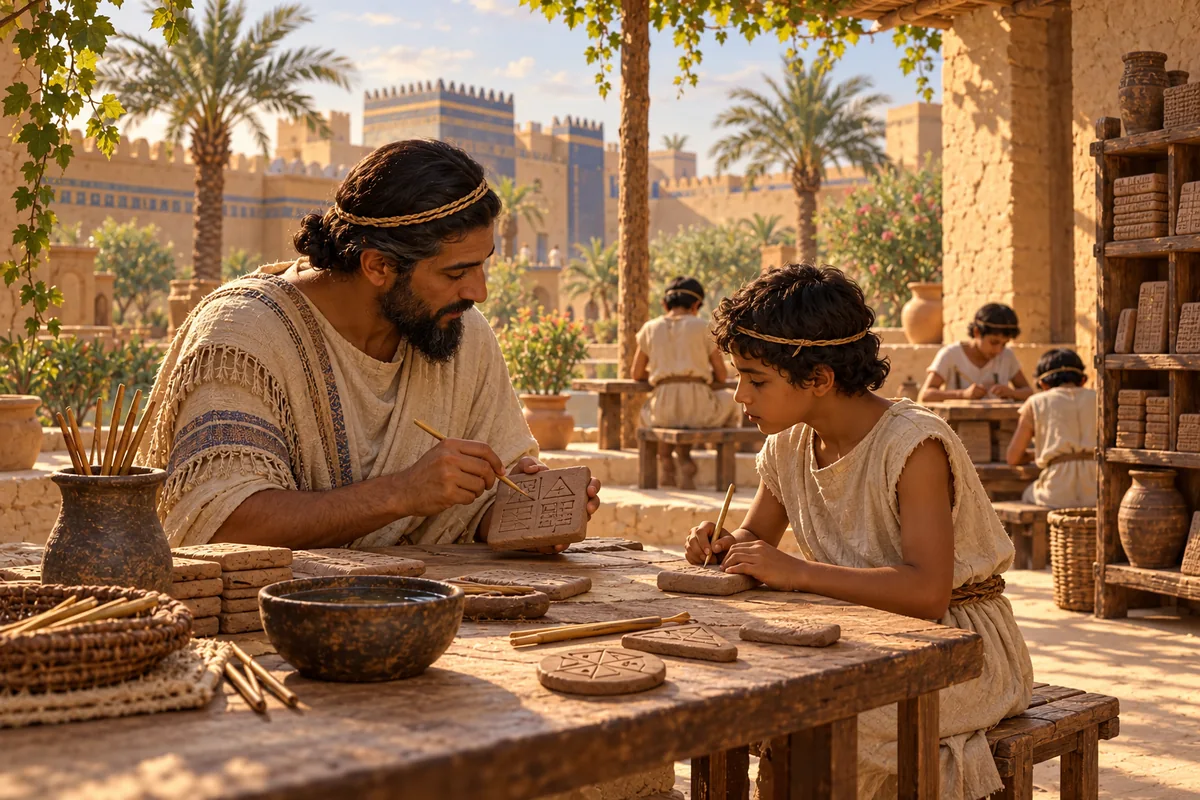
~1800 BCE · Multiple manuscripts across collections; see ETCSL bibliography for witnesses
A song of Inana for Ishme-Dagan (Ishme-Dagan J)
In plain English
Inana is called to the cattle-pen, where the sweet-voiced cows and gentle-voiced calves await her. When she arrives, the churn will sound — the churn of her husband Dumu-zid, rocking and singing, will fill her with joy. The good shepherd, the man of sweet songs, will sing loudly for her, and with all the finest things at hand he will gladden her heart. When she steps into the cattle-pen it will rejoice at her presence; when she enters the sheepfold it too will rejoice; and when she walks into the feeding-pen, the healthy ewes will spread their wool out before her.
AI-generated reading paraphrase; compare with the translation below.
“Lady, going to the sweet-voiced cows and gentle-voiced calves in the cattle-pen, young woman, when you arrive there, Inana, may the churn sound! May the churn of your spouse sound, Inana, may the churn sound! May the churn of Dumu-zid sound, Inana, may the churn sound! The rocking of the churn will sing (?) for you, Inana, may it thus make you joyous! The good shepherd, the man of sweet songs, will loudly (?) sing songs for you; lady, with all the sweetest things, Inana, may he make your heart joyous! Lady, when you enter the cattle-pen, Inana, the cattle-pen will indeed rejoice over you. Mistress, when you enter the sheepfold, Inana, the sheepfold will indeed rejoice over you. When you enter the feeding-pen, healthy ewes will spread out their wool for you.”
Source: ETCSL c.2.5.4.10: A song of Inana for Ishme-Dagan (Ishme-Dagan J). Black, J.A., Cunningham, G., Robson, E. & Zólyomi, G. (eds.), The Electronic Text Corpus of Sumerian Literature, Faculty of Oriental Studies, University of Oxford. https://etcsl.orinst.ox.ac.uk/cgi-bin/etcsl.cgi?text=c.2.5.4.10
Read the full tablet entry~1800 BCE · Multiple manuscripts across collections; see ETCSL bibliography for witnesses
A song of Ningishzida (Ningishzida D)
In plain English
Ningishzida is addressed directly — a lordly figure enthroned on a lofty dais, exalted before holy An and the Anunna gods, the gods of the earth. An has granted power to him, this princely son, and the lines repeat and reinforce that gift of divine authority. Several phrases are too damaged to read, and after the Anunna gods are invoked a final time, an unknown number of lines are completely lost.
AI-generated reading paraphrase; compare with the translation below.
“Holding ...... high, lordly one of holy An, holding ...... high on the lofty throne-dais, ......, lord Ninjiczida, lord ......! ...... the Anuna gods, gods of the earth ....... Ninjiczida, the Anuna gods, gods of the earth ....... An has given power to you, princely son, ....... An has given power to you, Ninjiczida, ....... ...... the Anuna gods ...... unknown no. of lines missing”
Source: ETCSL c.4.19.4: A song of Ningishzida (Ningishzida D). Black, J.A., Cunningham, G., Robson, E. & Zólyomi, G. (eds.), The Electronic Text Corpus of Sumerian Literature, Faculty of Oriental Studies, University of Oxford. https://etcsl.orinst.ox.ac.uk/cgi-bin/etcsl.cgi?text=c.4.19.4
Read the full tablet entry~1800 BCE · Multiple manuscripts across collections; see ETCSL bibliography for witnesses
A song to Ninimma (Ninimma A)
In plain English
Ninimma holds the seal of a treasury whose name is lost to damage, and she serves as caretaker of the great gods. She is the lady of all the great rites in the E-kur, Enlil's heavenly scribe, and the keeper of the tablet of life — though one line here is too fragmentary to read. She brings the finest grain and presides over the E-sara; the surveyor's gleaming line and measuring rod are said to suit her perfectly, and she stands as an equal among the great princes. Several phrases that once named her titles are lost, and two further lines survive only in broken scraps, but what remains praises her as exceptional in wisdom and cherished among the gods.
AI-generated reading paraphrase; compare with the translation below.
“You are the seal-holder of the treasury of the ....... You are the caretaker of the great gods, you are ....... Ninimma, you are the lady of all the great rites in the E-kur. Lady, you are the ...... of Enlil, you are the heavenly scribe. You ...... the tablet of life. 1 line fragmentary You, who bring the best corn, are the lady of the E-sara. The surveyor's gleaming line and the measuring rod suit you perfectly. You can hold your head high among the great princes. You are ....... You are ......, the cherished one. 1 line fragmentary ......; you are exceptional in wisdom. ...... joy .......…”
Source: ETCSL c.4.21.1: A song to Ninimma (Ninimma A). Black, J.A., Cunningham, G., Robson, E. & Zólyomi, G. (eds.), The Electronic Text Corpus of Sumerian Literature, Faculty of Oriental Studies, University of Oxford. https://etcsl.orinst.ox.ac.uk/cgi-bin/etcsl.cgi?text=c.4.21.1
Read the full tablet entry~1800 BCE · Multiple manuscripts across collections; see ETCSL bibliography for witnesses
A tigi of Enki for Ur-Ninurta (Ur-Ninurta B)
In plain English
Enki holds vast and inscrutable divine powers — a ruler of broad wisdom over the Anuna gods, he casts spells, provides guidance, weighs decisions, clarifies verdicts, and dispenses counsel from dawn to dusk. He is the lord of all true words, and the text declares intent to praise him. His father An, the king who brought human seed into being and placed all of humanity on the earth, has charged Enki with guarding the divine powers of heaven and earth and has raised him to rule over them as their prince. The passage breaks off mid-line as An is named again.
AI-generated reading paraphrase; compare with the translation below.
“Lord of complex divine powers, who establishes umderstanding, whose intentions are unfathomable, who knows everything! Enki, of broad wisdom, august ruler of the Anuna, wise one who casts spells, who provides words, who attends to decisions, who clarifies verdicts, who dispenses advice from dawn to dusk! Enki, lord of all true words, I will praise you. Your father, An the king, the lord who caused human seed to come forth and who placed all mankind on the earth, has laid upon you the guarding of the divine powers of heaven and earth, and has elevated you to be their prince. An, king of the…”
Source: ETCSL c.2.5.6.2: A tigi of Enki for Ur-Ninurta (Ur-Ninurta B). Black, J.A., Cunningham, G., Robson, E. & Zólyomi, G. (eds.), The Electronic Text Corpus of Sumerian Literature, Faculty of Oriental Studies, University of Oxford. https://etcsl.orinst.ox.ac.uk/cgi-bin/etcsl.cgi?text=c.2.5.6.2
Read the full tablet entry~1800 BCE · Multiple manuscripts across collections; see ETCSL bibliography for witnesses
A tigi to Bau for Gudea (Gudea A)
In plain English
Bau is addressed directly — gracious, beautiful, born of holy An, and beloved by Enlil. She came out of the heart of heaven carrying the divine powers her father An himself gave her, and those perfect powers are why the Anuna gods hold her in awe. The opening lines repeat in near-identical pairs, hammering the same titles and attributes twice: child of An, adorned with attractiveness, filled with great fearsomeness, the gods' most cherished lady.
AI-generated reading paraphrase; compare with the translation below.
“My lady, gracious woman, child of holy An, adorned with attractiveness, Enlil's beloved one, who is imbued with great fearsomeness and issues from the interior of heaven, the cherished lady of the gods. Bau, gracious woman, child of holy An, adorned with attractiveness, Enlil's beloved one, who is imbued with great fearsomeness and issues from the midst of heaven, the cherished lady of the gods. My lady, you have brought the divine powers from the interior of heaven. Your own father, An, the king, has presented you with perfect divine powers, so you inspire respect among the Anuna gods. Bau, you have brought the divine powers from the midst of heaven. Your own father, An the king, has presented you with perfect divine powers, so you inspire respect among the Anuna gods.”
Source: ETCSL c.2.3.2: A tigi to Bau for Gudea (Gudea A). Black, J.A., Cunningham, G., Robson, E. & Zólyomi, G. (eds.), The Electronic Text Corpus of Sumerian Literature, Faculty of Oriental Studies, University of Oxford. https://etcsl.orinst.ox.ac.uk/cgi-bin/etcsl.cgi?text=c.2.3.2
Read the full tablet entry~1800 BCE · Multiple manuscripts across collections; see ETCSL bibliography for witnesses
A tigi to Enlil for Ur-Namma (Ur-Namma B)
In plain English
Enlil, the Great Mountain and king of heaven and earth, surveyed all of humanity and chose Ur-Namma as his shepherd — singling him out from the multitude to rule on Enlil's behalf. He clothed Ur-Namma in fierce, terrifying splendor. Then Enlil, his mind clear and intent, decided that the plans for the brick-built E-kur should be laid out and that the temple should blaze like sunlight in all its glory. He commanded Ur-Namma to build the E-kur up high — and here the surviving text breaks off mid-sentence.
AI-generated reading paraphrase; compare with the translation below.
“Exalted Enlil, ...... fame ......, lord who ...... his great princedom, Nunamnir, king of heaven and earth ......, looked around among the people. The Great Mountain, Enlil, chose Ur-Namma the good shepherd from the multitude of people: "Let him be the shepherd of Nunamnir!" He made him emanate (?) fierce awesomeness. The divine plans of brick-built E-kur were drawn up. The Great Mountain, Enlil, made up his mind, filled with pure and useful thoughts, to make them shine like the sun in the E-kur, his august shrine. He instructed the shepherd Ur-Namma to make the E-kur rise high; the king made…”
Source: ETCSL c.2.4.1.2: A tigi to Enlil for Ur-Namma (Ur-Namma B). Black, J.A., Cunningham, G., Robson, E. & Zólyomi, G. (eds.), The Electronic Text Corpus of Sumerian Literature, Faculty of Oriental Studies, University of Oxford. https://etcsl.orinst.ox.ac.uk/cgi-bin/etcsl.cgi?text=c.2.4.1.2
Read the full tablet entry~1800 BCE · Multiple manuscripts across collections; see ETCSL bibliography for witnesses
A tigi to Inana and Dumuzid (Dumuzid-Inana H)
In plain English
Inana describes spending a day singing and dancing until evening, when Dumuzid — lord, friend of An, called here Ucumgal-ana — found her and took her in his arms, embracing her around the neck. She urges him to let her go so she can return home, and then worries aloud: what lie can she tell her mother Ningal to explain where she has been? Dumuzid offers to help — he will teach her the lies women tell — but the tablet breaks off just as he begins to speak.
AI-generated reading paraphrase; compare with the translation below.
“While I, the lady, was passing the day yesterday, while I, Inana, was passing the day yesterday, while I was passing the day, while I was dancing, while I was singing songs all day until evening, he met me, he met me. The lord, the friend of An, met me; the lord took me in his hands, Ucumgal-ana embraced me about my neck. "......, let me go, so that I can go to our house! Friend of Enlil, let me go, so that I can go to our house! What lie can I offer to my mother? What lie can I offer to my mother Ningal?" "Let me teach you, let me teach you! Inana, let me teach you the lies of women: "My…”
Source: ETCSL c.4.08.08: A tigi to Inana and Dumuzid (Dumuzid-Inana H). Black, J.A., Cunningham, G., Robson, E. & Zólyomi, G. (eds.), The Electronic Text Corpus of Sumerian Literature, Faculty of Oriental Studies, University of Oxford. https://etcsl.orinst.ox.ac.uk/cgi-bin/etcsl.cgi?text=c.4.08.08
Read the full tablet entry~1800 BCE · Multiple manuscripts across collections; see ETCSL bibliography for witnesses
A tigi to Inana (Inana E)
In plain English
Inana, whom Ningal adorned with beauty and joy, has also been given the power of destruction — fierce as a dragon's. She rides the south wind and holds the divine powers drawn up from the abzu, the cosmic underground waters. She has placed King Ama-ucumgal-ana on her sacred throne. The closing lines credit her with granting something to a hero and elevating her divine powers above all others, but the surface is damaged and the key words are lost.
AI-generated reading paraphrase; compare with the translation below.
“Lady whom Ningal has joyously made attractive with beauty, destruction has been given to you as to a dragon. Inana whom Ningal has joyously made attractive with beauty, destruction has been given to you as to a dragon. Riding on the south wind, you are she who has received the divine powers from the abzu. You have seated King Ama-ucumgal-ana upon your holy dais. Inana, riding on the south wind, you are she who has received the divine powers from the abzu. You have seated King Ama-ucumgal-ana upon your holy dais. Goddess, you have provided ...... to the hero and made your divine powers excel…”
Source: ETCSL c.4.07.5: A tigi to Inana (Inana E). Black, J.A., Cunningham, G., Robson, E. & Zólyomi, G. (eds.), The Electronic Text Corpus of Sumerian Literature, Faculty of Oriental Studies, University of Oxford. https://etcsl.orinst.ox.ac.uk/cgi-bin/etcsl.cgi?text=c.4.07.5
Read the full tablet entry