Chapter 05 · 2000 – 1600 BCE
Old Babylonian
Hammurabi, the Epic of Gilgamesh, mathematics.
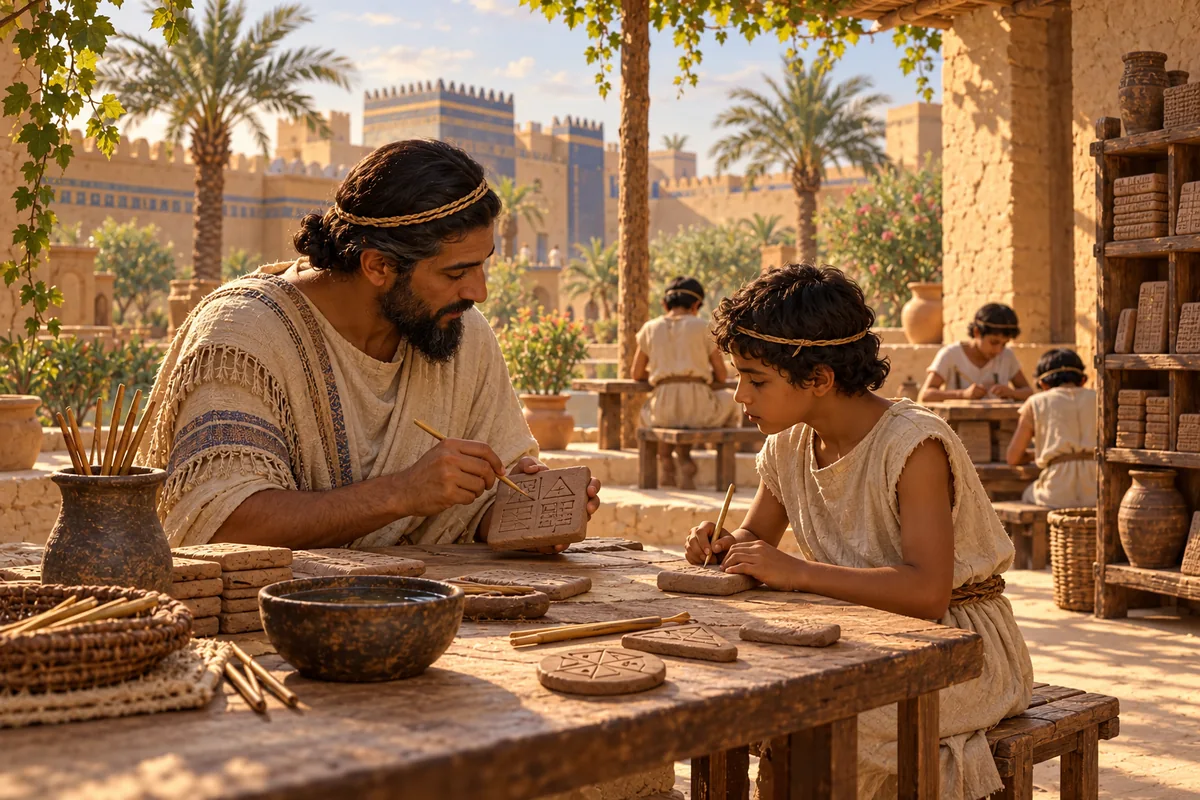
~1800 BCE · Multiple manuscripts across collections; see ETCSL bibliography for witnesses
A tigi to Nanaya for Ishbi-Erra (Ishbi-Erra C)
In plain English
Nanaya blazes into view like dawn itself — a lady chosen for her beauty, her virtue, and her wisdom, and set over all the lands by the great Mistress. She teaches and counsels in E-ana, Uruk's great temple, and she holds its high throne as its rightful occupant. Holy Inana shaped her education; she shines as bright as the stars, stands ready whenever she is called upon, and delivers fair judgment with compassion. An unknown word or phrase in one line is too damaged or obscure to read.
AI-generated reading paraphrase; compare with the translation below.
“Lady of the princely powers, emerging brilliantly like the daylight, chosen forever for her virtuous beauty! Nanaya, ornament of E-ana, worthy of the Lady! Wise one, correctly chosen as lady of all the lands by the Mistress: Nanaya, you instruct the Land, bestowing wisdom in E-ana. Barsud. As fine as An, woman with a holy (?) head, made perfect by the ...... lady! Nanaya, properly educated by holy Inana, woman who is as bright as the stars, wise lady who is available for everything, righteous sympathetic woman, lady who is always available on request, counselled by holy Inana, beloved by the Mistress! Nanaya, great judge, deity who occupies the high throne of Unug!”
Source: ETCSL c.2.5.1.3: A tigi to Nanaya for Ishbi-Erra (Ishbi-Erra C). Black, J.A., Cunningham, G., Robson, E. & Zólyomi, G. (eds.), The Electronic Text Corpus of Sumerian Literature, Faculty of Oriental Studies, University of Oxford. https://etcsl.orinst.ox.ac.uk/cgi-bin/etcsl.cgi?text=c.2.5.1.3
Read the full tablet entry~1800 BCE · Multiple manuscripts across collections; see ETCSL bibliography for witnesses
A tigi to Nanna (Nanna I)
In plain English
Nanna moves through his reed marshes — silent, far-reaching, enormous — and has built his house at the water's edge where the reeds grow green. He named his city the shrine Ur, and there Suen, lord of the long days, established his dwelling. In Ur, the city he chose for himself, the temple rings with praise like the bellowing of a bull. The place is sacred and without equal. Suen graces beloved Ur with pure divine powers, but the lines describing what he does there are too damaged to read, and the passage breaks off mid-sentence with Lord Acimbabbar's name.
AI-generated reading paraphrase; compare with the translation below.
“My king ...... in his reed marshes. He ...... in the silent (?) reed marshes. He extended his house over a huge reed marsh, over a ...... reed marsh. Its ...... is green (?); he has built ...... by the water. He called his city the shrine Urim. In his city, the lord of the long days, Suen, founded a dwelling-place. In Urim, the city chosen in his heart, bull-like the house gives praise. My king's splendid place is indeed an august place, a most precious place. Suen ...... his beloved city, the shrine Urim, the pure divine powers ...... his city. My king ...... the holy dais. Lord Acimbabbar .......”
Source: ETCSL c.4.13.09: A tigi to Nanna (Nanna I). Black, J.A., Cunningham, G., Robson, E. & Zólyomi, G. (eds.), The Electronic Text Corpus of Sumerian Literature, Faculty of Oriental Studies, University of Oxford. https://etcsl.orinst.ox.ac.uk/cgi-bin/etcsl.cgi?text=c.4.13.09
Read the full tablet entry~1800 BCE · Multiple manuscripts across collections; see ETCSL bibliography for witnesses
A tigi to Nergal (Nergal C)
In plain English
Nergal is addressed as a lord whose terror fills both heaven and earth, radiant across the land, born by his father's will to rule as king. His dread presses down on all humanity, and even the Anuna — the greatest of the gods — huddle together, shrinking before his awesome brilliance. The hymn repeats this praise in full before adding that after Nergal's father begot him, Enlil personally granted him dominion over the mountain of the earth — and then the tablet breaks off.
AI-generated reading paraphrase; compare with the translation below.
“Lord who inspires awe in heaven and on earth, who is resplendent in the Land, engendered for kingship by your father, your awesomeness weighs upon the black-headed. The Anuna, the great gods, cower together before your awesomeness and radiance. Nergal, lord who inspires awe in heaven and on earth, who is resplendent in the Land, engendered for kingship by your father, your awesomeness weighs upon the black-headed. The Anuna, the great gods, cower together before your awesomeness and radiance. Hero, after your father begot you, your father Enlil bestowed on you the mountain of the earth and…”
Source: ETCSL c.4.15.3: A tigi to Nergal (Nergal C). Black, J.A., Cunningham, G., Robson, E. & Zólyomi, G. (eds.), The Electronic Text Corpus of Sumerian Literature, Faculty of Oriental Studies, University of Oxford. https://etcsl.orinst.ox.ac.uk/cgi-bin/etcsl.cgi?text=c.4.15.3
Read the full tablet entry~1800 BCE · Multiple manuscripts across collections; see ETCSL bibliography for witnesses
A tigi to Nintud-Aruru (Nintud A)
In plain English
Nintud — Lady Aruru of the temple at Keš, born in the mountains, that pure and holy place — is the supreme mother of every land. She has appeared blazing with the terrifying ferocity of a lion, and from her have come the en priest, the lagar priest, and the king himself, born on the sacred throne-dais. The passage repeats this declaration in full: Nintud, lionlike and awe-inspiring, is the source of priest and ruler alike.
AI-generated reading paraphrase; compare with the translation below.
“Lady Aruru of the house Kec, born in the mountains, the pure place! Nintud, supreme mother of all lands, mother Nintud, lady Aruru of the house Kec, born in the mountains, the pure place! Nintud, supreme mother of all lands, has appeared with the hair-raising fearsomeness of a lion. She has given birth to the en priest, has given birth to the lagar priest. On the holy throne-dais, Nintud has given birth to the king. Nintud has appeared with the hair-raising fearsomeness of a lion. She has given birth to the en priest, has given birth to the lagar priest. On the holy throne-dais, Nintud has given birth to the king.”
Source: ETCSL c.4.26.1: A tigi to Nintud-Aruru (Nintud A). Black, J.A., Cunningham, G., Robson, E. & Zólyomi, G. (eds.), The Electronic Text Corpus of Sumerian Literature, Faculty of Oriental Studies, University of Oxford. https://etcsl.orinst.ox.ac.uk/cgi-bin/etcsl.cgi?text=c.4.26.1
Read the full tablet entry~1800 BCE · Multiple manuscripts across collections; see ETCSL bibliography for witnesses
A tigi (?) to Ninurta for Shu-Suen (Shu-Suen D)
In plain English
Ninurta is addressed as an ancient warrior of immense force — respected, powerful, fierce as a full-grown lion. He is a great wild bull, a battering ram against fortified walls, a flood that terrifies rebel lands and has no rival. He lays waste to enemy peoples, destroys cities, and reduces settlements to dust. Several phrases are damaged or uncertain: one manuscript reads 'imbued with fearsomeness' where another seems to describe a bolt of lightning, but both lines are too fragmentary to read fully. What survives ends with a declaration that Ninurta has spread the name of King Shu-Suen among peoples far and wide.
AI-generated reading paraphrase; compare with the translation below.
“Ancient warrior, greatly respected and forceful, with the strength of a full-grown lion! Ninurta, ...... flood, great lion, fierce opponent in battle! Mighty one, who ...... the enemy peoples, destroyer of cities, who turns the settlements into dust! Ninurta, great wild bull, a battering ram who ...... great walls! Barsud. A flood which frightens the rebel lands, without rival! Ninurta, deathly hush, ...... bolt of lightning (?), ...... (the other ms. has instead: imbued with fearsomeness, ......, ...... the enemy). You have made the name of king Cu-Suen known among the widespread people.…”
Source: ETCSL c.2.4.4.4: A tigi (?) to Ninurta for Shu-Suen (Shu-Suen D). Black, J.A., Cunningham, G., Robson, E. & Zólyomi, G. (eds.), The Electronic Text Corpus of Sumerian Literature, Faculty of Oriental Studies, University of Oxford. https://etcsl.orinst.ox.ac.uk/cgi-bin/etcsl.cgi?text=c.2.4.4.4
Read the full tablet entry~1800 BCE · Multiple manuscripts across collections; see ETCSL bibliography for witnesses
A tigi to Ninurta for Shulgi (Shulgi T)
In plain English
The text praises Ninurta as a perfect warrior — a towering mec tree with a broad, gleaming canopy, a dragon with a terrifying face, a venomous snake turning its poison against rebel lands, a lion without equal. He is the great wall of Nibru, an adviser who wields the broad wisdom of heaven and earth, and a king whose divine powers no force can scatter. The hymn ties him to the sanctuary E-cumeca in the city of Nibru and invokes his partnership with the great prince Enki. Dozens of descriptive lines are broken beyond reading, leaving only these fragments of the god's epithets and his relationship to Shulgi's kingship.
AI-generated reading paraphrase; compare with the translation below.
“Lord, perfect warrior, beloved by ....... Ninurta, mec tree with a broad shining canopy, ....... Weapon striding into battle, ...... foreign countries. A dragon with a terrifying face, venomous snake who ...... its venom against the rebel lands. ...... overpowering ......, foremost lion ....... Ninurta, who ...... with the great prince Enki. My king, in your city, shrine Nibru, ....... E-cumeca, where ...... for you. Lord, the kingship is perfect with you ....... Adviser, the dragon of the Land, ....... Ninurta, the great wall of Nibru, ....... My king, whose divine powers cannot be scattered, warrior ....... Forceful lion, ....... King with the broad wisdom of heaven and earth, ....... Exalted sceptre rising above the Land, ....... Ninurta, who ...... the enemy, .......”
Source: ETCSL c.2.4.2.20: A tigi to Ninurta for Shulgi (Shulgi T). Black, J.A., Cunningham, G., Robson, E. & Zólyomi, G. (eds.), The Electronic Text Corpus of Sumerian Literature, Faculty of Oriental Studies, University of Oxford. https://etcsl.orinst.ox.ac.uk/cgi-bin/etcsl.cgi?text=c.2.4.2.20
Read the full tablet entry~1800 BCE · Multiple manuscripts across collections; see ETCSL bibliography for witnesses
A tigi to Ninurta (Ninurta D)
In plain English
Ninurta boasts of the destruction he will unleash, and he wants his mother to hear every word of it: he will fell trees, level forests, knock down walls like a great axe, make enemy troops tremble, and devour them in storm and flood. Several comparisons in these lines are too damaged to read. The warrior then smashes heads in furious battle, and the Lord turns to curse the disobedient, rebellious lands — promising to deploy a battering ram against them and destroy their venom — but the tablet breaks off before the threat is finished.
AI-generated reading paraphrase; compare with the translation below.
“"I will fell trees, I will strike down forests. Let my mother know it. I, Ninurta, will fell trees, I will strike down forests. Let my mother know it. I will clear them away like an ...... axe. Let my mother know it. I will strike down ...... walls like a huge axe. Let my mother now it. I will make their troops tremble like ....... Let my mother know it. I will devour them like storm and flood. Let my mother know it." The warrior, ...... in furious battle, smashes heads. The Lord curses the disobedient, rebellious lands: "I will ...... battering ram, I will ...... your venom. I will destroy…”
Source: ETCSL c.4.27.04: A tigi to Ninurta (Ninurta D). Black, J.A., Cunningham, G., Robson, E. & Zólyomi, G. (eds.), The Electronic Text Corpus of Sumerian Literature, Faculty of Oriental Studies, University of Oxford. https://etcsl.orinst.ox.ac.uk/cgi-bin/etcsl.cgi?text=c.4.27.04
Read the full tablet entry~1800 BCE · Multiple manuscripts across collections; see ETCSL bibliography for witnesses
A tigi to Suen for Ibbi-Suen (Ibbi-Suen A)
In plain English
Suen is addressed as a lord whose divine powers cannot be scattered, radiating awe, the great crown, the youthful moon-god raised by Enlil to shine across the sky — a wide, majestic light born of Ninlil. Several phrases describing his appearance and his role in the assembly of the lands are too damaged to read. His princely powers embrace the heavens and reach down to the earth. Acimbabbar — another name for the moon-god — is linked to Ibbi-Suen, appointed to oversee the canals across the land and its peoples; Nanna has made the righteous crown blaze out, and Acimbabbar has presented Ibbi-Suen with the sceptre, though the lines that follow are too broken to recover.
AI-generated reading paraphrase; compare with the translation below.
“Lord whose divine powers cannot be dispersed, who emits an awe-inspiring radiance, great crown! Youthful Suen, light elevated by Enlil to shine forth in the firmament, wide-spreading majestic light, floating over the deep (?), born of Ninlil, god whose appearance is ......, ...... in the assembly of the lands! The moonlight ......, my Ibbi-Suen, ....... His princely divine powers embrace the heavens; his ...... is splendid, reaching the earth. Acimbabbar ......, my Ibbi-Suen, to be canal inspector in the Land among the widespread people. Nanna has made the righteous crown shine forth radiantly. Acimbabbar has ...... you the sceptre ....... My Ibbi-Suen, among the widespread people .......”
Source: ETCSL c.2.4.5.1: A tigi to Suen for Ibbi-Suen (Ibbi-Suen A). Black, J.A., Cunningham, G., Robson, E. & Zólyomi, G. (eds.), The Electronic Text Corpus of Sumerian Literature, Faculty of Oriental Studies, University of Oxford. https://etcsl.orinst.ox.ac.uk/cgi-bin/etcsl.cgi?text=c.2.4.5.1
Read the full tablet entry