Chapter 04 · 2112 – 2004 BCE
Ur III · Neo-Sumerian
A bureaucratic golden age, the Code of Ur-Nammu.
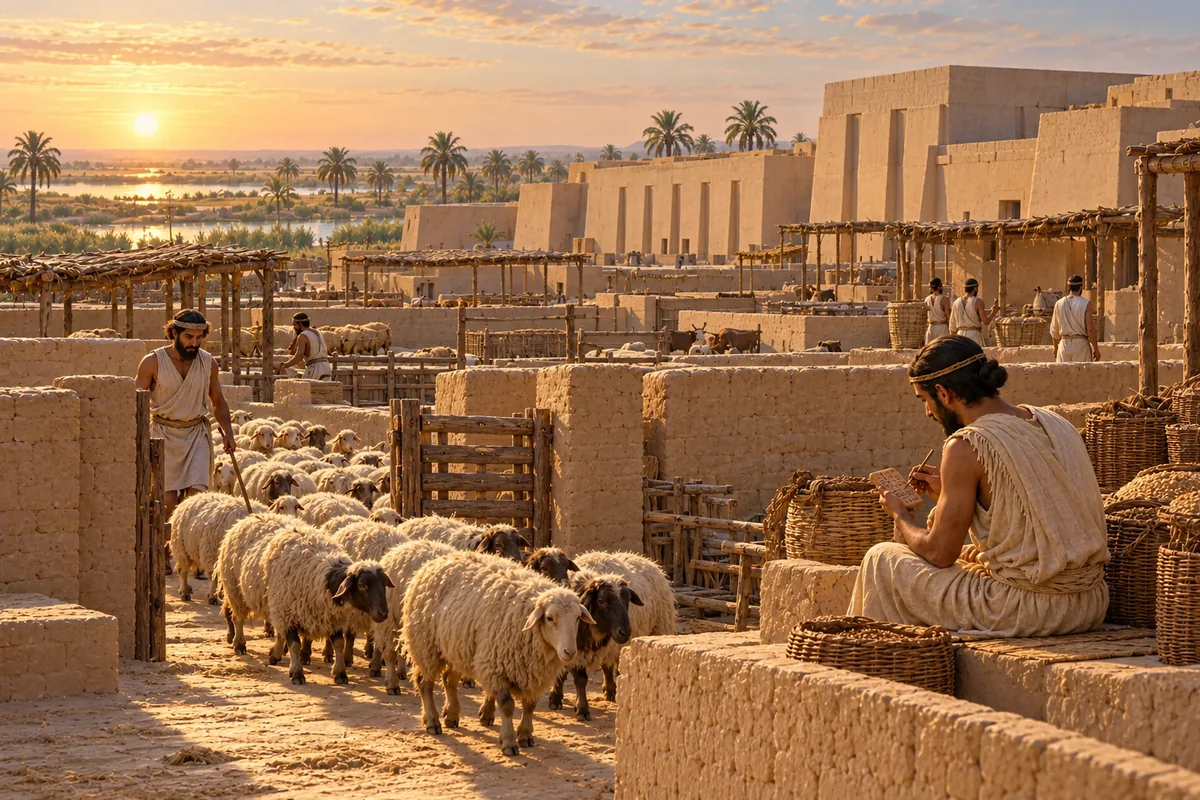
~2100 BCE · Reconstructed composite — see ORACC entry for manuscript witnesses
URU-KA-gina 34add
“(i 1') ... were the rulerś onion plots. (i 5') The team donkeys and the unblemished oxen .... (ii 1') Bau became the owner of all the households and fields of the female (members' of the ruler's family). ... all the households fields of the (ruler's) children. (iii 1') The ... of Niĝin are (entitled to) 180 loaves of bread and and 1 mud vessel of beer. (iii 5') The double men's toll through the gate (of the netherworld) is revoked.”
Source: Electronic Text Corpus of Sumerian Royal Inscriptions (ETCSRI), University of Vienna, edited by Gábor Zólyomi et al. https://oracc.museum.upenn.edu/etcsri/Q004873/
Read the full tablet entry~2100 BCE · Reconstructed composite — see ORACC entry for manuscript witnesses
Uruna-badbi 2001
A votive inscription in which a temple scribe dedicates an offering vessel to Ninlil on behalf of multiple named individuals, attesting the personal piety and social networks of literate cult personnel in the Ur III temple economy.
“(1) To Ninlil, Ur-saga, the ... scribe of Enlil’s temple, dedicated this (vase) as a votive offering for the life of Irina-badbi, the temple administrator of Enlil, for the well-being of Ama-abzi, and for the well being of his spouse and child.”
Source: Electronic Text Corpus of Sumerian Royal Inscriptions (ETCSRI), University of Vienna, edited by Gábor Zólyomi et al. https://oracc.museum.upenn.edu/etcsri/Q001436/
Read the full tablet entry~2100 BCE · Reconstructed composite — see ORACC entry for manuscript witnesses
Utuk/Uhub 1
“(1) For Zababa, Uhub, ruler of Kiš, ....”
Source: Electronic Text Corpus of Sumerian Royal Inscriptions (ETCSRI), University of Vienna, edited by Gábor Zólyomi et al. https://oracc.museum.upenn.edu/etcsri/Q001243/
Read the full tablet entry~2099 BCE · Ashm 1924-0553 — Ashmolean Museum, Oxford, UK
AAICAB 1/1, pl. 059, 1924-0553
In plain English
Received: 24 talents of gir2-gul-grade wool, weighed by a standard stone of 1 talent and 1⅔ minas per unit. The shipment came through Šulgi-mišar. It is wool from the sheep-house at Tummal, sent by [x]-Inanna as a delivery. Nur-Suen has taken receipt of it. Dated: the month of Šu-ešša, in the year the throne of Enlil was made.
AI-generated reading paraphrase; compare with the translation below.
“Obverse 1. 24 talents of gir2-gul wool, 2. (by) the stone (weight) of 1 talent 1 2/3 minas each; 3. via Šulgi-mišar; 4. wool of the sheep-house of Tummal, 5. from x-Inanna; 6. delivery. Reverse 7. Nur-Suen 8. received. 9. Month: Šu-ešša; 10. Year: The throne of Enlil was fashioned.”
Source: engine:claude-opus-5-5 (2026-09-20/v8-evolved) · claude-opus-5-5 · medium confidence
Read the full tablet entry~2099 BCE · Ashm 1935-0541 — Ashmolean Museum, Oxford, UK
AAICAB 1/2, pl. 093, 1935-541
In plain English
Bricks hauled by the boatmen: 16 sar 10 gin, credited to Agaga'a the singer; 20 sar delivered to the hamlet; and 3 2/3 sar 5 gin delivered to the mill-house. All of these brick loads were counted. The line naming the official responsible is damaged, though the name Umani can still be read, probably with 'via' after it. Dated in the month E-iti-6, in the year the throne of Enlil was made.
AI-generated reading paraphrase; compare with the translation below.
“16 sar 10 gin of bricks: Agaga'a, the singer; 20 sar of bricks: in the hamlet; 3 2/3 sar 5 gin: in the mill-house; the boatmen. Bricks carried, counted. [x] Umani [via?]. Month: E-iti-6. Year: the throne of Enlil was fashioned.”
Source: engine:claude-opus-5-5 (2026-09-20/v8-evolved) · claude-opus-5-5 · medium confidence
Read the full tablet entry~2099 BCE · Anonymous 464281 — private: anonymous, Barcelona, Spain
AuOr 31, 232 01
In plain English
On the 12th day of the month, two mature billy-goats and one milk-fed lamb were slaughtered and delivered. Nalu handed them over, and the official Ur-nigar took receipt of them. The transaction is dated to the month called "Ubi-feast" in the year when the throne of the god Enlil was made — Amar-Suena's second year as king.
AI-generated reading paraphrase; compare with the translation below.
“2 billy-goats (mature male goats), 1 milk-fed lamb, (booked as) slaughtered, day 12, from Nalu, Ur-nigar received. Month: "Ubi-feast" (iti u5-bi2-gu7), Year: "the throne of Enlil was fashioned" (Amar-Suena year 2).”
Source: engine:claude-sonnet-5 (2026-07-12/v7-evolved) · claude-sonnet-5 · high confidence
Read the full tablet entry~2099 BCE · Anonymous 114247 — private: anonymous, unlocated
MVN 05, 027
In plain English
This record tracks a few workers and their fractional labor shares, each dated by the month and year their assignment began. Lugal-nig-lagare is counted as a half-unit starting in the harvest month; an entry for 'the field of Balula' (possibly a person's name) is counted as one full unit, dated to the month of Dumuzi in the year the throne of Enlil was fashioned. Ur-Utu and Ur-sisa are each counted as half-units, both starting in the harvest month, in the year the priestess En-mahgalana was installed. The document closes by noting that responsibility for these was transferred from Lugal-muma'ag and taken over by Lu-kalla. Lu-kalla, the scribe who wrote this tablet, identifies himself as the son of Ur-e'e, a cattle-manager.
AI-generated reading paraphrase; compare with the translation below.
“1/2 (unit): Lugal-nig-lagare; from month: “Harvest” (iti sze-sag11-ku5); 1 (unit): the field(?) of Balula; month: “Dumuzi”; year: “the throne of Enlil was fashioned”; 1/2 (unit): Ur-Utu; 1/2 (unit): Ur-sisa; from month: “Harvest” (iti sze-sag11-ku5); year: “En-mahgalana was installed”; from Lugal-muma’ag; Lu-kalla took in charge (received); Lu-kalla, the scribe, son of Ur-e’e, the cattle-manager (šušš3).”
Source: engine:claude-sonnet-5 (2026-07-12/v7-evolved) · claude-sonnet-5 · medium confidence
Read the full tablet entry~2099 BCE · BM 088882 & BM 093364 & BM 093490 & BM 093494 & BM 093508 & BM 100380 & Cugnin 020 & Cugnin 021 & Cugnin 054 & SE 004 — British Museum, London, UK; private: Cugnin, France; Couvent Saint-Etienne, Jerusalem
Nisaba 17, 005a-d
In plain English
This is a receipt: seven royal-measure gur of barley, plus some flour, were issued as ration-grain and formally withdrawn from the granary tied to the cultivated fields. A man named Lu-saga took delivery of it, on behalf of laborers working at several different temples. The transaction is dated to the harvest month, in the year the throne of Enlil was made.
AI-generated reading paraphrase; compare with the translation below.
“7 gur barley (royal measure) — flour, for KA (rations?) — barley of the šuku-rations, was withdrawn (booked out) from the granary of the cultivated land (uru11) — Lu-saga received (it), for the workers of the various shrines. Month: "Harvest" (sze-sag11-ku5). Year: "The throne of Enlil was fashioned."”
Source: engine:claude-sonnet-5 (2026-07-12/v7-evolved) · claude-sonnet-5 · medium confidence
Read the full tablet entry