Chapter 07 · 911 – 609 BCE
Neo-Assyrian
Empire, library, terror, scholarship.
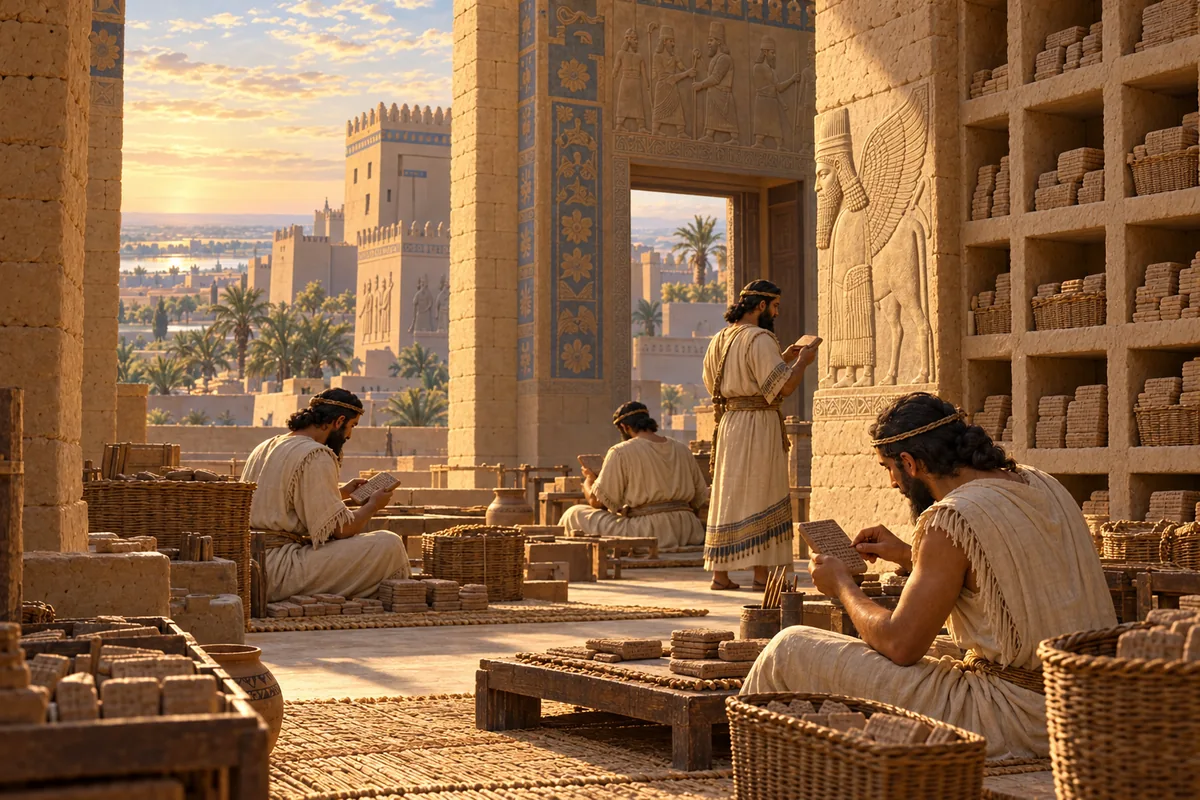
~730 BCE · Reconstructed composite — see ORACC entry for manuscript witnesses
SAA 19 138. Mukin-zeri Instigating Babylonians (CTN 5 p. 18)
“(1) Your [ser]vant Dummuq[u]: I wo[uld gladly] die for the king, my lord! May Nergal and Laṣ bless the king, my lord! Say to the king, my lord: (5) I am (hereby) sending my tablet to greet the king, my lord. The temples and the city of the king, my lord, are well. (8) I b[le]ss the king, [my lor]d, eve[ry] day before Nergal and Laṣ. (10) News of Bab[ylon]: Mukin-ze[ri] has entered Babylon from Bit-Amukani having 10 horses with him. (r 1) He greeted the Babylonian[s], saying: "I have ...ed 600 horses insi[de] Assyria (and) ...ed (them) into m[y] country. Do[n]’t be afra[id]!" (r 7) The Babyl[oni]ans did not want [...] but went up to [...]. When I found (this) out, I wro[te] to the king, my lord.”
Source: Luukko, M. 2012. The Correspondence of Tiglath-pileser III and Sargon II from Calah/Nimrud. SAA 19. Helsinki: Helsinki University Press. https://oracc.museum.upenn.edu/saao/saa19/P224465/
Read the full tablet entry~730 BCE · Reconstructed composite — see ORACC entry for manuscript witnesses
SAA 19 139. Leftovers from Nippur for the King’s Good Health (CTN 5 p. 91)
“(1) Your serva[nt], the gov[ernor of Nippur]: I would gladly die for the ki[ng, my lord]! May [Enlil, Ninur]ta and [Nusku] bless the king, my lord! Say to the king, [my l]ord: (6) On account of the temple of Aššur, I have sent the leftovers of the land to invigorate the life of the king, my lord. (8) Since the king is residing in the land, I have sen[t] an express messenger for a [re]p[ly] of the king, my lord, and he will bring it. I [have] wr[itten t]rut[hfully to] the king, my lord [...] (13) my [servan]ts and [......] (14) [...] to be(come) strong(er) [......] (Break) (r 1) "In the same…”
Source: Luukko, M. 2012. The Correspondence of Tiglath-pileser III and Sargon II from Calah/Nimrud. SAA 19. Helsinki: Helsinki University Press. https://oracc.museum.upenn.edu/saao/saa19/P224454/
Read the full tablet entry~730 BCE · Reconstructed composite — see ORACC entry for manuscript witnesses
SAA 19 140. News to The Delegate of Elam: Rebels Defeated (CTN 5 p. 58)
“(1) Your servant Hamapi: I would gladly die for the ki[ng], my lord! Say to my lord: (3) When the delegate of Elam, who lives in Bit-[Imb]ia, wrote to me: "What news is there on the camp which came?," I subsequently wrote to him: "The king of Assyria has [de]feated them. Šumu-ukin, his son, (as well as) [his] bro[ther are dead]. (8) [...] Bit-Amukan[i ...] (Break) (r 1) [...] when [......] (r 2) have [deliv]ered [...] into your hands, (and) by the command of Bel and Nabû you have now liberated Šapiya, the [...] of the whole land. (r 5) By that very command, whoever transgresses your word (or) alters your treaty, will be consigned into your hands.”
Source: Luukko, M. 2012. The Correspondence of Tiglath-pileser III and Sargon II from Calah/Nimrud. SAA 19. Helsinki: Helsinki University Press. https://oracc.museum.upenn.edu/saao/saa19/P224400/
Read the full tablet entry~730 BCE · Reconstructed composite — see ORACC entry for manuscript witnesses
SAA 19 141. Men for the Royal Mule Express Service (CTN 5 p. 89)
“(1) Your servant [Abi]-hari: I would gladly die for the king, my lord! Say to the king, my lord: (4) I am (hereby) sending my tablet to greet the king, my lord. I am [doing] (my) work. (7) And since [......] m[e], the king in [......] (Break) (r 2) to the men [...] (r 3) those who [stayed] until the end, did not return. (r 4) No[w] I have provided 100 men from their midst for the royal mule express service. (r 7) By the gods of the king, my lord, I and my father are servants of the king, my lord, (and) our loins [are girded] for the king. (e. 1) Let the king strive [...]. (e. 2) [He has gi]ven me [much], what [can I give] (him)? [May I hea]r [the well-b]eing of the king, my lord, and may I be happy!”
Source: Luukko, M. 2012. The Correspondence of Tiglath-pileser III and Sargon II from Calah/Nimrud. SAA 19. Helsinki: Helsinki University Press. https://oracc.museum.upenn.edu/saao/saa19/P393656/
Read the full tablet entry~730 BCE · Reconstructed composite — see ORACC entry for manuscript witnesses
SAA 19 142. Letter to the Grand Vizier (CTN 5 p. 79)
“(1) Your servant Iqipi: I would gladly die for the grand vizier, [m]y lord! Say to my lord: (5) After I had prepared for journey the king's messenger, who raised high her ritual, and after he had left for the king, the oblates of Cutha and Ba[byl]on, ki[ng]’s men, arrived in the fortress [under] our [pro]tection.”
Source: Luukko, M. 2012. The Correspondence of Tiglath-pileser III and Sargon II from Calah/Nimrud. SAA 19. Helsinki: Helsinki University Press. https://oracc.museum.upenn.edu/saao/saa19/P393657/
Read the full tablet entry~730 BCE · Reconstructed composite — see ORACC entry for manuscript witnesses
SAA 19 143. I Shall Keep my Watch (CTN 5 p. 253)
“(1) [To the k]i[ng], my lord: [your servant Mann]u-ki-Aššur. Good heal[th] to the king, my lord! (4) Con[cerni]ng the [...] about which the king, my lord, [wrote to me]: "Right now [......] (6) [......] to yo[u] (7) [......] and I/he will raise seed (Break) (r 2) [... ...]... I [have] now [...ed] them and am [in GN]. (r 4) Right now I s[t]and at my watchpost [and] keep my [w]atch.”
Source: Luukko, M. 2012. The Correspondence of Tiglath-pileser III and Sargon II from Calah/Nimrud. SAA 19. Helsinki: Helsinki University Press. https://oracc.museum.upenn.edu/saao/saa19/P224381/
Read the full tablet entry~730 BCE · Reconstructed composite — see ORACC entry for manuscript witnesses
SAA 19 144. Family Affairs (CTN 5 p. 234)
“(1) A tablet of Datâ to her brother Šumu-iddina. (3) May Mulliltu and Ištar of Babylon decree the well-being of my brother's land. I pray daily to Mulliltu and Ištar of Babylon for the good health of my brother. (8) Why have I not seen your messenger until this very day? Now, if you are alive, let me forgive the shortcomings of your character and dance. (13) The lady Gagâ has died and your brother is troubled. Come to see him! I have written to you out of desperation. Come quickly! (r 3) By Mulliltu and Ištar of Babylon, he is every day among my concerns. Do not [tr]ust [in the b]laze of your heart! Oh my god! (r 10) Šullumâ asks about the health of his [b]rother Šumu-idd[ina].”
Source: Luukko, M. 2012. The Correspondence of Tiglath-pileser III and Sargon II from Calah/Nimrud. SAA 19. Helsinki: Helsinki University Press. https://oracc.museum.upenn.edu/saao/saa19/P224382/
Read the full tablet entry~730 BCE · Reconstructed composite — see ORACC entry for manuscript witnesses
SAA 19 145. Confined to Babylon (CTN 5 p. 80)
“(Beginning destroyed) (1) has been sent from [...]. (2) [...] watc[h]es the evening cerem[ony of DN]. (5) Let him stay there, until I come to the king, my lord. (r 1) Perhaps the king will say: "Why does he stay put since he is in Babylon?" – he has se[nt] his messengers to [...]. (r 7) Right no[w ...] (Rest destroyed)”
Source: Luukko, M. 2012. The Correspondence of Tiglath-pileser III and Sargon II from Calah/Nimrud. SAA 19. Helsinki: Helsinki University Press. https://oracc.museum.upenn.edu/saao/saa19/P393658/
Read the full tablet entry