Chapter 07 · 911 – 609 BCE
Neo-Assyrian
Empire, library, terror, scholarship.
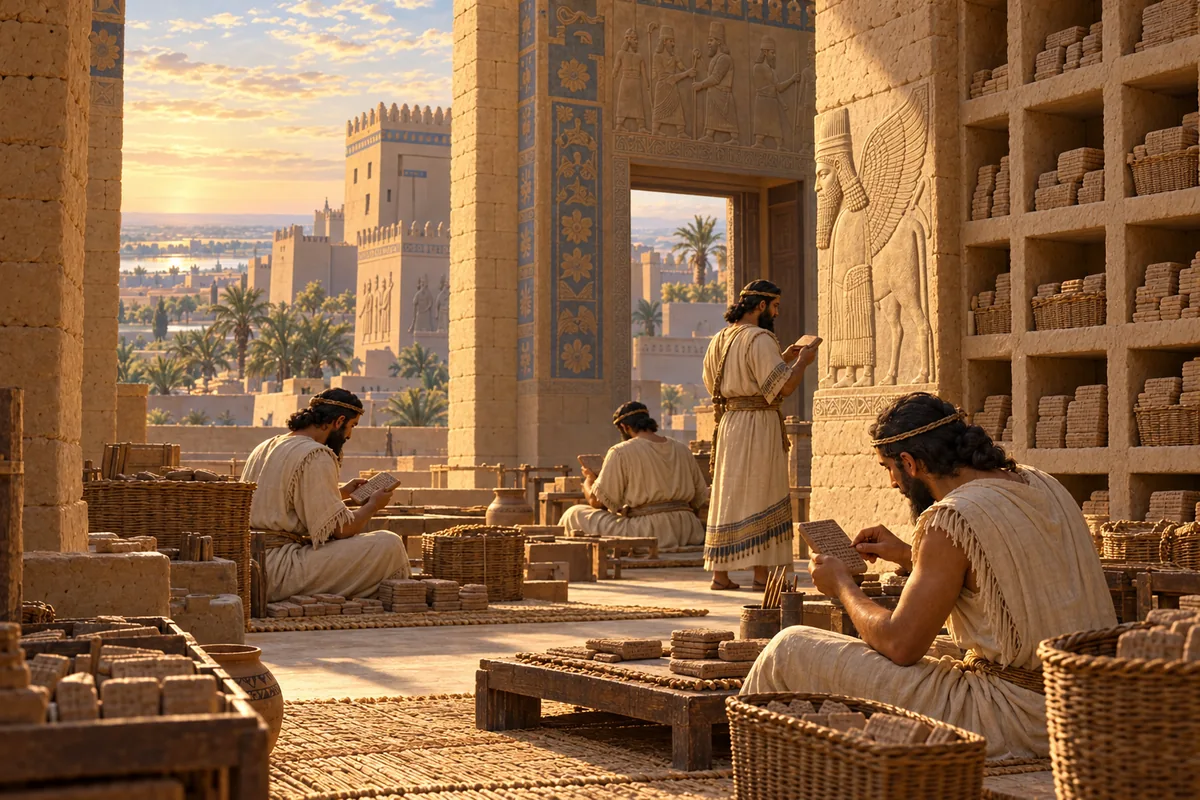
~730 BCE · Reconstructed composite — see ORACC entry for manuscript witnesses
SAA 19 130. Threatened by Mukin-zeri (CTN 5 p. 61)
“(Beginning destroyed) (1) the king, my lord [......] (2) my dead one ...[......] (3) [concealed] my report from the ki[ng] (4) and my ... does not come into [the king, my lo]rd's presence. From this the kin[g], my lord, should understand that I am sick and ...... (8) After Mukin-zeri set up camp against me in Bit-Am[u]kani, I did not die thanks to the protection of the king, my lord. (10) Now why did I not have bread to eat for four days on the distant road? The king, my l[or]d, should not say: "What is it? Why didn't you w[ri]te to me?" (15) I have sent all ...... [...] to the king (and)…”
Source: Luukko, M. 2012. The Correspondence of Tiglath-pileser III and Sargon II from Calah/Nimrud. SAA 19. Helsinki: Helsinki University Press. https://oracc.museum.upenn.edu/saao/saa19/P224442/
Read the full tablet entry~730 BCE · Reconstructed composite — see ORACC entry for manuscript witnesses
SAA 19 131. Messengers of the Sons of Mukin-zeri Moving to Puqudu (CTN 5 p. 57)
“(1) Yo[ur servant] Salamu: I would gladly die for the Palace of my lord. Say to the Palace and [...] of my lord: The order which the king gave was a signal. (4) Now, the messengers of the sons of Mukin-zeri have proceeded to the land of the [P]uqudu [...] (6) [......] opened (7) And now [......] (8) [...] of which the king said to [...]... (9) as [his] entire shadow [......] moves on into the marsh (10) anything [...] (11) above me ...... from [...] (Rest too broken for translation)”
Source: Luukko, M. 2012. The Correspondence of Tiglath-pileser III and Sargon II from Calah/Nimrud. SAA 19. Helsinki: Helsinki University Press. https://oracc.museum.upenn.edu/saao/saa19/P224398/
Read the full tablet entry~730 BCE · Reconstructed composite — see ORACC entry for manuscript witnesses
SAA 19 132. Babylonians Arrested (CTN 5 p. 82)
“(Beginning destroyed) (1) [the s]hei[kh .....] (2) from [......] (3) saying: "Th[e]se are [......] (4) citizens of Babylon [whom ......] (5) caught [...... The king] (6) will impo[se a punishment] on them. [...... He] (7) knows [...]." He said (this). [Now then] I am sendi[ng them] t[o] my brother. (8) [......] (9) Aplaya, son of [NN ......] (10) He says: Concerning Munnab[itu ......] (11) concerning Ṣalliy[a ......] (12) concerning La-bas[i ......] (13) concerning Bel-ibni [......] (14) concerning Sulay[a ......] (15) concerning Šuzub[u ......] (16) concerning Šamšat[i ......] (17)…”
Source: Luukko, M. 2012. The Correspondence of Tiglath-pileser III and Sargon II from Calah/Nimrud. SAA 19. Helsinki: Helsinki University Press. https://oracc.museum.upenn.edu/saao/saa19/P393660/
Read the full tablet entry~730 BCE · Reconstructed composite — see ORACC entry for manuscript witnesses
SAA 19 133. Treaty with the Son of Yakin (CTN 5 p. 14)
“(Beginning destroyed) (1) [To NN, my brother: thus says NN, your brother. Good] health [to you]! Sa[y to my brother]: (2) As to what my brother wrote: "[NN] ha[s] hear[d] the news [......] (4) whatever Mukin-zeri [......] (5) but you provi[ded] shelter [for me ...] (6) ......[...] (7) [...] not [... a]nything to Bit-... (8) As to what my brother wrote: "What is the news of the land that they discussed with you? Outline it and write to me!" (10) Earlier Nabû-naṣir [w]rote to the king: "Mukin-zeri has moved horses up from the Borsippa gate against Babylon, so nobody can leave Babylon, and we…”
Source: Luukko, M. 2012. The Correspondence of Tiglath-pileser III and Sargon II from Calah/Nimrud. SAA 19. Helsinki: Helsinki University Press. https://oracc.museum.upenn.edu/saao/saa19/P224458/
Read the full tablet entry~730 BCE · Reconstructed composite — see ORACC entry for manuscript witnesses
SAA 19 134. Horses and Troops to Borsippa and Dilbat (CTN 5 p. 63)
“(1) Your servant Nabû-damiq: I would gladly die for the king, my lord! May Nabû and Marduk bless the king, my lord! Say to the king, my lord: (5) Concerning the orders that the king gave me, things have developed nicely in front of me. Now the king should quickly send the caravan of Nabû-bani and 500 horses here, so that those who are around us can go to Borsippa. (12) Also, a royal messenger [should c]ome into the presence of Yaqiru, the sheikh of the Li['tamu], to summon men to protect the civilians, and they should go up to Dilbat before us. Perhaps it will be possible to enter Borsippa. The king [sho]uld know (this); it is only (a matter) to the army, to the king and to our mission.”
Source: Luukko, M. 2012. The Correspondence of Tiglath-pileser III and Sargon II from Calah/Nimrud. SAA 19. Helsinki: Helsinki University Press. https://oracc.museum.upenn.edu/saao/saa19/P393675/
Read the full tablet entry~730 BCE · Reconstructed composite — see ORACC entry for manuscript witnesses
SAA 19 135. “How Could These People Be Wrenched away from the King, My Lord?” (CTN 5 p. 51)
“(1) Your [serva]nt Nabû-balassu-iqbi: I would gladly die [f]or the king, my lord! May [Na]bû and Marduk bless the king, my lord! Say to the king, my lord: (6) Concerning the clansmen of Dur-ša-Balihaya about whom the king, my lord, wrote, by [Be]l [and Nabû, the god]s of the king, my lord, I do not know (any) sin of theirs. The witnesses did swear (it). (13) (Time) will pass and you will come. Until I send word and whis[per ...] in Dur-ša-Bali[haya] and in the country of [...] (r 1) Eat! I [......] (r 2) ... [......]. (r 3) And when [......]. (r 4) and [...] not [...] them (r 5) [M]y arms…”
Source: Luukko, M. 2012. The Correspondence of Tiglath-pileser III and Sargon II from Calah/Nimrud. SAA 19. Helsinki: Helsinki University Press. https://oracc.museum.upenn.edu/saao/saa19/P224464/
Read the full tablet entry~730 BCE · Reconstructed composite — see ORACC entry for manuscript witnesses
SAA 19 136. My Messages Do not Reach the King (CTN 5 p. 53)
“(1) Your servant Nabû-balassu-iqb[i]: I would gladly die [for] the king, my lord! May Nabû and [Ma]rduk bless the king, my lord! Say to the king, my lord: (5) I am (hereby) sending my tablet to greet the king, my lord. The king, my lord, said: "Your messenger and your [re]port are co[nce]aled from me. Why do I send you a m[essag]e, but you do not send me [a repl]y?" (12) I do [regular]ly send my lett[er] to the king of king[s], but somebody has not all[owed m]y messenger[s g]o quickly to the [k]in[g but] sends them away. (r 1) Eve[r] since a letter of the king has [c]ome to me I have [w]ritten a reply to it and sent it to the king. (But) if somebody does not forward it, the king should not blame his servant!”
Source: Luukko, M. 2012. The Correspondence of Tiglath-pileser III and Sargon II from Calah/Nimrud. SAA 19. Helsinki: Helsinki University Press. https://oracc.museum.upenn.edu/saao/saa19/P393654/
Read the full tablet entry~730 BCE · Reconstructed composite — see ORACC entry for manuscript witnesses
SAA 19 137. No News Yet from Babylon (CTN 5 p. 52)
“(1) [Your servant] Nabû-balassu-iqbi: [I would gladly di]e [for] the king, my lord! May Nabû and Marduk bless [the king, my lord]! [Say] to the king, my lord: I have sent [a messenger t]o greet [the king, my lord]. (8) [Concerning the ne]ws of Babylon, [I have sen]t [messen]gers to Babylon (but) they [have not com]e back until now. (Break) (r 3) [... t]o the king (r 4) [...]... of the centre of the city (r 5) [...]...”
Source: Luukko, M. 2012. The Correspondence of Tiglath-pileser III and Sargon II from Calah/Nimrud. SAA 19. Helsinki: Helsinki University Press. https://oracc.museum.upenn.edu/saao/saa19/P393655/
Read the full tablet entry