Chapter 07 · 911 – 609 BCE
Neo-Assyrian
Empire, library, terror, scholarship.
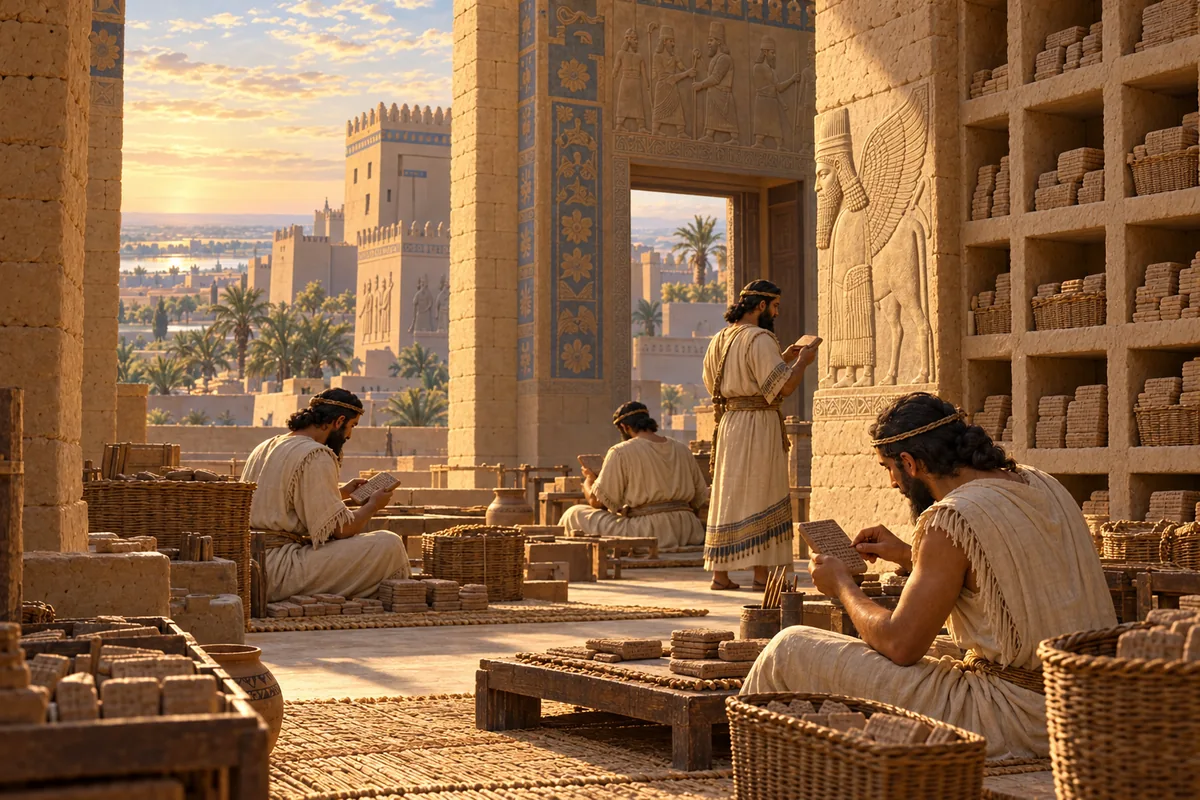
~730 BCE · Reconstructed composite — see ORACC entry for manuscript witnesses
SAA 19 106. Report on Mas’eans (CTN 5 p. 271)
“(1) To the king, [my lo]rd: your servant Na[bû-nammir]. Good health to [the king, my lord]! May Nabû and [Marduk] b[less] the king, my lord. (6) Concerning the Ma[s'eans] about whom the king, my lord, [gave me orders ...] (Rest destroyed)”
Source: Luukko, M. 2012. The Correspondence of Tiglath-pileser III and Sargon II from Calah/Nimrud. SAA 19. Helsinki: Helsinki University Press. https://oracc.museum.upenn.edu/saao/saa19/P393648/
Read the full tablet entry~730 BCE · Reconstructed composite — see ORACC entry for manuscript witnesses
SAA 19 107. Talents of Silver (CTN 5 p. 78)
“(1) [To the k]ing, m[y] lord: your [servant] Nabû-nammi[r. Good] health to the king, m[y] lord! May [Na]bû and Marduk bless [the king], my lord! (6) [As to what the king, ou]r [lord], wrote to us, [......] (Break) (r 3) [... t]hey placed [...] (r 4) [x ta]lent(s) of silver [...] (r 5) [...] upon the ci[ty ...] (r 6) [...] y[ou ...] (Rest destroyed or too broken for translation)”
Source: Luukko, M. 2012. The Correspondence of Tiglath-pileser III and Sargon II from Calah/Nimrud. SAA 19. Helsinki: Helsinki University Press. https://oracc.museum.upenn.edu/saao/saa19/P393649/
Read the full tablet entry~730 BCE · Reconstructed composite — see ORACC entry for manuscript witnesses
SAA 19 108. Raising Barley from Babylonian Cities (CTN 5 p. 34)
“(1) To the king, my lord: your servant Ašipâ. Good health to (the king,) my lord! (4) Concerning the barley which the king, my lord, sent me for, when I set out from the king, my lord, I entered [Cut]ha and Sippar and I stayed two days in Babylon but the barley of Ṣil-Bel was not available. I could not go near it until Mušezib-Ilu came from Kar-Aššur. (r 7) I towed the boats and went a day’s march below Cutha. (r 10) On the 23rd I will set out and put in place the barley of Cutha.”
Source: Luukko, M. 2012. The Correspondence of Tiglath-pileser III and Sargon II from Calah/Nimrud. SAA 19. Helsinki: Helsinki University Press. https://oracc.museum.upenn.edu/saao/saa19/P393650/
Read the full tablet entry~730 BCE · Reconstructed composite — see ORACC entry for manuscript witnesses
SAA 19 109. Barley from Babylonian Cities (CTN 5 p. 33)
“(1) To the kin[g], my [lo]rd: (your) servant Ašipâ. (3) 6,000 (homers of) barley of the village manager Ṣil-Bel is near by. The rest of the barley has not been piled up. (8) (There is also) 2,000 (homers of) Nergal-eṭir; (9) (and) 3,000 (homers of) barley in Sippar. The barley is far from the river bank. (r 1) The barley is in place, (but) I cannot go to Sippar and the barley is far from the river. (r 6) If the king should say: 'Go (there)!', the work is in progress. They complain, saying: "From Cutha, from Kar-Nergal."”
Source: Luukko, M. 2012. The Correspondence of Tiglath-pileser III and Sargon II from Calah/Nimrud. SAA 19. Helsinki: Helsinki University Press. https://oracc.museum.upenn.edu/saao/saa19/P224419/
Read the full tablet entry~730 BCE · Reconstructed composite — see ORACC entry for manuscript witnesses
SAA 19 110. Launching Boats and Water-Skin Rafts in Northern Babylonia (CTN 5 p. 35)
“(1) [To the king], my [lo]rd: [your servant A]šipâ. [Good heal]th to the king, my lord! (4) [We] set into motion [the boat]s and water-skin rafts [which] were launched [into wate]r [in] Dur-Ladini, and proceeded to Bab-bitqi. (8) If [the kin]g commands: "Let the first-come (boats) proceed to take (the barley)", (then) either Balassu or Nadinu should man the bo[at]s and water-skin rafts and set out until I have fetched the later ones from Dur-Balihaya.”
Source: Luukko, M. 2012. The Correspondence of Tiglath-pileser III and Sargon II from Calah/Nimrud. SAA 19. Helsinki: Helsinki University Press. https://oracc.museum.upenn.edu/saao/saa19/P393651/
Read the full tablet entry~730 BCE · Reconstructed composite — see ORACC entry for manuscript witnesses
SAA 19 111. Boats and Water-Skin Rafts are Well Despite an Attack (CTN 5 p. 31)
“(1) [T]o the king, my lord: your se[rvant] Ašipâ. Good health to the king, [m]y lord! (4) I brought the boats to Sur[u]. The prefect of the boatmen who [...] (Break) (r 2) [Bor]sippan [troops c]ame out and attacked the men of Balassu; seven men were wo[un]ded and five were killed. Also one chariot fighter of [mi]ne was killed with them. But the boats and water-skin rafts are well.”
Source: Luukko, M. 2012. The Correspondence of Tiglath-pileser III and Sargon II from Calah/Nimrud. SAA 19. Helsinki: Helsinki University Press. https://oracc.museum.upenn.edu/saao/saa19/P224390/
Read the full tablet entry~730 BCE · Reconstructed composite — see ORACC entry for manuscript witnesses
SAA 19 112. “Should We Detain the Boats?” (CTN 5 p. 32)
“(1) To the king, m[y] lord: your servant Ašipâ. Good health t[o the king, my lord]! (4) Concerning the boats about which the king, my lord, wrote to me, 400 boats [and x] water-skin rafts (Break) (r 2) I shall set out. (r 3) After the boats have been unloaded, should I let them go, or shall we detain them?”
Source: Luukko, M. 2012. The Correspondence of Tiglath-pileser III and Sargon II from Calah/Nimrud. SAA 19. Helsinki: Helsinki University Press. https://oracc.museum.upenn.edu/saao/saa19/P224406/
Read the full tablet entry~730 BCE · Reconstructed composite — see ORACC entry for manuscript witnesses
SAA 19 113. Killing Locusts (CTN 5 p. 199)
“(1) To the [k]ing, my lord: your se[rva]nt Ašipâ. Good health to the [k]i[ng], my [lo]rd! May Nabû (and) Marduk bless the king, my lord. (6) The royal bodyguard whom the king, my lord, sent, said: "Kill the locusts!" (9) We have exterminated all that there was of them, they did not damage any of the harvest. [The g]ods of the king, my lord, destroyed them. (r 1) The harvests in the [en]tire land of the king, my lord, are very well.”
Source: Luukko, M. 2012. The Correspondence of Tiglath-pileser III and Sargon II from Calah/Nimrud. SAA 19. Helsinki: Helsinki University Press. https://oracc.museum.upenn.edu/saao/saa19/P224435/
Read the full tablet entry