Chapter 07 · 911 – 609 BCE
Neo-Assyrian
Empire, library, terror, scholarship.
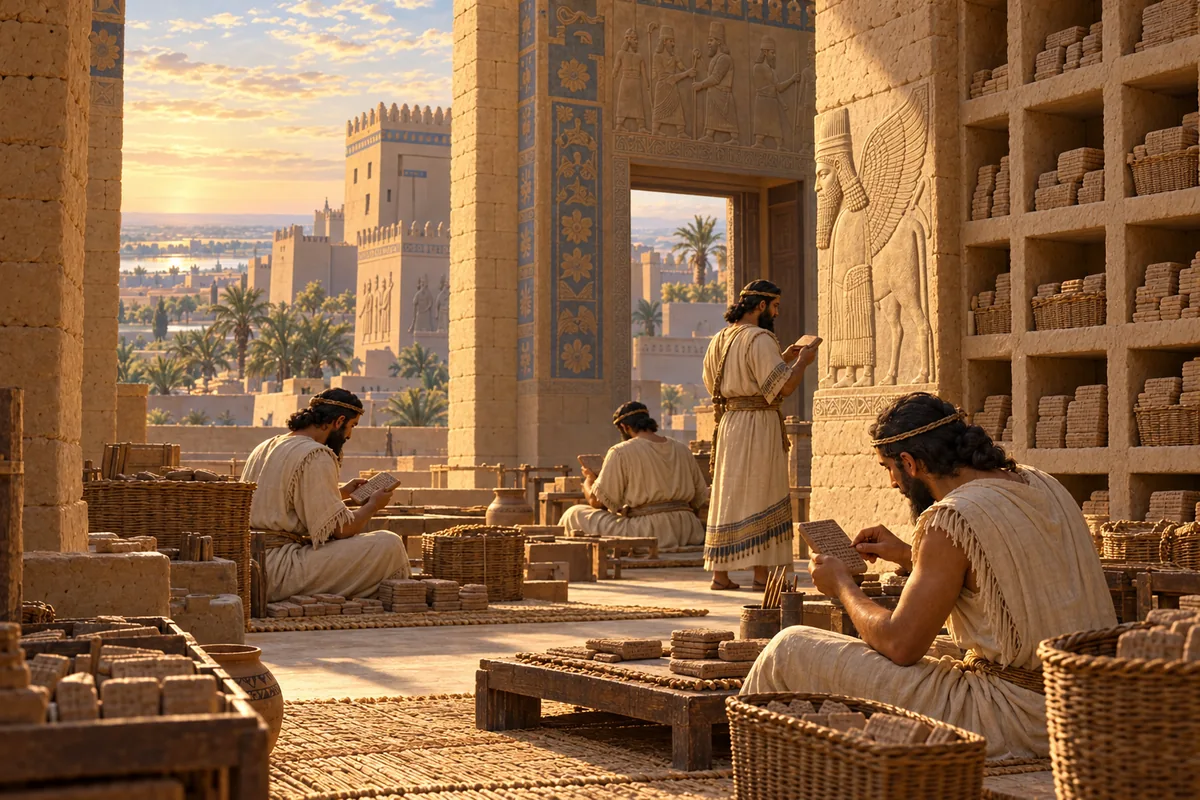
~730 BCE · Reconstructed composite — see ORACC entry for manuscript witnesses
SAA 19 098. Peace Negotiations with the Babylonians (CTN 5 p. 19)
“(1) To the king, my lord: your servants [Šamaš]-bunaya (and) Nabû-nammir. Good health to the king, my lord! May Nabû (and) Marduk ble[ss] the king, my lord! (5) We went to Babylon on the 28th. We stood in front of the Marduk gate and spoke with the Babylonian(s). (8) Z[a]sinnu, a servant of Mukin-zeri and some Chaldeans with him came out and stood with the Babylonians before the city-gate. We spoke to the Babylonians as follows: "The k[in]g has s[en]t us to you, saying: '[Let me speak] with the [Babylonians] th[rough] your mouths. I shall establish [the am]ne[sty o]f Babylon and your…”
Source: Luukko, M. 2012. The Correspondence of Tiglath-pileser III and Sargon II from Calah/Nimrud. SAA 19. Helsinki: Helsinki University Press. https://oracc.museum.upenn.edu/saao/saa19/P224440/
Read the full tablet entry~730 BCE · Reconstructed composite — see ORACC entry for manuscript witnesses
SAA 19 099. Answer by the Babylonians (CTN 5 p. 74)
“(1) [Your servants Šamaš-bunaya, Nabu]-nammir [and] the Babylonian[s]: [W]e would gladly di[e fo]r [our] lord! May Nabû and [Marduk] bless the king, our lord! [Say] to our lord: (8) [As to what the king w]rote to us: "Fear [no]t! (10) [... do] the work! [...] (12) [...] the army [of the king] our [lo]rd. (14) [...] our [lord] (Break) (r 1) [As to what] o[ur lo]rd wrote to us: "Let them make a report together, and let nobody make him fight, until I throw against him the troops that are in the surroundings of Babylon." (r 8) ...... [...]... (r 9) [......] revolted and [...ed] in the a[r]ea of Chaldea. (r 12) [They/he] greet[ed] the ki[ng, ...] and [......] (Rest destroyed or too broken for translation)”
Source: Luukko, M. 2012. The Correspondence of Tiglath-pileser III and Sargon II from Calah/Nimrud. SAA 19. Helsinki: Helsinki University Press. https://oracc.museum.upenn.edu/saao/saa19/P224402/
Read the full tablet entry~730 BCE · Reconstructed composite — see ORACC entry for manuscript witnesses
SAA 19 100. Troop Movements in Babylonia (CTN 5 p. 26)
“(1) [To the kin]g, my lord: [your servant] Šamaš-buna[ya]. (3) [As to] the news of the troop[s about which the king], my [lo]rd, wrote to me: "[Why] did you not se[nd] them?" (6) The troops, some 50 men of the Itu’eans s[e]t out from the course of the Tigris to the other side of the river by the road of S[ippa]r with their [...]s and went to the king, my lord. (12) [......] the R[u]'u(a) (13) [......] road of Kar-Šamaš (14) [that] leads [to the king], my lord (15) [... the men] of Amu[d]anu (16) [......] Amudanu (17) [......] the men of their land (18) [......] our [m]en (Break) (r 3) [......…”
Source: Luukko, M. 2012. The Correspondence of Tiglath-pileser III and Sargon II from Calah/Nimrud. SAA 19. Helsinki: Helsinki University Press. https://oracc.museum.upenn.edu/saao/saa19/P224452/
Read the full tablet entry~730 BCE · Reconstructed composite — see ORACC entry for manuscript witnesses
SAA 19 101. Checking and Receiving People at Parak-Mari (CTN 5 p. 30)
“(1) To the king, my lord: your servant Šamaš-bunaya. Good health to the king, my lord! (4) I set out from Marad on the 29th and went as far as Parak-Mari. I checked and received the people who were in the custody of the citizens of Larak (and) Nippur. (11) I shall set out from Parak-Mari on the first. I shall bring and appoint the people. (Then) I shall come to the king, my lord.”
Source: Luukko, M. 2012. The Correspondence of Tiglath-pileser III and Sargon II from Calah/Nimrud. SAA 19. Helsinki: Helsinki University Press. https://oracc.museum.upenn.edu/saao/saa19/P393644/
Read the full tablet entry~730 BCE · Reconstructed composite — see ORACC entry for manuscript witnesses
SAA 19 102. Sending People to the King (CTN 5 p. 28)
“(1) To the king, my [l]ord: your servant Šamaš-bunaya. (3) Concerning the people about whom the king, my lord, wrote to me, right now I am sending 373 persons under the care of [Z]er-abi to the king, my lord. (6) 57 men; 6 men of [5 spans' height, 3] of 4 spans' height, 12 of 3 spans’ height; 8 [weaned; x] sucklings. (9) Total 78 men [and ......] (10) 3 (of) 4 (spans' height); 2 (of) 3 (spans' height) [......]. (11) Total 52 o[f ......] (12) 70 men [......] (13) 12 of 4 spa[ns' height ......] (14) 16 of 3 s[pans' height ......]. (15) Total 136 [......] (16) 5 of 4 spans' height [......] (17)…”
Source: Luukko, M. 2012. The Correspondence of Tiglath-pileser III and Sargon II from Calah/Nimrud. SAA 19. Helsinki: Helsinki University Press. https://oracc.museum.upenn.edu/saao/saa19/P393645/
Read the full tablet entry~730 BCE · Reconstructed composite — see ORACC entry for manuscript witnesses
SAA 19 103. Writing-Boards Listing the People of Mount Hasuatti (CTN 5 p. 76)
“(1) To the ki[n]g, my lord: your [se]rvant Nabû-nammir. May Nabû (and) Marduk bless the k[in]g, my lord. (5) The governor of (Bit)-Hamban arrived at the river on the 2nd day. We will set out and go as soon as he has complete[ly] cros[s]ed over the river (Break) (r 3) ... ... (r 4) he takes the w[riting-board] containing the numb[ers] and sends it [to me] in the h[ands] of his messenger. I (and) the [... official] take it to [the k]ing, my lor[d]. (r 9) The silver together with [...] is 15 talents [......]. (r 11) The writing-boards (listing) the f[or]mer (people from) Mount Hasuatti and the later (people from) Mount Hasuatti are at the disposal of the chief judge. The seal of the chief judge is on (them).”
Source: Luukko, M. 2012. The Correspondence of Tiglath-pileser III and Sargon II from Calah/Nimrud. SAA 19. Helsinki: Helsinki University Press. https://oracc.museum.upenn.edu/saao/saa19/P393646/
Read the full tablet entry~730 BCE · Reconstructed composite — see ORACC entry for manuscript witnesses
SAA 19 104. Going to Sapia (CTN 5 p. 39)
“(1) To the k[ing, m]y lord: your se[rv]ant Nabû-[namm]ir. Good he[alt]h to the k[in]g, my lo[r]d! May [Nabû] (and) [M]a[rdu]k bless [the kin]g, m[y lor]d. (4) [......] (5) I have set out and am marching to a town called [...]lu. (6) I conquered the Bethelites. (7) [In] the territory of the Hindar[eans ......] (Break) (r 1) [the ...]s to [......] (r 2) [I] sent [...] to Nabû-ušabši, [NN], Salamu and [...]-uṣur; they came with me and helped me pass from the presence of Nabû-ušabši. (r 6) Now then I am going to Sapia to speak with t[he ...]. (r.e. 8) I shall find out [wh]atever the news is and se[nd] it to the king, my lord.”
Source: Luukko, M. 2012. The Correspondence of Tiglath-pileser III and Sargon II from Calah/Nimrud. SAA 19. Helsinki: Helsinki University Press. https://oracc.museum.upenn.edu/saao/saa19/P393647/
Read the full tablet entry~730 BCE · Reconstructed composite — see ORACC entry for manuscript witnesses
SAA 19 105. The Prefect is not Holding Back Any People (CTN 5 p. 206)
“(1) To the king, my lord: your servant Nabû-nammir. May Nabû (and) Mard[uk] bless the king, my lord. (7) At this moment they have cross-examined the people and are gathering them, and I am herewith sending (them) to the king, my [lo]rd. (r 1) Earlier on he said to me as follows: "Should he as[k] for the people, I will not hold back even a single one of those in my presence, but will set free and give them all to the king, my lord."”
Source: Luukko, M. 2012. The Correspondence of Tiglath-pileser III and Sargon II from Calah/Nimrud. SAA 19. Helsinki: Helsinki University Press. https://oracc.museum.upenn.edu/saao/saa19/P224448/
Read the full tablet entry