Chapter 07 · 911 – 609 BCE
Neo-Assyrian
Empire, library, terror, scholarship.
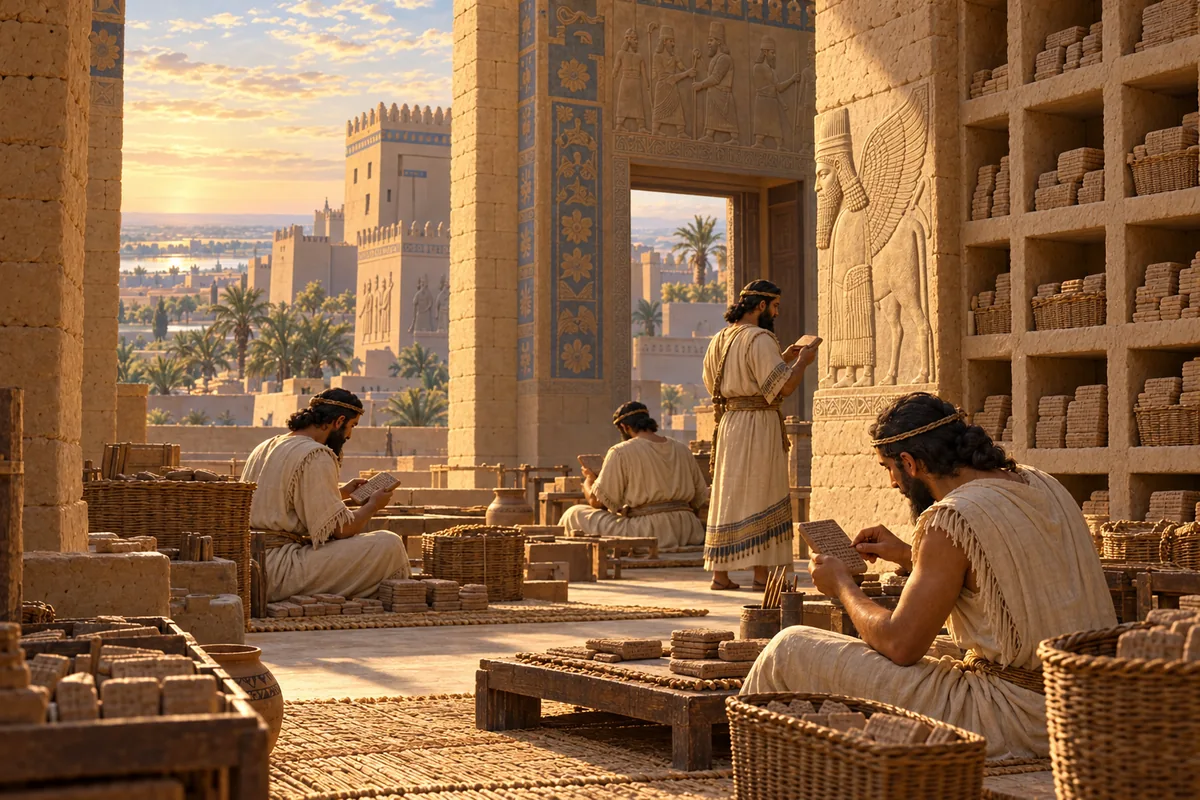
~730 BCE · Reconstructed composite — see ORACC entry for manuscript witnesses
SAA 19 114. Theft in the Palace (CTN 5 p. 232)
“(1) To the king, my lord: your servant Ašipâ. (3) Good health to the king, my lord! (5) The baker of the harem manageress came and told me: "A scepter, a chest, an iron brazier and a copper kettle have been stolen from the Palace and sold for money. (r 1) I sent word and those who sold the iron brazier for money were arrested. (r 5) I am herewith sending the informer to the king, my [lo]rd. Let [the king, my lo]rd, question him.”
Source: Luukko, M. 2012. The Correspondence of Tiglath-pileser III and Sargon II from Calah/Nimrud. SAA 19. Helsinki: Helsinki University Press. https://oracc.museum.upenn.edu/saao/saa19/P393652/
Read the full tablet entry~730 BCE · Reconstructed composite — see ORACC entry for manuscript witnesses
SAA 19 115. Fragment Mentioning Boats, Barley and Houses (CTN 5 p. 296)
“(Beginning destroyed) (3) [...... fr]om (4) [.....] their boats (5) As to what [the king, my lord], wrote to me: "Set out ...! (7) ... me ... (8) "whoever had set out (9) "...... (10) [...] boats [...] (11) [...] my [wat]ch [...] (12) [......] outside the city (13) [... ...]s [...] house[s] (14) [......] is/are lef[t] (Break) (r 1) [......] ... (r 2) [......] is not (r 3) [......] ...... (r 4) [...] ... [...] (r 5) [...] all [...] (r 6) [x] houses from Mazamua and three from Urzuhina have c[ome] to Sippar. They are picking up all of their barley [which] they left there. (r 12) [...] ...... [...] (r 13) [As to what the kin]g wrote to [me]: "...] (Rest destroyed)”
Source: Luukko, M. 2012. The Correspondence of Tiglath-pileser III and Sargon II from Calah/Nimrud. SAA 19. Helsinki: Helsinki University Press. https://oracc.museum.upenn.edu/saao/saa19/P224468/
Read the full tablet entry~730 BCE · Reconstructed composite — see ORACC entry for manuscript witnesses
SAA 19 116. Fragment Referring to Boats and River Transport (CTN 5 p. 243)
“(Beginning destroyed) (1) [Nabû-šarru-uṣur], the eunuch of the gov[ernor], the official in charge of the boats, will come with the boats where the king commands. (8) (Concerning the) four boats about which the king said: "You will b[ring] them to [t]his sid[e] (of the river) after [they have arrived]. (r 1) Nabû-šarru-[uṣur has (now) arrived saf]ely. (r 2) (It was) Gurali, a [serva]nt of Adasi who told (this). (r 5) [...] this news, (r 6) he holds l[and] (r 7) [......] of its side (r 8) I have spoken to him in this side (of the river). (r 9) He said that the workers (lit. “any single arm”) are far [from] the river. (r 11) The cornfield which is in [......] (Break) (e. 1) Should [the servants of the offic]ial (in charge of the boats) fetch [the boat]s [or] leave (them)?”
Source: Luukko, M. 2012. The Correspondence of Tiglath-pileser III and Sargon II from Calah/Nimrud. SAA 19. Helsinki: Helsinki University Press. https://oracc.museum.upenn.edu/saao/saa19/P224393/
Read the full tablet entry~730 BCE · Reconstructed composite — see ORACC entry for manuscript witnesses
SAA 19 117. Boats, Water-Skin Rafts, and Accusations (CTN 5 p. 86)
“(Beginning destroyed) (1) [......] who/which were plundered. P[N ...] (3) Nabû-ahu-iddina [......] (4) and Kudurru, the [......] (5) of the governor of [......] (6) boats together with those of G[N ...] (7) and 20 water-skin rafts [......] (8) with man[y] men [......] (9) after [he had arrived] safely (10) I appointed him as th[e ......] (11) which are in the quay of ships [...] (Break) (r 1) all the men [...] (r 2) I do not tel[l] to the king [...] (r 3) [...] have become available; who is taking [them] away? (r 4) And now [...] is blaming me and I have become an outcast [and ... on account…”
Source: Luukko, M. 2012. The Correspondence of Tiglath-pileser III and Sargon II from Calah/Nimrud. SAA 19. Helsinki: Helsinki University Press. https://oracc.museum.upenn.edu/saao/saa19/P393685/
Read the full tablet entry~730 BCE · Reconstructed composite — see ORACC entry for manuscript witnesses
SAA 19 118. Fragment Mentioning Balassu (CTN 5 p. 38)
“(Beginning destroyed) (13) [... ...] fort (14) [...] let the troops [...] (Break) (17) [...] did [n]ot obey [becau]se of [......] (18) [...]. Per[haps the ki]ng, my lord, will s[ay: “...] in [...] (20) [......]. As to [what the kin]g, [my] lo[rd, wrote to] me: “[......] (Break) (25) [... w]e will releas[e ...] (26) [...] kill [......] (Break) (r 6) [... the king], my lord, knows that [...] (r 7) [... s]ailed downstream. [Let ...] quickly [...] (r 8) staying [at yo]ur [disposal] ...[...] (r 9) [...] in the canal which [...] o[n ...] (r 10) [...] the terrain [...] the previous people (r 11)…”
Source: Luukko, M. 2012. The Correspondence of Tiglath-pileser III and Sargon II from Calah/Nimrud. SAA 19. Helsinki: Helsinki University Press. https://oracc.museum.upenn.edu/saao/saa19/P415762/
Read the full tablet entry~730 BCE · Reconstructed composite — see ORACC entry for manuscript witnesses
SAA 19 119. Wounded in a Campaign (CTN 5 p. 246)
“(1) [T]o the king, my lord: yo[ur] se[rvant] Mušezib-ilu. Good health to the king, my lord! (3) The Gambuleans were in Arrapha on the 3rd day. I was wounded in the military campaign and I am very ill. It is not possible for me to co[me] to the king, my lord. (8) At the moment I am laid up in the town Ša-Turmiš on the Za[b] river. The king, my lord, [knows] that I [... whatev]er Šarru-i[qb]i of Ša-Turm[iš] together with the heralds have taken. (13) If I write [...], I [...]. (14) [Perhaps the king], my lord, will say: "Is [it true] that they have sent [...] to [NN]?" The kin[g, my lord],…”
Source: Luukko, M. 2012. The Correspondence of Tiglath-pileser III and Sargon II from Calah/Nimrud. SAA 19. Helsinki: Helsinki University Press. https://oracc.museum.upenn.edu/saao/saa19/P393639/
Read the full tablet entry~730 BCE · Reconstructed composite — see ORACC entry for manuscript witnesses
SAA 19 120. Shipping Barley (CTN 5 p. 68)
“(1) [To the king, my lord: your servant M]ušez[ib-ilu. Good he]alth to the king, [my lord!] (4) [As to what the ki]n[g], my lord, wrote to me: "Do not pile up the rest of the barley until Abi-hari comes. Let him give it to you. Let Ahunu come here quickly [and] super[vise] the Itu'[eans]." (11) Ah[unu is departing] right now. For 20, 21 days [they have been] wa[iting for] the king my lord's [caravan], until A[bi-hari ......] (Break) (r 1) [The king, my lord], kno[ws that ...]. (r 2) I went t[o ... ......] but there was no shipment to the king, my [l]ord. Let me see the king [my] l[ord]'s…”
Source: Luukko, M. 2012. The Correspondence of Tiglath-pileser III and Sargon II from Calah/Nimrud. SAA 19. Helsinki: Helsinki University Press. https://oracc.museum.upenn.edu/saao/saa19/P393653/
Read the full tablet entry~730 BCE · Reconstructed composite — see ORACC entry for manuscript witnesses
SAA 19 121. Fragment Mentioning Mušezib-ilu (CTN 5 p. 249)
“(Beginning destroyed) (2) [... the ki]ng, my lord, sh[ould know ...] (3) [...] for nonsen[se ...] (4) [... be]fore me [was] not in the [...] (5) I did not provide [...]. I departed [...... with] my [boa]ts [(and) we]nt [to ...]. Mušezib-ilu [...] (8) [...]s in the well [...] (9) [......] not [...] (Rest destroyed)”
Source: Luukko, M. 2012. The Correspondence of Tiglath-pileser III and Sargon II from Calah/Nimrud. SAA 19. Helsinki: Helsinki University Press. https://oracc.museum.upenn.edu/saao/saa19/P393694/
Read the full tablet entry