Chapter 04 · 2112 – 2004 BCE
Ur III · Neo-Sumerian
A bureaucratic golden age, the Code of Ur-Nammu.
~2050 BCE · SI 344991l — Smithsonian Institution, Washington, DC, USA
Smithsonian 27
In plain English
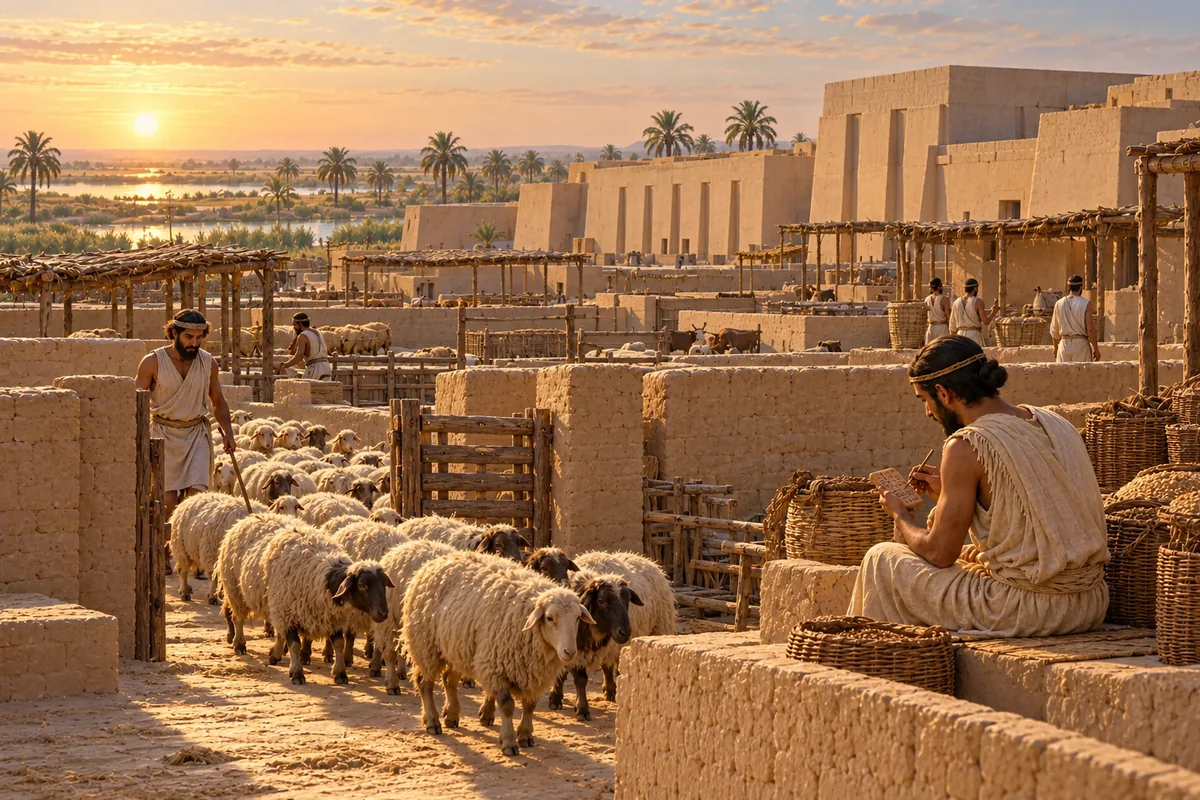
Work report: 500 sar of field were hoed at the standard rate of 5 sar per man per day, which comes to 100 workdays; that was in the Greater A'uda field. Another 1,395 sar were cleared of thornbushes at 15 sar per man per day, totaling 93 workdays, in the E-girgilu field. The oxen crews were supervised by Lugal-inim-gina, with Šara-kam as foreman. The account was certified under the seal of Da'aga, the scribe, son of Ur-geš-šaga, in the year the land of Zabšali was destroyed.
AI-generated reading paraphrase; compare with the translation below.
“500 sar (of field) hoed, at 5 sar (per workday) each — its labor: 100 days. Field: A'uda-gula ("Greater A'uda"). 1,395 sar of diḫ-thorns cut, at 15 sar (per workday) each — its labor: 93 days. Field: E-girgilu. Oxen overseer: Lugal-inim-gina. Foreman: Šara-kam. Sealed tablet of Da'aga. Year: "The land of Zabšali was destroyed." (Seal:) Da'aga, scribe, son of Ur-geš-šaga.”
Source: engine:claude-fable-5 (2026-07-12/v7-evolved) · claude-fable-5 · medium confidence
Read the full tablet entry~2050 BCE · BM 014923 — British Museum, London, UK
SNAT 185
In plain English
Inventory note, day 5 of the month Amar-a'asi. On hand: about 200 liters of groats, valued at roughly 133 1/3 liters of barley, and just over 700 liters of bran, valued at 140 liters of barley — total barley value: 273 1/3 liters. The goods are stored at ...-sabum, in the timber storehouse. Handled by Ur-Igalim and his brother Lu-Utu. Filed in the year the high priestess of Inanna was chosen by omen — Ibbi-Suen's second year on the throne.
AI-generated reading paraphrase; compare with the translation below.
“3 barig 2 ban of groats (milled grain), its barley (equivalent): 2 barig 1 ban 3 1/3 sila; 2 gur 1 barig 4 ban of ... bran, its barley (equivalent): 2 barig 2 ban; (total:) 4 barig 3 ban 3 1/3 sila, in ...-sabum, in the timber storehouse; conveyor: Ur-Igalim and Lu-Utu, his brother. Month: Amar-a'asi; year: "The en-priest(ess) of Inanna was chosen by means of the (omen-)kid." The 5th day.”
Source: engine:claude-fable-5 (2026-07-12/v7-evolved) · claude-fable-5 · medium confidence
Read the full tablet entry~2050 BCE · BM 012477 — British Museum, London, UK
SNAT 236
In plain English
This is an IOU: one-third of a shekel of silver, covering the wages of Ur-Ningešzida, charged to the account of Ur-Ningešzida the smith. Ur-Ningešzida the leatherworker has put his seal on the document, and the money is due back by the new moon. Filed under wages, in the harvest month. The tablet then repeats the same terms — a third-shekel of silver, the smith's wages, the leatherworker's seal, repayment by the new moon — before a couple of signs too damaged to read. The seal impression identifies the guarantor: Ur-Ningešzida the leatherworker, son of Ur-E.
AI-generated reading paraphrase; compare with the translation below.
“One-third (shekel) of sil[ver], the wages of Ur-Ningešzida — in the name of Ur-Ningešzida, the smith; sealed tablet of Ur-Ningešzida, the leatherworker. It is to be repaid by the new moon. Wages. Month: "Harvest" (še-sag-ku). [One-third (shekel) of silver], [the wages of Ur]-Ningešzida, the smith — [in the name of Ur-Nin]gešzida, the smith; sealed tablet of Ur-Ningešzida, the leatherworker. It is to be repaid by the new moon. ... (two signs illegible) [...] (Seal:) Ur-Ningešzida, the leatherworker, son of Ur-E(?).”
Source: engine:claude-fable-5 (2026-07-12/v7-evolved) · claude-fable-5 · medium confidence
Read the full tablet entry~2050 BCE · BM 012282 — British Museum, London, UK
SNAT 258
In plain English
Ahum-beli signed for a delivery of 34 gur and 1 ban of fresh fish (over 10,000 liters by the official royal measure), earmarked as rations for the women weavers of Girsu. A second, smaller lot — 6 gur, 3 barig, and 2 ban — went to the weavers who worked for the high priestess of the goddess Baba; the weaver women took receipt of it directly from a man named La'a. Filed in the barley-harvest month of the year the king's army destroyed the city of Huhnuri — the seventh year of Amar-Sin's reign.
AI-generated reading paraphrase; compare with the translation below.
“34 gur 1 ban of fresh fish, (measured by) the royal gur — of this fish, (that destined for) the female weavers of Girsu, Ahum-beli received; 6 gur 3 barig 2 ban, (for) the female weavers of the nin-dingir priestess of Baba — from La'a the female weavers received it. Month: "Barley harvest" (še-sag-ku). Year: "Huhnuri was destroyed" (= Amar-Sin, year 7, ca. 2040 BCE).”
Source: engine:claude-fable-5 (2026-07-12/v7-evolved) · claude-fable-5 · medium confidence
Read the full tablet entry~2050 BCE · Reconstructed composite — see ORACC entry for manuscript witnesses
Šu-Suen 01
“(ii 7) In support of Šu-Suen, the powerful king, king of Urim, king of the four quarters, Enlil installed Inana as his own helper, and both of them descended from the sky to his right and left.”
Source: Electronic Text Corpus of Sumerian Royal Inscriptions (ETCSRI), University of Vienna, edited by Gábor Zólyomi et al. https://oracc.museum.upenn.edu/etcsri/Q000991/
Read the full tablet entry~2050 BCE · Reconstructed composite — see ORACC entry for manuscript witnesses
Šu-Suen 03
Records Šu-Suen's systematic disposal of conquered populations — blinded men assigned to temple orchards, women to textile mills — documenting the Ur III state's institutionalised exploitation of war captives as temple labour.
“(i 1) For Enlil, the king of all lands, his master. (iv 2) Even the young men who evaded the battle and took refuge like birds in their cities could not escape his hand. He shrieked at their cities like an Anzu-bird. He reduced their cities and settlements to ruin mounds. He destroyed their walls completely. (iv 15) He blinded all the young men of the cities he had conquered, and made them serve in the orchards of Enlil and Ninlil and in the orchards of the great gods. (iv 23) He presented the female workers of the cities he conquered to the textile mills of Enlil and Ninlil and to the…”
Source: Electronic Text Corpus of Sumerian Royal Inscriptions (ETCSRI), University of Vienna, edited by Gábor Zólyomi et al. https://oracc.museum.upenn.edu/etcsri/Q000992/
Read the full tablet entry~2050 BCE · Reconstructed composite — see ORACC entry for manuscript witnesses
Šu-Suen 06
“(1') When he conquered the land of Zabšali and the (other) Šimaškian lands, then for ..., ..., the powerful king, king of Urim, king of the four quarters, fashioned an image of the billy goat brought to him as a diplomatic gift of Anšan. He dedicated it to him for his well-being.”
Source: Electronic Text Corpus of Sumerian Royal Inscriptions (ETCSRI), University of Vienna, edited by Gábor Zólyomi et al. https://oracc.museum.upenn.edu/etcsri/Q001813/
Read the full tablet entry~2050 BCE · Reconstructed composite — see ORACC entry for manuscript witnesses
Šu-Suen 07
“(shoulder 1) Šu-Suen, the beloved of Enlil, the king whom Enlil chose in his heart, the powerful king, king of Urim, king of the four quarters, dedicated this (statue) for his well being. (colophon 1, 1) Inscription, right shoulder, stone statue. (socle 1) 2 sila of bread, 2 sila of date-syrup, 1 sila of liquor, 1 sila of beer, one cut of meat, as monthly food offering from the table of Enlil, my master; 1 ..., 1 sila of good oil, as monthly food offering from the temple of Ninlil, my lady, was assigned by Šu-Suen, the beloved of Enlil, the king whom Enlil chose in his heart, the powerful…”
Source: Electronic Text Corpus of Sumerian Royal Inscriptions (ETCSRI), University of Vienna, edited by Gábor Zólyomi et al. https://oracc.museum.upenn.edu/etcsri/Q000994/
Read the full tablet entry