Chapter 05 · 2000 – 1600 BCE
Old Babylonian
Hammurabi, the Epic of Gilgamesh, mathematics.
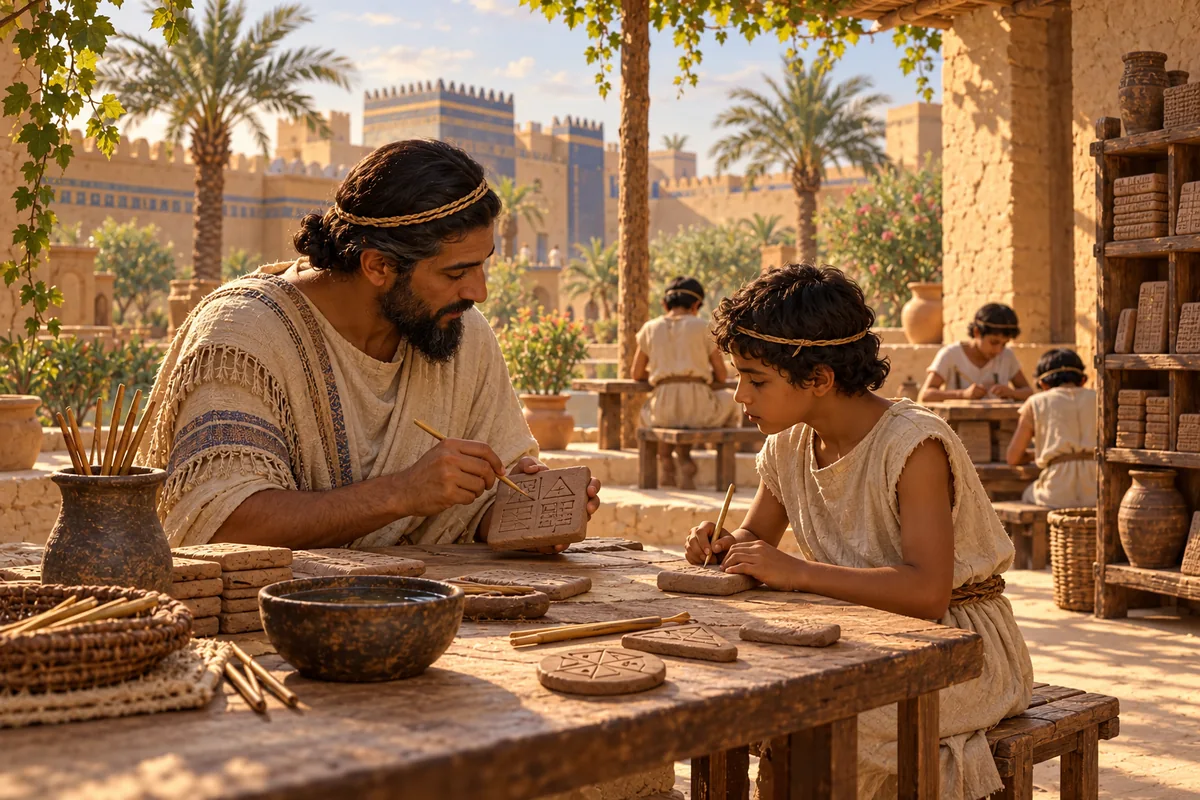
~1900 BCE · Reconstructed composite — see ORACC entry for manuscript witnesses
Šamši-Adad I 2022
“(1) Kunnat[um], son of Mezi..., servant of Šamšī-Adad (I).”
Source: Royal Inscriptions of Assyria online (RIAo), Munich Open-access Cuneiform Corpus Initiative (MOCCI), Ludwig-Maximilians-Universität München; in association with the RINAP Project, University of Pennsylvania. https://oracc.museum.upenn.edu/riao/Q005679/
Read the full tablet entry~1900 BCE · Reconstructed composite — see ORACC entry for manuscript witnesses
Šamši-Adad I 2023
“(1) Samiya, son of Ḫani-m[alik], servant of Šamš[ī-Adad (I)].”
Source: Royal Inscriptions of Assyria online (RIAo), Munich Open-access Cuneiform Corpus Initiative (MOCCI), Ludwig-Maximilians-Universität München; in association with the RINAP Project, University of Pennsylvania. https://oracc.museum.upenn.edu/riao/Q005680/
Read the full tablet entry~1850 BCE · Reconstructed composite — see ORACC entry for manuscript witnesses
Abi-sare 2005 / CDLI Seals 012800 (CDLI Seals 012800 (composite))
In plain English
A scribe — whose name is lost — son of Lu-Ninšubur, the temple administrator of Ningal, is recorded here as a slave belonging to Abi-sare.
AI-generated reading paraphrase; compare with the translation below.
“(1) ..., the scribe, child of Lu-Ninšubur, the temple administrator of Ningal, is the slave of Abi-sare.”
Source: Electronic Text Corpus of Sumerian Royal Inscriptions (ETCSRI), University of Vienna, edited by Gábor Zólyomi et al. https://oracc.museum.upenn.edu/etcsri/Q002028/
Read the full tablet entry~1850 BCE · Reconstructed composite — see ORACC entry for manuscript witnesses
Abi-sare 2006 / CDLI Seals 012801 (CDLI Seals 012801 (composite))
In plain English
The seal records its owner as Lugal-šuba, a scribe and son of Ur-dukuga, who was a slave of Abi-sare.
AI-generated reading paraphrase; compare with the translation below.
“(1) Lugal-šuba, the scribe, child of Ur-dukuga, the slave of Abi-sare.”
Source: Electronic Text Corpus of Sumerian Royal Inscriptions (ETCSRI), University of Vienna, edited by Gábor Zólyomi et al. https://oracc.museum.upenn.edu/etcsri/Q002029/
Read the full tablet entry~1850 BCE · Reconstructed composite — see ORACC entry for manuscript witnesses
Abi-sare 3add
In plain English
Abi-sare, the powerful man and king of Ur, built and restored the city wall of Iškun-Suen as an offering to his master, the god Nanna.
AI-generated reading paraphrase; compare with the translation below.
“(1) For Nanna, his master, Abi-sare, the powerful man, king of Urim, built and restored the city wall of Iškun-Suen.”
Source: Electronic Text Corpus of Sumerian Royal Inscriptions (ETCSRI), University of Vienna, edited by Gábor Zólyomi et al. https://oracc.museum.upenn.edu/etcsri/Q005032/
Read the full tablet entry~1850 BCE · Reconstructed composite — see ORACC entry for manuscript witnesses
Gungunum 1
Attests an en priestess of Nanna — a royal cultic office held by a king's daughter — dedicating a storehouse to Dagan in her own name, linking Gungunum's Ur III dynasty to both lunar and grain-god patronage.
“(1) For Dagan, the lord of the great gods, her personal god, En-ana-tuma, the beloved en priestess of Nanna in Urim, child of Išme-Dagan, king of Sumer and Akkad, built the E-eš-medaĝala, her holy storehouse, and dedicated it to him for the well-being of Gungunum, the powerful man, king of Urim and for her (own) well-being.”
Source: Electronic Text Corpus of Sumerian Royal Inscriptions (ETCSRI), University of Vienna, edited by Gábor Zólyomi et al. https://oracc.museum.upenn.edu/etcsri/Q002014/
Read the full tablet entry~1850 BCE · Reconstructed composite — see ORACC entry for manuscript witnesses
Gungunum 2
“(1) For Utu, the offspring of Nanna, the heir of the E-kišnuĝal, who was born by Ningal, his master, En-ana-tuma, the zirru priestess, the en priestess of Nanna in Urim, child of Išme-Dagan, king of Sumer and Akkad, built his E-hili, built his holy storehouse, and dedicated it to him for the well-being of Gungunum, the powerful man, king of Urim, and for her (own) well-being.”
Source: Electronic Text Corpus of Sumerian Royal Inscriptions (ETCSRI), University of Vienna, edited by Gábor Zólyomi et al. https://oracc.museum.upenn.edu/etcsri/Q002015/
Read the full tablet entry~1850 BCE · Reconstructed composite — see ORACC entry for manuscript witnesses
Gungunum 3
“(1) Gungunum, king of Larsa, king of Sumer and Akkad, the powerful heir of Samium, fashioned both the bricks and the walls of the great wall of Larsa, its name is “Utu is the vanquisher of the rebellious lands”, in a single year.”
Source: Electronic Text Corpus of Sumerian Royal Inscriptions (ETCSRI), University of Vienna, edited by Gábor Zólyomi et al. https://oracc.museum.upenn.edu/etcsri/Q002016/
Read the full tablet entry