Chapter 07 · 911 – 609 BCE
Neo-Assyrian
Empire, library, terror, scholarship.
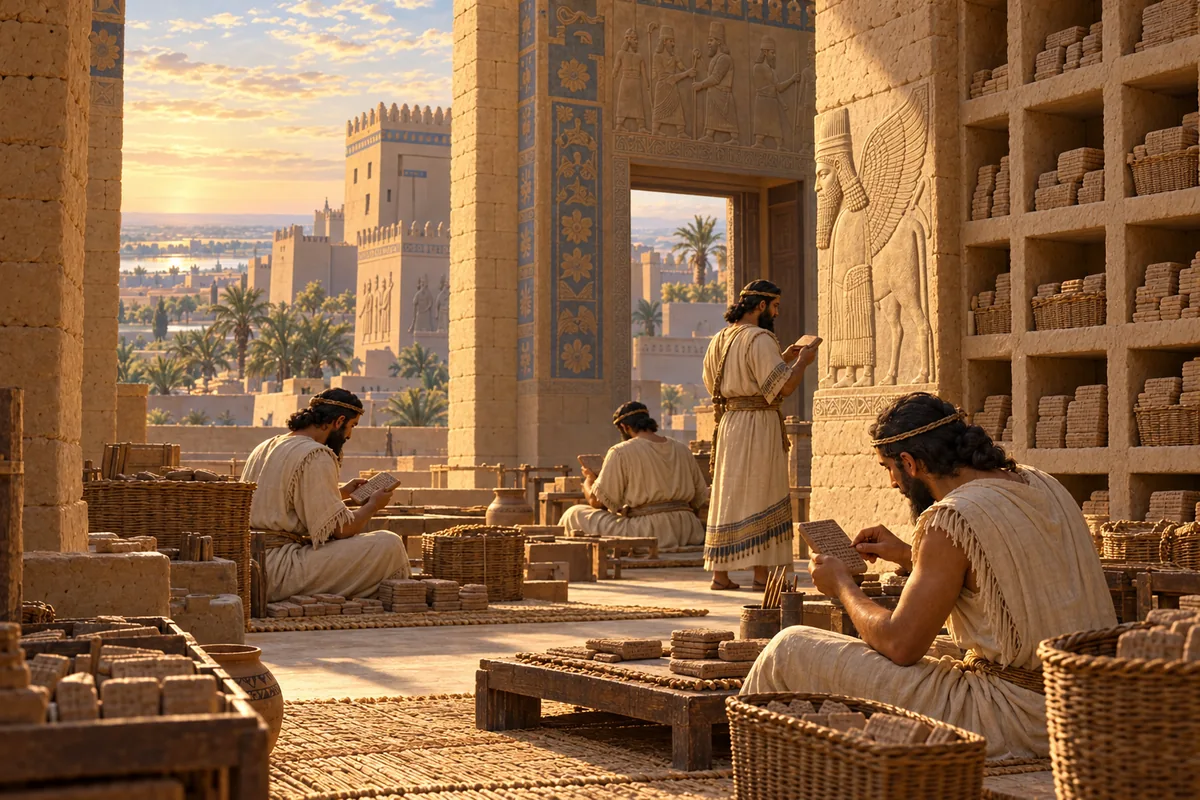
~730 BCE · Reconstructed composite — see ORACC entry for manuscript witnesses
SAA 19 163. Bringing Money into the New Palace (CTN 5 p. 227)
“(1) To the king, my lord: your servant Mannu-ki-Nergal. (3) On the 22nd of Marchesvan (VIII) I brought the money into the New Palace and put it into a cedar (box). The (royal) signet ring and the land are well.”
Source: Luukko, M. 2012. The Correspondence of Tiglath-pileser III and Sargon II from Calah/Nimrud. SAA 19. Helsinki: Helsinki University Press. https://oracc.museum.upenn.edu/saao/saa19/P224443/
Read the full tablet entry~730 BCE · Reconstructed composite — see ORACC entry for manuscript witnesses
SAA 19 164. Guards are Appointed (CTN 5 p. 97)
“(1) To the king, my lord: your servant Aššur-nirka-da''in. Good health to the king, my lord! May Aššur (and) Mullissu bless the king, my lord. (5) As to what the king, my lord, wrote to me: "A [ca]ravan of 1,000 has come up; (7) "[......]. Perhaps (8) [......] I have crossed [the rive]r (9) [......] two days (10) [......] orchards (Break) (r 3) [......] the messenger (r 4) [......] of the villages (r 5) all the [availab]le riding horses and every single Aramean – I have appointed the guards from the town of Adad as far as the town of Uqimutaya. (r 8) I am returning, and (after) I have…”
Source: Luukko, M. 2012. The Correspondence of Tiglath-pileser III and Sargon II from Calah/Nimrud. SAA 19. Helsinki: Helsinki University Press. https://oracc.museum.upenn.edu/saao/saa19/P393662/
Read the full tablet entry~730 BCE · Reconstructed composite — see ORACC entry for manuscript witnesses
SAA 19 165. Aššur-nirka-da’’in in Trouble (CTN 5 p. 289)
“(1) [A tab]let of Aššur-nirka-da''in to [m]y brot[her] Nabû-nammir. The [b]est of heal[th] to my brother! (4) The thing is: Yo[u] know that my family is fr[om the king] (and) the commander-in-chief, whom he (the king) entrusted into the service of Dayan-Adad in the Fortress, saying: "If he proves loyal in your service, return him." He has been having me as his delegate in the town Sahiru. (10) [H]e is now selling the household of Dayan-[A]dad at my di[sp]osal and all the cities of the king that are at [my] disposal, the horses that [... and] the flo[cks of sheep]. (16) All the hors[es and…”
Source: Luukko, M. 2012. The Correspondence of Tiglath-pileser III and Sargon II from Calah/Nimrud. SAA 19. Helsinki: Helsinki University Press. https://oracc.museum.upenn.edu/saao/saa19/P224461/
Read the full tablet entry~730 BCE · Reconstructed composite — see ORACC entry for manuscript witnesses
SAA 19 166. Excellent Harvest but Fodder Stolen (CTN 5 p. 197)
“(Beginning destroyed) (2) It rained [extre]mely heavily [on the nig]ht of the 27th until the daybreak, the whole day on the 27th and the whole night on the night of the 28th. [The r]ain poured down very [mu]ch water, the amount [o]f water is great indeed. The harvest will be excellent. (r 1) [...]qu has come and taken fo[dder from] the fodder and [...] stores. He took once when I was in the king my lord's presence in Arbela, and now he has done it again and taken it for the second time! (r 8) (Concerning) Aššur-naṣir, Ammi-[ha]tî (and) Bel-apkal-ilani, total three recruitment officers, about…”
Source: Luukko, M. 2012. The Correspondence of Tiglath-pileser III and Sargon II from Calah/Nimrud. SAA 19. Helsinki: Helsinki University Press. https://oracc.museum.upenn.edu/saao/saa19/P393673/
Read the full tablet entry~730 BCE · Reconstructed composite — see ORACC entry for manuscript witnesses
SAA 19 167. Dying of Hunger (CTN 5 p. 224)
“(Beginning destroyed) (1) [The king, my lord], gave pa[ck animals] into my care but I am not able to take care of them; they will die o[f hu]nger. (5) I have used up the gr[ain ratio]ns that the king, my lord, gave me, having giv[en] them [to] the local people, the specialists in the service of the treasurer and the quartermaster corps of the P[alace]. (r 3) I can give out one homer of barley, but the king, my lord, knows what the governor of Arbela can [affo]rd. (r 6) The Hindareans (and) [the H]atalleans [...] (r 8) Ki[...] (Rest destroyed)”
Source: Luukko, M. 2012. The Correspondence of Tiglath-pileser III and Sargon II from Calah/Nimrud. SAA 19. Helsinki: Helsinki University Press. https://oracc.museum.upenn.edu/saao/saa19/P393664/
Read the full tablet entry~730 BCE · Reconstructed composite — see ORACC entry for manuscript witnesses
SAA 19 169. King of Karalla Bringing Tribute to Calah (CTN 5 p. 139)
“(1) To the king, my lord: your servant Ah-abi. Good health to the king, my lord! (4) Concerning the king of Karalla to whom the king sent me, he entered Kilizi on the 22nd and will enter Calah on the 23rd. He has his tribute with him. (r 1) Perhaps my lord will say: "Why didn't the bodyguard proceed here in advance?" He is helping him across the river, thereupon he will proceed here.”
Source: Luukko, M. 2012. The Correspondence of Tiglath-pileser III and Sargon II from Calah/Nimrud. SAA 19. Helsinki: Helsinki University Press. https://oracc.museum.upenn.edu/saao/saa19/P224460/
Read the full tablet entry~730 BCE · Reconstructed composite — see ORACC entry for manuscript witnesses
SAA 19 170. Raising Food and Fodder from Desert Towns (CTN 5 p. 173; SAA 01 172)
“(1) To [the king, my lord: yo]ur servant [Bel-duri]. (3) The king, my lord, [gave orders]: "[All] gover[nors] may raise food and fodder from [Šamaš]-a[hu-idd]ina with you, and Adad-issiya (and) Bel-lešir are to support Abi-lešir!" (9) They have not agreed to this though, but are disobedient, saying: "Why should our villages in the desert belong to all the governors? The villages are ... within each other!" (13) The king, my lord, should sent word that they are to write down their desert villages. Ever since the king my lord has levied pack animals from Hamath, I have been on my own, and he (=…”
Source: Luukko, M. 2012. The Correspondence of Tiglath-pileser III and Sargon II from Calah/Nimrud. SAA 19. Helsinki: Helsinki University Press. https://oracc.museum.upenn.edu/saao/saa19/X190170/
Read the full tablet entry~730 BCE · Reconstructed composite — see ORACC entry for manuscript witnesses
SAA 19 171. Reclaiming Runaway Servants (CTN 5 p. 227)
“(1) To the king, my lord: your servant Bel-duri. (3) The king [install]ed Ilu-mušezib, a baker of Bel-emuranni, in Hatarikka. When the king [pas]sed by, Ku[baba]-ereš a (member) of his community and the (members) of the community of his relatives made him r[u]n away. They should make inquiries and return the man to me. (14) When there was an [ep]idemic here, Ilu-bi'di a cohort commander under my jurisdiction killed a horse. I made up for the horse in his stead and he promised: "I'll give you money." (Now this) Ilu-bi'di has died; his wife, has married ..., a young boy, and that person has…”
Source: Luukko, M. 2012. The Correspondence of Tiglath-pileser III and Sargon II from Calah/Nimrud. SAA 19. Helsinki: Helsinki University Press. https://oracc.museum.upenn.edu/saao/saa19/X190171/
Read the full tablet entry