Chapter 07 · 911 – 609 BCE
Neo-Assyrian
Empire, library, terror, scholarship.
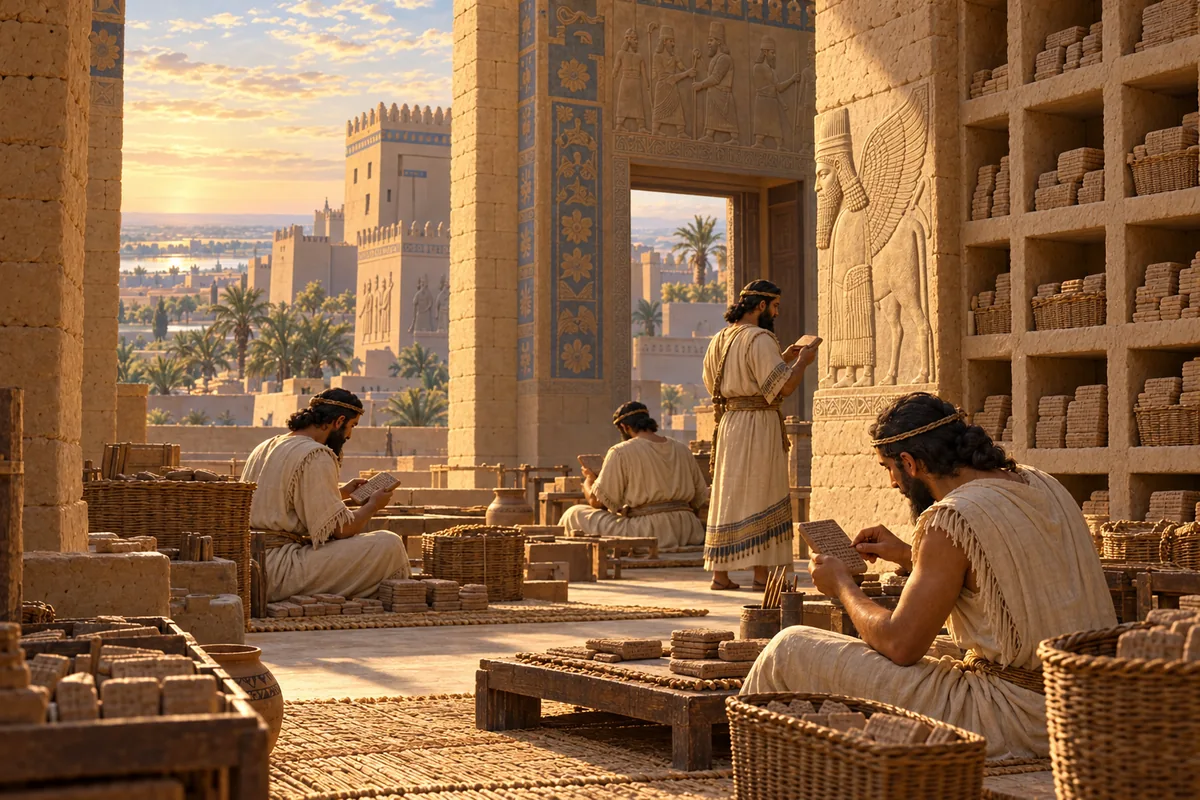
~730 BCE · Reconstructed composite — see ORACC entry for manuscript witnesses
SAA 19 074. The Major-Domo of Aššur-le’i in Birdunu (CTN 5 p. 115)
“(1) [To the ki]ng, my lord: your [ser]vant Aššur-le'i. (3) The major-domo has come and entered Birdunu. (6) All the vast troops who escaped have not yet even minimally come together, so we are not able to se[nd] details of how many were killed or taken prisoners. (13) The messenger of the king, my [lor]d [is in the presence of] Inurta-ila'i [......] (Rest destroyed or too broken for translation)”
Source: Luukko, M. 2012. The Correspondence of Tiglath-pileser III and Sargon II from Calah/Nimrud. SAA 19. Helsinki: Helsinki University Press. https://oracc.museum.upenn.edu/saao/saa19/P393633/
Read the full tablet entry~730 BCE · Reconstructed composite — see ORACC entry for manuscript witnesses
SAA 19 075. Business with Kummeans (CTN 5 p. 251)
“(1) T[o the king, my lord]: yo[ur] servant [NN]. Good [he]alth t[o the king, my lord]! (4) (As to) the silver which the ki[ng], my lord, gave me, saying: "[... ...] to the Kummaean!" (9) I returned [x] men to their country [according] to their wish, and (after that) [x] men [r]emained. I have sent them with the royal bodyguard to the king, my lord.”
Source: Luukko, M. 2012. The Correspondence of Tiglath-pileser III and Sargon II from Calah/Nimrud. SAA 19. Helsinki: Helsinki University Press. https://oracc.museum.upenn.edu/saao/saa19/P224380/
Read the full tablet entry~730 BCE · Reconstructed composite — see ORACC entry for manuscript witnesses
SAA 19 076. “Aššur and Šamaš Will Deliver Ṭurušpa into the King’s Hands” (CTN 5 p. 136)
“(1) To the king, my lord: your servant [Aššu]r-belu-[...]. The very best of health t[o the kin]g, [my lord]! (4) This month the ki[n]g, my lord, will go up to Urarṭu! Aššur (and) Šamaš have delivered Ṭurušpâ into the hands of the king, my lord! (7) Let the king, my lord, launch his military campaign against Urarṭu, conquer Ṭurušpâ and let the king, my lord, estab[li]sh his name for[e]ver. (10) Perhaps the king, my lord, will retrieve and give back the ruins of [...]. (12) I have rece[iv]ed the sealed letter which the [k]ing, my lord, sen[t] to me, and I have g[one and] asked Par[n]i-aldê…”
Source: Luukko, M. 2012. The Correspondence of Tiglath-pileser III and Sargon II from Calah/Nimrud. SAA 19. Helsinki: Helsinki University Press. https://oracc.museum.upenn.edu/saao/saa19/P224457/
Read the full tablet entry~730 BCE · Reconstructed composite — see ORACC entry for manuscript witnesses
SAA 19 077. Itu’eans Requested (CTN 5 p. 136)
“(Obv. too broken for translation) (r 2) to the k[ing, my lord ...] (r 3) As to [the chief cupbearer, to whom] the Šub[ri]an [had written]: "[Send] 300 [It]u'eans!", the chief cupbearer w[rote to me ...]: "The Šubrian has writ[ten] that I should send him 300 [It]u'eans." (r 9) I wrote to the chief [cu]pbe[arer] as follows: "Write to the Šubrian like this: "Instead of requesting Itu’eans from me, send (them) to me, and (then) I will come." (r 15) Perhaps the king, my lord, will say: "Is there any enemy?" There is no enemy at all. (r 17) The king has much delayed answering me. Let me come to the…”
Source: Luukko, M. 2012. The Correspondence of Tiglath-pileser III and Sargon II from Calah/Nimrud. SAA 19. Helsinki: Helsinki University Press. https://oracc.museum.upenn.edu/saao/saa19/P224429/
Read the full tablet entry~730 BCE · Reconstructed composite — see ORACC entry for manuscript witnesses
SAA 19 078. Report on a Vassal King(?) (CTN 5 p. 201)
“(1) [To the king], my lord: [your servant NN]. (2) [They] bles[s] the ki[ng], my [lo]rd, saying: "[...... DN] will make the king, my lord, live forever. (6) The ... wrote (to me), saying: "my [...] (8) [......] the kin[g], my lord (Break) (r 1) [As t]o [..., about wh]om the king, my lord, wro[te to me]: "Find out what is the news about him and write it to me." (r 4) He is in his country and does his work. His whole country is quiet; they are doing their work. His men are doing work in the fort.”
Source: Luukko, M. 2012. The Correspondence of Tiglath-pileser III and Sargon II from Calah/Nimrud. SAA 19. Helsinki: Helsinki University Press. https://oracc.museum.upenn.edu/saao/saa19/P224477/
Read the full tablet entry~730 BCE · Reconstructed composite — see ORACC entry for manuscript witnesses
SAA 19 079. Fragment by Nabu-šumu-iškun (CTN 5 p. 202)
“(1) T[o the kin]g, my lord: your servant Nabû-šumu-iškun. (3) The very best of health to the king, my lord! The forts [of the ki]ng, [my lord], are well (Rest destroyed)”
Source: Luukko, M. 2012. The Correspondence of Tiglath-pileser III and Sargon II from Calah/Nimrud. SAA 19. Helsinki: Helsinki University Press. https://oracc.museum.upenn.edu/saao/saa19/P224479/
Read the full tablet entry~730 BCE · Reconstructed composite — see ORACC entry for manuscript witnesses
SAA 19 080. Mukin-zeri and his Son Šumu-ukin Have Been Killed (CTN 5 p. 45)
“(1) To the king, m[y] lord: your servant Aššur-šallimann[i]. Good health to the kin[g, my lord]! (4) We got together on the 26th, stood in the presence of the commander-in-chief and gave orders to one another. We arrived within the (city) gates and inflicted a defeat: Mukin-zeri has been killed and Šumu-ukin, his son, has also been killed. The city is conquered. The king, my lord, can be glad. (13) The king, my lord, should wait for our messenger, until our messenger comes. Only thereupon should the king, [my] lo[rd], come. (r 1) Perhaps the king, [my] lord, will say: "Did they kill (people)…”
Source: Luukko, M. 2012. The Correspondence of Tiglath-pileser III and Sargon II from Calah/Nimrud. SAA 19. Helsinki: Helsinki University Press. https://oracc.museum.upenn.edu/saao/saa19/P393635/
Read the full tablet entry~730 BCE · Reconstructed composite — see ORACC entry for manuscript witnesses
SAA 19 081. Barley for Captives (CTN 5 p. 49)
“(1) To the king, my lord: your servant Aššur-šallimanni. Good health to the king, my lord! (4) As to what I wrote to the king, my lord: "I shall be late as I am assembling the people wherever they are." I have (now) asked the sheikhs, and they told me: "Not a single one is left. These are all there are." (10) Now the sheikhs are coming; let the king, my lord, ask the[m]! (12) Rema[n]ni-[Is]sar came up and met us along the stretch that leads to Ka[r]-Aššur. (16) As to what the king, my l[o]rd, wrote to me: "Feed the 6,000 captives in your presence." (19) For how long? (They are) 6,000! Can I…”
Source: Luukko, M. 2012. The Correspondence of Tiglath-pileser III and Sargon II from Calah/Nimrud. SAA 19. Helsinki: Helsinki University Press. https://oracc.museum.upenn.edu/saao/saa19/P224441/
Read the full tablet entry