Chapter 07 · 911 – 609 BCE
Neo-Assyrian
Empire, library, terror, scholarship.
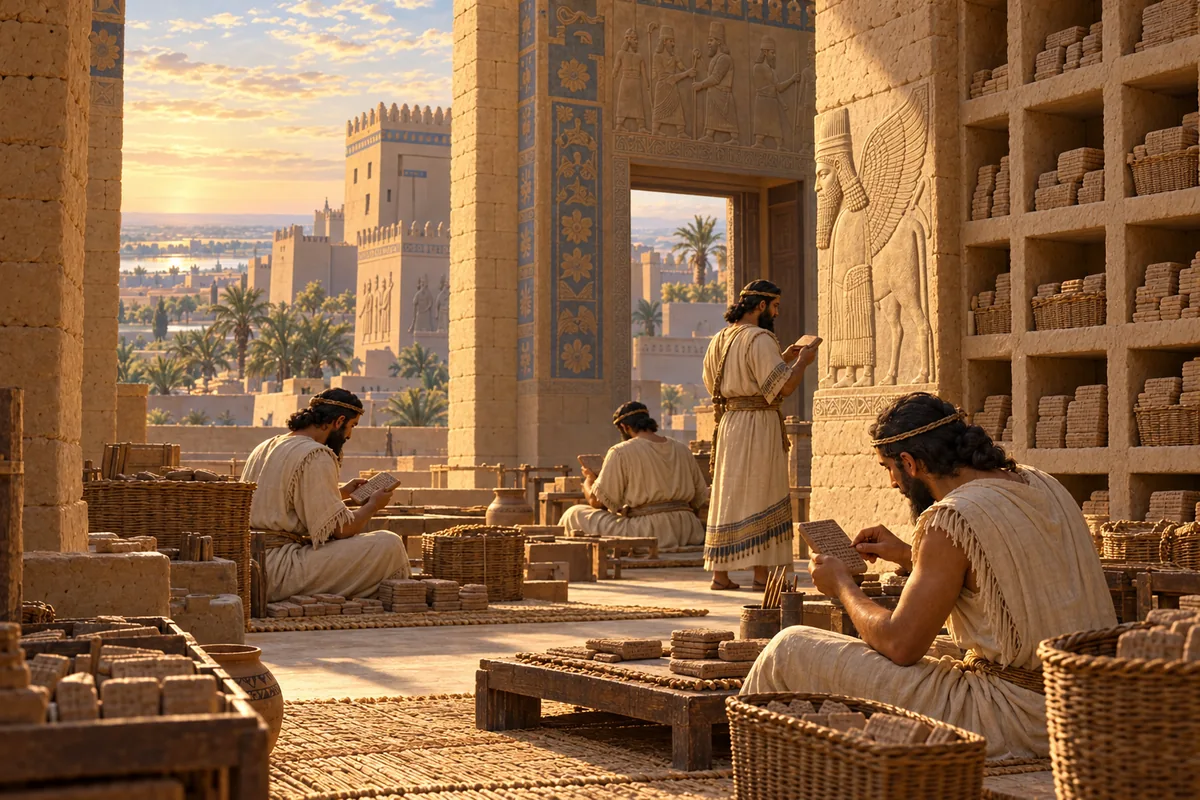
~715 BCE · Reconstructed composite — see ORACC entry for manuscript witnesses
SAA 15 105. Horses and Recruitment Officers of Calah (ABL 0127)
In plain English
To His Majesty, from your servant Mannu-ki-Ninua: greetings and good health to the king, my lord. Please have a royal bodyguard assigned to supervise the scribe and the recruiting officers, and have them muster their men and turn them over. The king knows that the horses I had have died; please send me, urgently, one riding horse each from their stock, to be at my disposal. As for the dependents who came with me, I have handed them over to the recruiting officers. If the king wishes to take them in hand, they are with the recruiting officers at Calah.
AI-generated reading paraphrase; compare with the translation below.
“To the king, my lord: your servant Mannu-ki-Ninua. Good health to the king, my lord! Let them appoint a royal bodyguard (qurbūtu) to oversee the scribe and the recruitment officers; let them raise their troops and hand them over. The king, my lord, knows that the horses which were at my disposal are dead. Let the king quickly send me one riding horse each of theirs, to be at my disposal. The tarbiānu (household dependents) who came with me — I have assigned them to the recruitment officers. If the king, my lord, would take charge of them: they are with the recruitment officers in Calah (Kalḫu).”
Source: engine:claude-opus-5 (2026-07-12/v7-evolved) · claude-opus-5 · medium confidence
Read the full tablet entry~715 BCE · Reconstructed composite — see ORACC entry for manuscript witnesses
SAA 15 106. A Carpenter of Kar-Šarrukin (ABL 1045)
“(Beginning destroyed) (2) [......] they call him (3) [...... in ch]arge of Gadyâ (4) [......] of Kar-Šarrukin (5) [......] saying, "Where (6) [...] he is [... o]f the Palace (7) [......] has not entered (Break) (r 2) [......] (he) is a carpenter instead of (r 3) [...... de]portees from Til-Barsip (r 4) [......] before (r 5) [...] he is [...] (r 6) [......] Šulmu-bel-ašme (r 7) [......] seized (Rest destroyed)”
Source: Fuchs, A. & Parpola, S. 2001. The Correspondence of Sargon II, Part III: Letters from Babylonia and the Eastern Provinces. SAA 15. Helsinki: Helsinki University Press. https://oracc.museum.upenn.edu/saao/saa15/P334696/
Read the full tablet entry~715 BCE · Reconstructed composite — see ORACC entry for manuscript witnesses
SAA 15 107. The Work Assignment of Mannu-ki-Ninua (CT 53 392)
“(Beginning destroyed) (1) I raised my (own) bricks which [...], went away, took over the work assignment of Mannu-ki-Ninua, 100 [brick courses], and shall finish bricking it up. (r 2) The king, [my] lo[rd ...] the work assignme[nt ...] (Rest destroyed)”
Source: Fuchs, A. & Parpola, S. 2001. The Correspondence of Sargon II, Part III: Letters from Babylonia and the Eastern Provinces. SAA 15. Helsinki: Helsinki University Press. https://oracc.museum.upenn.edu/saao/saa15/P313806/
Read the full tablet entry~715 BCE · Reconstructed composite — see ORACC entry for manuscript witnesses
SAA 15 108. There are no Logs There (CT 53 066)
“(Beginning destroyed) (1) [...] their [... which] they desire, nothing at all; they had [not] brought them. (4) I did the king's work there. [...] the king, my lord, watched me and sent a [body]guard, saying: "Let him go and get the logs." Yet there are no logs there! (9) By the gods of the king, my lord, there are no logs, I am not hiding any from the king, my lord! (Rest destroyed or too broken for translation)”
Source: Fuchs, A. & Parpola, S. 2001. The Correspondence of Sargon II, Part III: Letters from Babylonia and the Eastern Provinces. SAA 15. Helsinki: Helsinki University Press. https://oracc.museum.upenn.edu/saao/saa15/P313481/
Read the full tablet entry~715 BCE · Reconstructed composite — see ORACC entry for manuscript witnesses
SAA 15 109. Fragment Concerning Spoils and Tribute Horses (CT 53 315)
“(Beginning destroyed) (r 2) [...] lai[d down] (r 3) [... o]f the spoils (r 4) [... of s]ilver upon a ...[...] (r 5) [...] ...[...] (r 6) [...] the exit [...] (r 7) [...] you go out [......] (r 8) Concerning the [tri]bute horse[s] about which the king, my lord, [wrote to me], the king, my lord [...] (Rest destroyed)”
Source: Fuchs, A. & Parpola, S. 2001. The Correspondence of Sargon II, Part III: Letters from Babylonia and the Eastern Provinces. SAA 15. Helsinki: Helsinki University Press. https://oracc.museum.upenn.edu/saao/saa15/P313730/
Read the full tablet entry~715 BCE · Reconstructed composite — see ORACC entry for manuscript witnesses
SAA 15 110. Returning Landed Property (CT 53 081)
“(1) [T]o the king, [my lord]: your servant [NN]. Good health t[o the king, my lord]! (4) When I was in the town Ur[...], (5) concernin[g the ...] (6) [wh]ich Niya and Hi[...] (7) had seized [...] (8) I had seen, and the king [my lord] (9) had returned [... ......]. (10) Now Niya [and Hi...] have returned [......] (12) [...] 130 hectares of [land ...] (13) [...] silver [......] (Break) (r 1) [... o]f ...[...] (r 2) I shall turn them [...] (r 3) [I] shall pour [...] (r 4) He/they said: "Umak[satar ...] (Rest destroyed)”
Source: Fuchs, A. & Parpola, S. 2001. The Correspondence of Sargon II, Part III: Letters from Babylonia and the Eastern Provinces. SAA 15. Helsinki: Helsinki University Press. https://oracc.museum.upenn.edu/saao/saa15/P313496/
Read the full tablet entry~715 BCE · Reconstructed composite — see ORACC entry for manuscript witnesses
SAA 15 111. How Many Stages from Hunnuru to Me? (CT 53 382+)
“(Beginning destroyed) (4) [Perhaps the ki]ng, [my] lor[d, will s]ay: "How many stages are there [from] Hun[nur] to [Bit-Bunak]ki?" (7) [From Hun]nur to Bubilu it is [x stages, fr]om Bubilu [to Mada]ktu one stage, [from Madaktu t]o [Malak]ka [...]..., [from Mal]ak [to Bit-B]unakki [x stages, and from] Bit-Bunakk[i to] me three stages. (r 4) [...] has written to me: "[The king of] Elam heard [that a] citizen of Babylon has written to [Assyr]ia: '[Concern]ing the news of the king of Elam, tell your [lord] that [...... as f]ar as [...]'" (Rest destroyed)”
Source: Fuchs, A. & Parpola, S. 2001. The Correspondence of Sargon II, Part III: Letters from Babylonia and the Eastern Provinces. SAA 15. Helsinki: Helsinki University Press. https://oracc.museum.upenn.edu/saao/saa15/P313796/
Read the full tablet entry~715 BCE · Reconstructed composite — see ORACC entry for manuscript witnesses
SAA 15 112. The King of Elam in Bit-Bunakki (CT 53 893)
“(1) To the king, [my lord]: your servant [Šamaš-belu-uṣur]. Good health t[o the king, my lord]! The city of D[er and the fort a]re well. (5) My messenger [whom] I sent [to ...] has c[ome back and told me (this)]: (7) "Nabû-ušab[ši ......] (8) "from Hidal[u ......] (9) "six stag[es ......] (10) "there [......] (11) "the tr[oops ......] (12) "in Bubi[lu ......] (13) "The king of E[lam ... is] in Bit-B[unakki]. (15) Further, "the [...] is coming [......] (Break) (t.e. 2) of Inurta-[......] (t.e. 3) to the kin[g, my lord ...] (t.e. 4) I shall se[nd ...]”
Source: Fuchs, A. & Parpola, S. 2001. The Correspondence of Sargon II, Part III: Letters from Babylonia and the Eastern Provinces. SAA 15. Helsinki: Helsinki University Press. https://oracc.museum.upenn.edu/saao/saa15/P314302/
Read the full tablet entry