Chapter 07 · 911 – 609 BCE
Neo-Assyrian
Empire, library, terror, scholarship.
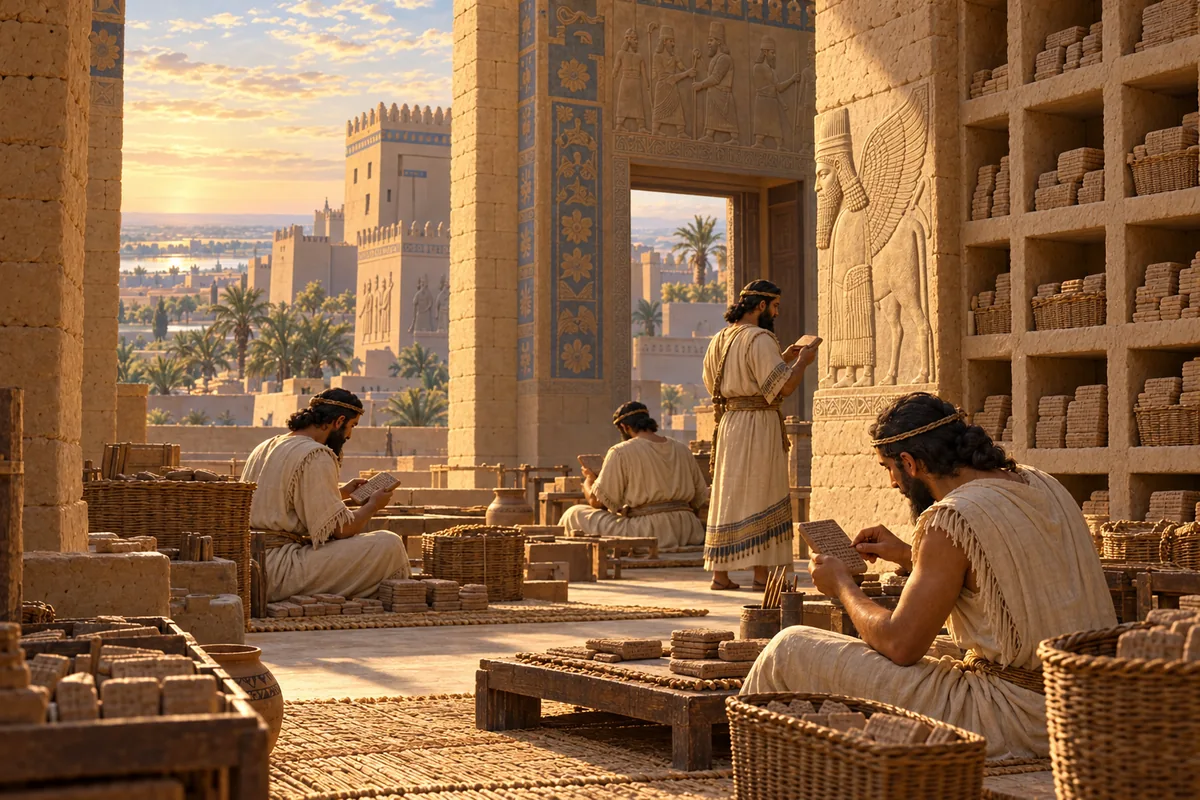
~715 BCE · Reconstructed composite — see ORACC entry for manuscript witnesses
SAA 15 113. The King of Elam Leaves Bit-Bunakki and Goes to Burati (CT 53 089+)
“(1) To the king, my lord: your servant Šamaš-belu-uṣur. Good health to the king, my lord! The city of Der and the fort are well. (6) Perhaps the king, my lord, will say: "What is the news of the king of Elam?" He entered Bit-Bunakki on the 11th of Tammuz (IV), left it on the 13th, and went up to the mountain. [My] messenger [has written to me] as follows: (12) "A town called Burati, (one of) his forts outside the house of Daltâ, has turned hostile against him; he is going there, and will either pacify it or bring them down through battle. From there he will march to Ellipi against the s[on of…”
Source: Fuchs, A. & Parpola, S. 2001. The Correspondence of Sargon II, Part III: Letters from Babylonia and the Eastern Provinces. SAA 15. Helsinki: Helsinki University Press. https://oracc.museum.upenn.edu/saao/saa15/P313504/
Read the full tablet entry~715 BCE · Reconstructed composite — see ORACC entry for manuscript witnesses
SAA 15 114. The King of Elam in the Mountain, in the Town Burati (ABL 1348)
“(1) [To the king, my lord: your servant Šamaš-belu-uṣur. Good health to the king, my lord! The city of Der and the fort are w]ell. (6) Perhaps [the king, my lord], will say: "Wha[t] is the news of the king of Elam?" The king of Elam is in the mountain, in the town Burati. He has not set out, he is still there. (12) [... to] the king, my lord (13) [......], saying: (14) [...... u]s (Break) (r 1) [......] of Assyria (r 2) [......] are attacking (r 3) [......] to the guard (r 4) [......] entered (Rest destroyed)”
Source: Fuchs, A. & Parpola, S. 2001. The Correspondence of Sargon II, Part III: Letters from Babylonia and the Eastern Provinces. SAA 15. Helsinki: Helsinki University Press. https://oracc.museum.upenn.edu/saao/saa15/P334857/
Read the full tablet entry~715 BCE · Reconstructed composite — see ORACC entry for manuscript witnesses
SAA 15 115. The King of Elam is in the Mountain (ABL 0800)
“(1) [To the king], my [lo]rd: [your servant] Šamaš-belu-uṣur. [Good health t]o the king, my lord! The city of Der and the fort [are well]. (6) [Perhaps] the king, my lord, [will say: "Any new]s of the king of Elam?" He is in the mountain. (9) [......] When (Break) (r 1) [...... incr]eased (r 2) [...... mu]ch (r 3) [......] the king, my lord (r 4) [...... to]day (r 5) [......] ... (r 6) [......] does (r 7) [...... the ...]nians (r 8) [...] they are [...] (r 9) [Concerning what the king, my lord], wrote to me (r 10) [......] before them (r 11) [......] are excellent (r 12) two [...]... (r 13) [...] did (r 14) [......]”
Source: Fuchs, A. & Parpola, S. 2001. The Correspondence of Sargon II, Part III: Letters from Babylonia and the Eastern Provinces. SAA 15. Helsinki: Helsinki University Press. https://oracc.museum.upenn.edu/saao/saa15/P334562/
Read the full tablet entry~715 BCE · Reconstructed composite — see ORACC entry for manuscript witnesses
SAA 15 116. Pacifying a City and Gathering Troops (ABL 1044)
“(Beginning destroyed) (2) I d[id] as the king, [my] lo[rd, had or]dered me. [The ...] were before me, the Gar[...eans] were holding the mountain, the whole city of Gab[ê] was resident, half of the population in town, the other half i[n the mountain]. (8) Having gone there, I sent [my] messenger to them. Some 30 men fr[om] Gabê and some 50 from Qari[...], prefects and elders of the city, and Ahu-lê ca[me] into my presence. I spoke with them, so they se[nt (word)] and made the rest of their people [...] come down. (15) [...] inside the city [...] (16) sincerely [...] (Break) (r 1) I spo[ke with…”
Source: Fuchs, A. & Parpola, S. 2001. The Correspondence of Sargon II, Part III: Letters from Babylonia and the Eastern Provinces. SAA 15. Helsinki: Helsinki University Press. https://oracc.museum.upenn.edu/saao/saa15/P334695/
Read the full tablet entry~715 BCE · Reconstructed composite — see ORACC entry for manuscript witnesses
SAA 15 117. The King is Coming and has Crossed the River (ABL 1349)
“(1) [To the ki]ng, my lord: [your servant Šamaš-belu-uṣur]. Good health to the king, my lord! [The city of Der and] the fort are well. (4) [Concerning the royal ...]s who live in Der, [about whom the king, my lord, wrote to m]e: "Let two of them come [and ent]er [into my presence]" — now then Nabû-ušabši [and NN] have come [befo]re me. [...... in] Calah the king my lord [gave] this very order [to me]: (9) "[......] royal [...]s [t]o me [...]" (Break) (r 1) [......] some 10 men from among them (r 2) [have come before me, saying]: "To the king (r 3) [......] ... (r 4) [...... g]o [...]." I…”
Source: Fuchs, A. & Parpola, S. 2001. The Correspondence of Sargon II, Part III: Letters from Babylonia and the Eastern Provinces. SAA 15. Helsinki: Helsinki University Press. https://oracc.museum.upenn.edu/saao/saa15/P334858/
Read the full tablet entry~715 BCE · Reconstructed composite — see ORACC entry for manuscript witnesses
SAA 15 118. Elamite Troops Besiege and Take Malaku (ABL 1063)
“(Beginning destroyed) (2) they came and besieged [Malak]. At [day]break, they let their released troops go to the [...] and towns, and they plundered all the people and oxen. Those who escaped got scared and entered Der. (9) On the 14th of Kislev (IX) I sent cavalrymen to Malak. They come back and told me: (13) "The herald has entered the house of Zera-iddin, gathered the inhabitants of the country (and) the Malakites, and entered them into a temple. They keep watch over them, and have [...ed the ...] of Zera-iddin [...]." (20) [M]y messenger returned from the c[ity ...] on the 14th, and I…”
Source: Fuchs, A. & Parpola, S. 2001. The Correspondence of Sargon II, Part III: Letters from Babylonia and the Eastern Provinces. SAA 15. Helsinki: Helsinki University Press. https://oracc.museum.upenn.edu/saao/saa15/P334708/
Read the full tablet entry~715 BCE · Reconstructed composite — see ORACC entry for manuscript witnesses
SAA 15 119. Provisioning the Fort (CT 53 077)
“(1) T[o the king, my lord]: yo[ur] servant [Šamaš-belu-uṣur]. Good he[alth to the king, my lord! The city of Der and the fort] are well. (6) The king of El[am ...] (Break) (11) the [c]amp [......] (12) He is [......] (13) I shall send [......] (14) the king, my lord [......] (15) I shall do [......] (16) because of [......] (17) his reports [......] (18) Concerning what the king, my lord, wr[ote to me]: "I will send [you straw]. Do not leav[e ...] one litre of straw [... outside] but bring it [all into the fort]!" — I have d[one] a[s the king, my lord], wrote to me. I have not l[eft] one…”
Source: Fuchs, A. & Parpola, S. 2001. The Correspondence of Sargon II, Part III: Letters from Babylonia and the Eastern Provinces. SAA 15. Helsinki: Helsinki University Press. https://oracc.museum.upenn.edu/saao/saa15/P313492/
Read the full tablet entry~715 BCE · Reconstructed composite — see ORACC entry for manuscript witnesses
SAA 15 120. A Letter of the King of Elam Intercepted and Brought to Der (CT 53 306)
“(Beginning destroyed) (4) [...... ha]ve become hostile (5) [...... R]apâ-il (6) [......] (7) [......] (8) [...... ha]ve become hostile (Break) (r 1) [...] they brought [bef]ore me with their letter a messenger [who carried the lett]er of the king of Elam. (r 5) [As to what the king, m]y [lord], wrote to me: "Bel-iqb[i ......] the Babylonian should be [in D]er" — I [we]nt and told it to them, [but they said to me]: "He should not come! (r 10) [... will wri]te to him (r 11) [...] "I shall go (r 12) [......] I have been sent (r 13) [...... No]w then (r 14) [......] with me (r 15) [...... Now th]en (r 16) [...... is comin]g (r 17) [...... the kin]g, my lord (Rest destroyed)”
Source: Fuchs, A. & Parpola, S. 2001. The Correspondence of Sargon II, Part III: Letters from Babylonia and the Eastern Provinces. SAA 15. Helsinki: Helsinki University Press. https://oracc.museum.upenn.edu/saao/saa15/P313721/
Read the full tablet entry