Chapter 05 · 2000 – 1600 BCE
Old Babylonian
Hammurabi, the Epic of Gilgamesh, mathematics.
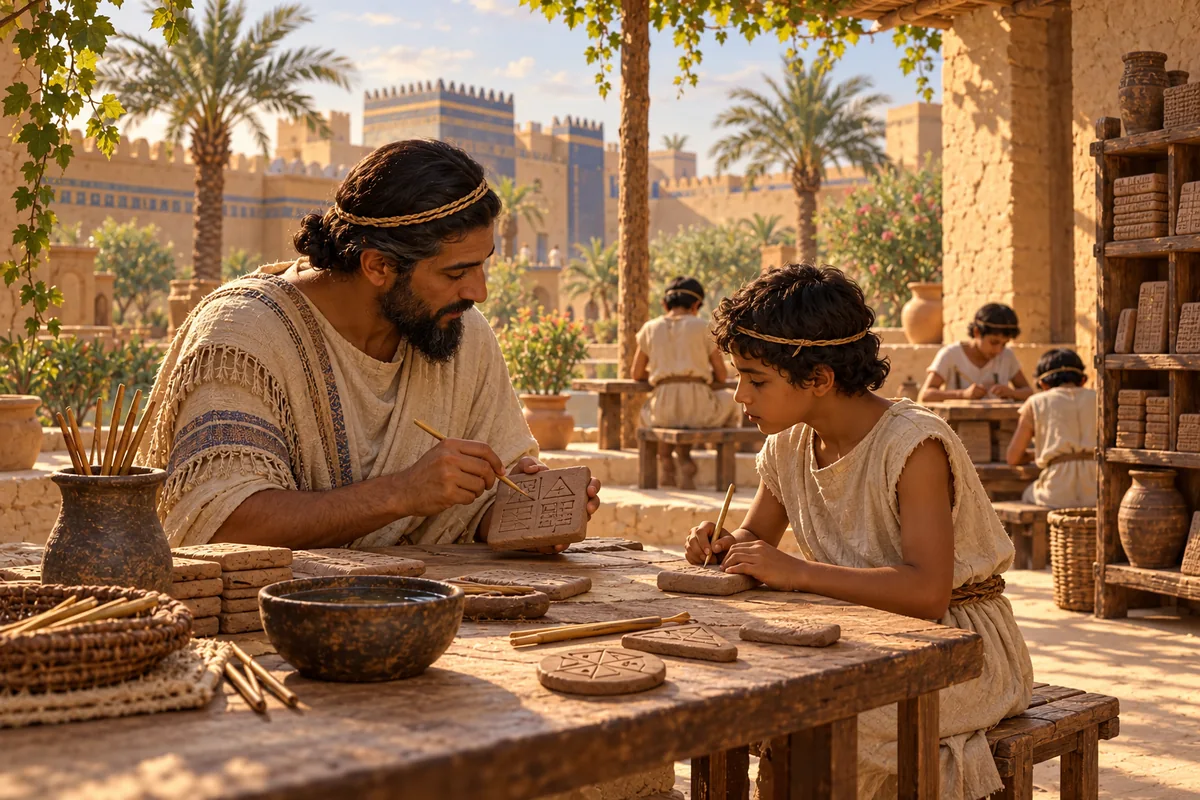
~1800 BCE · Multiple manuscripts across collections; see ETCSL bibliography for witnesses
The Flood story
“...... sets up ....... "I will ...... the perishing of my mankind; for Nintud, I will stop the annihilation of my creatures, and I will return the people from their dwelling grounds. Let them build many cities so that I can refresh myself in their shade. Let them lay the bricks of many cities in pure places, let them establish places of divination in pure places, and when the the fire-quenching ...... is arranged, the divine rites and exalted powers are perfected and the earth is irrigated, I will establish well-being there." After An, Enlil, Enki and Ninhursaja had fashioned the black-headed people, they also made animals multiply everywhere, and made herds of four-legged animals exist on the plains, as is befitting. approximately 32 lines missing”
Source: ETCSL c.1.7.4: The Flood story. Black, J.A., Cunningham, G., Robson, E. & Zólyomi, G. (eds.), The Electronic Text Corpus of Sumerian Literature, Faculty of Oriental Studies, University of Oxford. https://etcsl.orinst.ox.ac.uk/cgi-bin/etcsl.cgi?text=c.1.7.4
Read the full tablet entry~1800 BCE · Multiple manuscripts across collections; see ETCSL bibliography for witnesses
The herds of Nanna (Nanna F)
“The lord has burnished (?) the heavens; he has embellished the night (1 ms. has instead: the earth). Nanna has burnished the heavens; he has embellished the night (1 ms. has instead: the earth). When he comes forth from the turbulent mountains, he stands as Utu stands at noon. When Acimbabbar comes forth from the turbulent mountains, he stands as Utu stands at noon. His father, whose word is true, speaks with him day and night. Enlil, whose word is true, speaks with him day and night, and in decision determines the fates with him. His lofty jipar number four. There are four platforms (1 ms. has instead: cattle pens) which he has established for him. His great temple cattle pens, one ece in size, number four. They play for him on the aljarsura instrument (1 ms. has instead: on the churn).”
Source: ETCSL c.4.13.06: The herds of Nanna (Nanna F). Black, J.A., Cunningham, G., Robson, E. & Zólyomi, G. (eds.), The Electronic Text Corpus of Sumerian Literature, Faculty of Oriental Studies, University of Oxford. https://etcsl.orinst.ox.ac.uk/cgi-bin/etcsl.cgi?text=c.4.13.06
Read the full tablet entry~1800 BCE · Multiple manuscripts across collections; see ETCSL bibliography for witnesses
The heron and the turtle
“What do they say in the reed-beds whose growth is good? In the wide reed-beds of Tutub, whose growth is good? In the marshes of Kiritaba, whose growth is good? In the adara thickets of Akcak, whose growth is good? In Enki's interconnecting (?) lagoons, whose growth is good? In the smaller lagoon, Enki's lagoon, whose growth is good? In Enki's barbar reeds, whose growth is good? In the little zi reeds of Urim, whose growth is good? In Urim, where cows and calves abound, whose growth is good? At that time, the water was drained away from the reeds ......, and they were visible at the sheepfold.…”
Source: ETCSL c.5.9.2: The heron and the turtle. Black, J.A., Cunningham, G., Robson, E. & Zólyomi, G. (eds.), The Electronic Text Corpus of Sumerian Literature, Faculty of Oriental Studies, University of Oxford. https://etcsl.orinst.ox.ac.uk/cgi-bin/etcsl.cgi?text=c.5.9.2
Read the full tablet entry~1800 BCE · Multiple manuscripts across collections; see ETCSL bibliography for witnesses
The history of the Tummal
“En-me-barage-si, the king, built the Iri-nanam in Enlil's temple. Aga, son of En-me-barage-si, made the Tummal flourish and brought Ninlil into the Tummal. Then the Tummal fell into ruins for the first time. Mes-ane-pada built the Burcucua in Enlil's temple. Mes-ki-aj-nuna, son of Mes-ane-pada, made the Tummal flourish and brought Ninlil into the Tummal. Then the Tummal fell into ruins for a second time. Gilgamec built the Numunbura in Enlil's temple. Ur-lugal, son of Gilgamec, made the Tummal flourish and brought Ninlil into the Tummal. Then the Tummal fell into ruins for a third time. Nanni built the Lofty Garden in Enlil's temple. Mes-ki-aj-Nanna, son of Nanni, made the Tummal flourish and brought Ninlil into the Tummal. Then the Tummal fell into ruins for a fourth time.”
Source: ETCSL c.2.1.3: The history of the Tummal. Black, J.A., Cunningham, G., Robson, E. & Zólyomi, G. (eds.), The Electronic Text Corpus of Sumerian Literature, Faculty of Oriental Studies, University of Oxford. https://etcsl.orinst.ox.ac.uk/cgi-bin/etcsl.cgi?text=c.2.1.3
Read the full tablet entry~1800 BCE · Multiple manuscripts across collections; see ETCSL bibliography for witnesses
The home of the fish
“My fish, I have built you a home! My fish, I have built you a house, I have built you a store! I have built you a house bigger than a house, in fact a large sheepfold. Inside there is incense, and I have covered it with cloths for you; in this happy place, I ...... water of joy for you; a house not bothered by cords dividing the plots, ...... in the gutters. In the house, there is food, food of the best quality. In the house, there is food, food in good condition. No flies buzz around in your house where beer is poured out. Your reputation ...... cannot be alienated (?). The threshold and the…”
Source: ETCSL c.5.9.1: The home of the fish. Black, J.A., Cunningham, G., Robson, E. & Zólyomi, G. (eds.), The Electronic Text Corpus of Sumerian Literature, Faculty of Oriental Studies, University of Oxford. https://etcsl.orinst.ox.ac.uk/cgi-bin/etcsl.cgi?text=c.5.9.1
Read the full tablet entry~1800 BCE · Multiple manuscripts across collections; see ETCSL bibliography for witnesses
The instructions of Shuruppag
“In those days, in those far remote days, in those nights, in those faraway nights, in those years, in those far remote years, at that time the wise one who knew how to speak in elaborate words lived in the Land; Curuppag, the wise one, who knew how to speak with elaborate words lived in the Land. Curuppag gave instructions to his son; Curuppag, the son of Ubara-Tutu gave instructions to his son Zi-ud-sura: My son, let me give you instructions: you should pay attention! Zi-ud-sura, let me speak a word to you: you should pay attention! Do not neglect my instructions! Do not transgress the words I speak! The instructions of an old man are precious; you should comply with them!”
Source: ETCSL c.5.6.1: The instructions of Shuruppag. Black, J.A., Cunningham, G., Robson, E. & Zólyomi, G. (eds.), The Electronic Text Corpus of Sumerian Literature, Faculty of Oriental Studies, University of Oxford. https://etcsl.orinst.ox.ac.uk/cgi-bin/etcsl.cgi?text=c.5.6.1
Read the full tablet entry~1800 BCE · Multiple manuscripts across collections; see ETCSL bibliography for witnesses
The Kesh temple hymn
“The princely one, the princely one came forth from the house. Enlil, the princely one, came forth from the house. The princely one came forth royally from the house. Enlil lifted his glance over all the lands, and the lands raised themselves to Enlil. The four corners of heaven became green for Enlil like a garden. Kec was positioned there for him with head uplifted, and as Kec lifted its head among all the lands, Enlil spoke the praises of Kec. Nisaba was its decision-maker (?); with its words she wove it intricately like a net. Written on tablets it was held in her hands: House, platform of…”
Source: ETCSL c.4.80.2: The Kesh temple hymn. Black, J.A., Cunningham, G., Robson, E. & Zólyomi, G. (eds.), The Electronic Text Corpus of Sumerian Literature, Faculty of Oriental Studies, University of Oxford. https://etcsl.orinst.ox.ac.uk/cgi-bin/etcsl.cgi?text=c.4.80.2
Read the full tablet entry~1800 BCE · Multiple manuscripts across collections; see ETCSL bibliography for witnesses
The lament for Eridug
“(beginning of 1st kirugu) 4 lines missing The roaring storm covered it like a cloak, was spread over it like a sheet. It covered Eridug like a cloak, was spread over it like a sheet. In the city, the furious storm resounded ....... In Eridug, the furious storm resounded ....... Its voice was smothered with silence as by a sandstorm. Its people ....... Eridug was smothered with silence as by a sandstorm. Its people ....... Its king stayed outside his city as if it were an alien city. He wept bitter tears. Father Enki stayed outside his city as if it were an alien city. He wept bitter tears.…”
Source: ETCSL c.2.2.6: The lament for Eridug. Black, J.A., Cunningham, G., Robson, E. & Zólyomi, G. (eds.), The Electronic Text Corpus of Sumerian Literature, Faculty of Oriental Studies, University of Oxford. https://etcsl.orinst.ox.ac.uk/cgi-bin/etcsl.cgi?text=c.2.2.6
Read the full tablet entry