Chapter 05 · 2000 – 1600 BCE
Old Babylonian
Hammurabi, the Epic of Gilgamesh, mathematics.
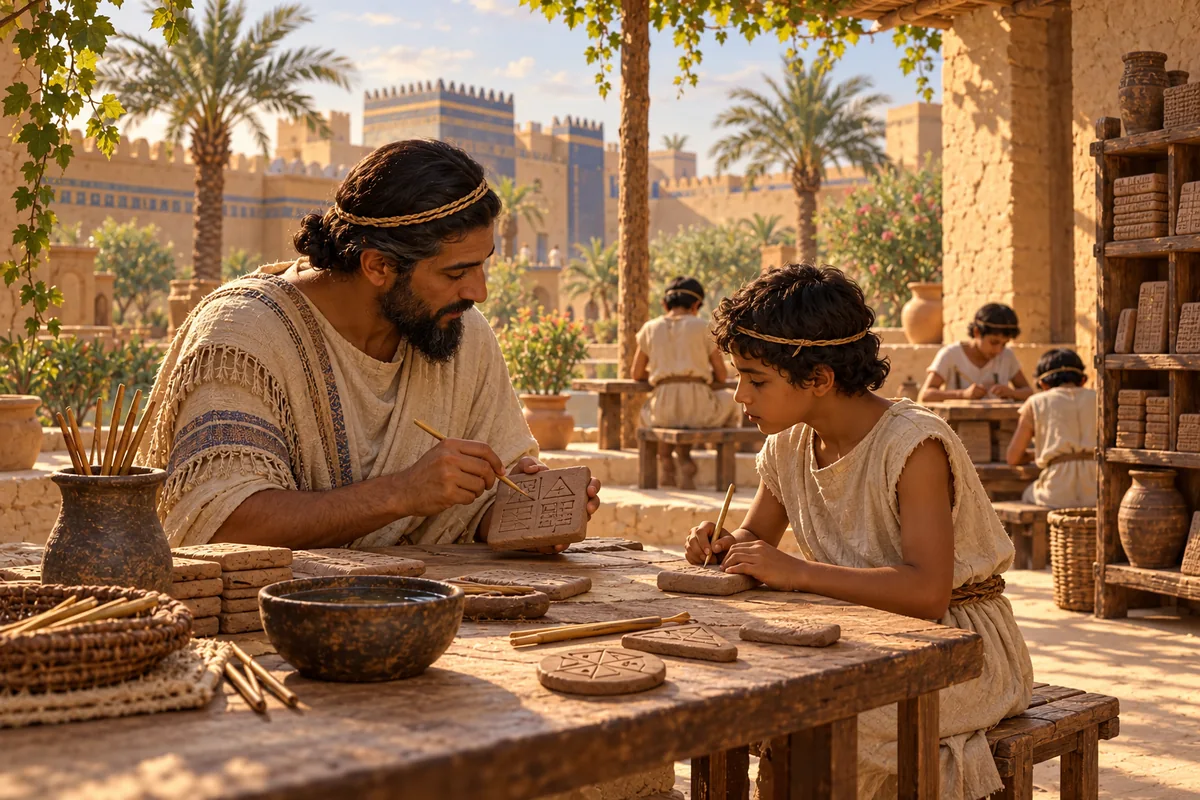
~1800 BCE · Multiple manuscripts across collections; see ETCSL bibliography for witnesses
The debate between Silver and Copper
“5 lines fragmentary (Silver (?) speaks:) "Powerful with huge arms, does he have any rival? He walks carrying the precious hammer stone and anvil stone. He can create ...... and thus make it larger -- ......, a brother, is your right arm; ......, a mother (?), is your left (?). He has created ......; let him show it off. Constantly digging ......, let him accumulate goods. After exalted ...... conceived (?) him, after ...... like a breast, after ...... towards the abzu, ...... to the edge of the horizon, may ...... bring ...... for you. After ...... made ......." 2 lines fragmentary 31 lines missing”
Source: ETCSL c.5.3.6: The debate between Silver and Copper. Black, J.A., Cunningham, G., Robson, E. & Zólyomi, G. (eds.), The Electronic Text Corpus of Sumerian Literature, Faculty of Oriental Studies, University of Oxford. https://etcsl.orinst.ox.ac.uk/cgi-bin/etcsl.cgi?text=c.5.3.6
Read the full tablet entry~1800 BCE · Multiple manuscripts across collections; see ETCSL bibliography for witnesses
The debate between the Date Palm and the Tamarisk
“The Tamarisk opened his mouth and spoke. He addressed the Date Palm: "My body ...... the bodies of the gods. (The reference is to statues of tamarisk wood.) You grow your fruits but someone places them before me like a maid approaching her mistress. You do not provide the measuring vessels. You are ...... minor crops, but I ....... Your attendants ...... before me for you." In his anger the Date Palm answered him. He addressed his brother the Tamarisk: "You say: "If people build daises for me and beautify them too, they certainly do not swear by the gods before clay (?)." -- You may be the body of the gods in their shrines and people may name with a good name the daises of the gods, but it is silver that can pride itself as the overlay of the gods. ......, describe your beauty!" unknown no. of lines missing”
Source: ETCSL c.5.3.7: The debate between the Date Palm and the Tamarisk. Black, J.A., Cunningham, G., Robson, E. & Zólyomi, G. (eds.), The Electronic Text Corpus of Sumerian Literature, Faculty of Oriental Studies, University of Oxford. https://etcsl.orinst.ox.ac.uk/cgi-bin/etcsl.cgi?text=c.5.3.7
Read the full tablet entry~1800 BCE · Multiple manuscripts across collections; see ETCSL bibliography for witnesses
The debate between the Hoe and the Plough
“O the Hoe, the Hoe, the Hoe, tied together with thongs; the Hoe, made from poplar, with a tooth of ash; the Hoe, made from tamarisk, with a tooth of sea-thorn; the Hoe, double-toothed, four-toothed; the Hoe, child of the poor, ...... bereft even of a loin-cloth (?) -- the Hoe started a quarrel ...... with the Plough. The Hoe having engaged in a dispute with the Plough, the Hoe addressed the Plough: "Plough, you draw furrows -- what does your furrowing matter to me? You break clods -- what does your clod-breaking matter to me? When water overflows you cannot dam it up. You cannot fill baskets…”
Source: ETCSL c.5.3.1: The debate between the Hoe and the Plough. Black, J.A., Cunningham, G., Robson, E. & Zólyomi, G. (eds.), The Electronic Text Corpus of Sumerian Literature, Faculty of Oriental Studies, University of Oxford. https://etcsl.orinst.ox.ac.uk/cgi-bin/etcsl.cgi?text=c.5.3.1
Read the full tablet entry~1800 BCE · Multiple manuscripts across collections; see ETCSL bibliography for witnesses
The debate between Winter and Summer
“An lifted his head in pride and brought forth a good day. He laid plans for ...... and spread the population wide. Enlil set his foot upon the earth like a great bull. Enlil, the king of all lands, set his mind to increasing the good day of abundance, to making the ...... night resplendent in celebration, to making flax grow, to making barley proliferate, to guaranteeing the spring floods at the quay, to making ...... lengthen (?) their days in abundance, to making Summer close the sluices of heaven, and to making Winter guarantee plentiful water at the quay. He copulated with the great…”
Source: ETCSL c.5.3.3: The debate between Winter and Summer. Black, J.A., Cunningham, G., Robson, E. & Zólyomi, G. (eds.), The Electronic Text Corpus of Sumerian Literature, Faculty of Oriental Studies, University of Oxford. https://etcsl.orinst.ox.ac.uk/cgi-bin/etcsl.cgi?text=c.5.3.3
Read the full tablet entry~1800 BCE · Multiple manuscripts across collections; see ETCSL bibliography for witnesses
The dedication of an axe to Nergal
“Nibruta-lu, the son of the merchant Lugal-cuba, has had this tin axe made for Nergal. Its wooden part is of arganum tree of the mountains, a wood which is superior even to the alal stone; its stone part is of antasura, a stone which has no equal. The arm of the man who strikes with it will never get tired. Should it break, I will repair it for Nergal. Should it disappear, I will replace it for him. May Nergal look after me during my life, and may he provide me with clean water in the underworld after my death.”
Source: ETCSL c.5.7.3: The dedication of an axe to Nergal. Black, J.A., Cunningham, G., Robson, E. & Zólyomi, G. (eds.), The Electronic Text Corpus of Sumerian Literature, Faculty of Oriental Studies, University of Oxford. https://etcsl.orinst.ox.ac.uk/cgi-bin/etcsl.cgi?text=c.5.7.3
Read the full tablet entry~1800 BCE · Multiple manuscripts across collections; see ETCSL bibliography for witnesses
The exaltation of Inana (Inana B)
“Lady of all the divine powers, resplendent light, righteous woman clothed in radiance, beloved of An and Urac! Mistress of heaven, with the great pectoral jewels, who loves the good headdress befitting the office of en priestess, who has seized all seven of its divine powers! My lady, you are the guardian of the great divine powers! You have taken up the divine powers, you have hung the divine powers from your hand. You have gathered up the divine powers, you have clasped the divine powers to your breast. Like a dragon you have deposited venom on the foreign lands. When like Ickur you roar at the earth, no vegetation can stand up to you. As a flood descending upon (?) those foreign lands, powerful one of heaven and earth, you are their Inana.”
Source: ETCSL c.4.07.2: The exaltation of Inana (Inana B). Black, J.A., Cunningham, G., Robson, E. & Zólyomi, G. (eds.), The Electronic Text Corpus of Sumerian Literature, Faculty of Oriental Studies, University of Oxford. https://etcsl.orinst.ox.ac.uk/cgi-bin/etcsl.cgi?text=c.4.07.2
Read the full tablet entry~1800 BCE · Multiple manuscripts across collections; see ETCSL bibliography for witnesses
The exploits of Ninurta
“(1 ms. adds before line 1: An, king of the gods, majestic one:) O King, storm of majestic splendour, peerless Ninurta, possessing superior strength; who pillages the Mountains all alone; deluge, indefatigable serpent hurling yourself at the rebel land, Hero striding formidably into battle; Lord whose powerful arm is fit to bear the mace, reaping like barley the necks of the insubordinate; Ninurta, King, son in whose strength his father rejoices; Hero whose awesomeness covers the Mountains like a south storm; Ninurta, who makes the good tiara, the rainbow (?), flash like lightning; grandly…”
Source: ETCSL c.1.6.2: The exploits of Ninurta. Black, J.A., Cunningham, G., Robson, E. & Zólyomi, G. (eds.), The Electronic Text Corpus of Sumerian Literature, Faculty of Oriental Studies, University of Oxford. https://etcsl.orinst.ox.ac.uk/cgi-bin/etcsl.cgi?text=c.1.6.2
Read the full tablet entry~1800 BCE · Multiple manuscripts across collections; see ETCSL bibliography for witnesses
The farmer's instructions
“Ud-ul-uru (Old man cultivator) gave advice to his son: When you have to prepare a field, inspect the levees, canals and mounds that have to be opened. When you let the flood water into the field, this water should not rise too high in it. At the time that the field emerges from the water, watch its area with standing water; it should be fenced. Do not let cattle herds trample there. After you cut the weeds and establish the limits of the field, level it repeatedly with a thin hoe weighing two-thirds of a mina (approx. 650 g). Let a flat hoe erase the oxen tracks, let the flied be swept clean. A maul should flatten the furrow bottoms of the area. A hoe should go round the four edges of the field. Until the field is dry it should be smoothed out.”
Source: ETCSL c.5.6.3: The farmer's instructions. Black, J.A., Cunningham, G., Robson, E. & Zólyomi, G. (eds.), The Electronic Text Corpus of Sumerian Literature, Faculty of Oriental Studies, University of Oxford. https://etcsl.orinst.ox.ac.uk/cgi-bin/etcsl.cgi?text=c.5.6.3
Read the full tablet entry