Chapter 05 · 2000 – 1600 BCE
Old Babylonian
Hammurabi, the Epic of Gilgamesh, mathematics.
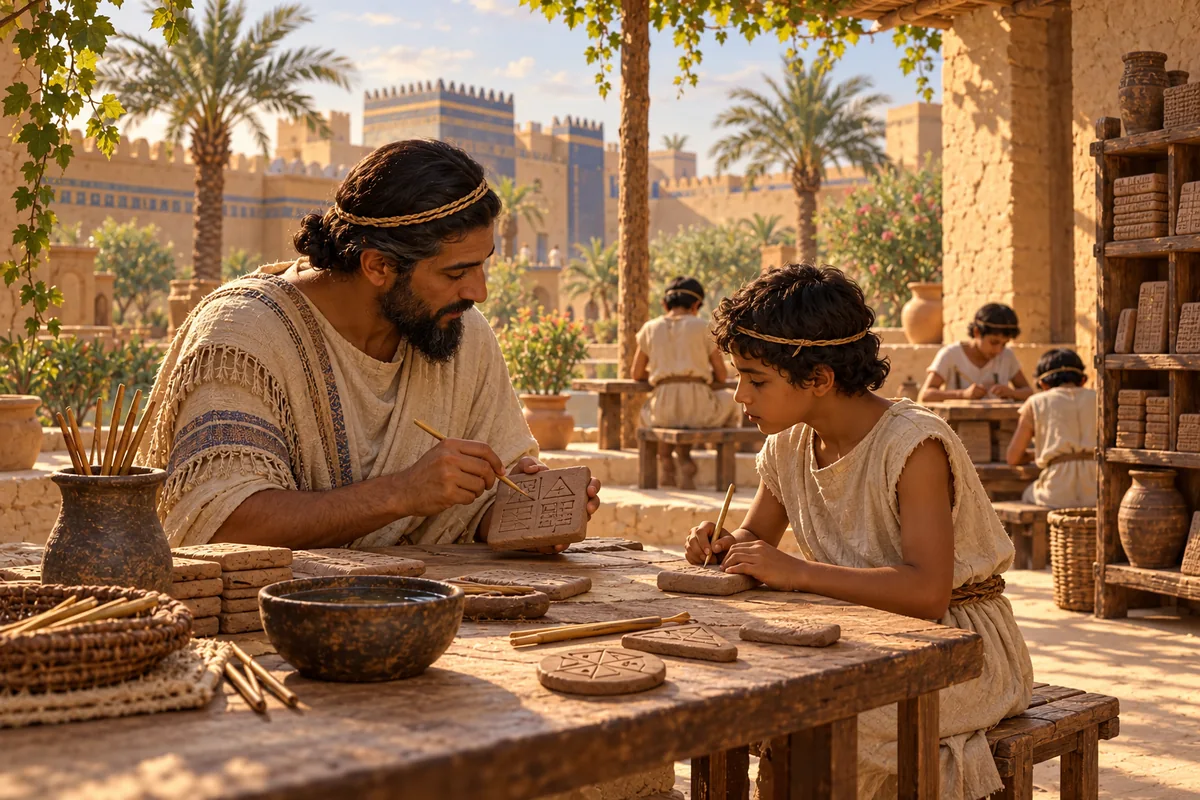
~1800 BCE · Multiple manuscripts across collections; see ETCSL bibliography for witnesses
Shulgi and Ninlil's Barge (Shulgi R)
“Oh barge, Enki assigned the quay of abundance to you as your fate. Father Enlil looked at you with approval. Your lady, Ninlil, commanded your construction. She entrusted it to the faithful provider, king Culgi; and the shepherd, who is of broad intelligence and who will not rest day and night in thinking deeply about you. He, the wise one, who is proficient in planning, he, the omniscient one, will fell large cedars in the huge forests for you. He will make you perfect and you will be breathtaking to look upon. Your woven ...... is ....... Your covering reed-mats are the daylight spreading…”
Source: ETCSL c.2.4.2.18: Shulgi and Ninlil's Barge (Shulgi R). Black, J.A., Cunningham, G., Robson, E. & Zólyomi, G. (eds.), The Electronic Text Corpus of Sumerian Literature, Faculty of Oriental Studies, University of Oxford. https://etcsl.orinst.ox.ac.uk/cgi-bin/etcsl.cgi?text=c.2.4.2.18
Read the full tablet entry~1800 BCE · Multiple manuscripts across collections; see ETCSL bibliography for witnesses
The advice of a supervisor to a younger scribe (E-duba C)
“(The supervisor speaks:) "One-time member of the school, come here to me, and let me explain to you what my teacher revealed. "Like you, I was once a youth and had a mentor. The teacher assigned a task to me -- it was man's work. Like a springing reed, I leapt up and put myself to work. I did not depart from my teacher's instructions, and I did not start doing things on my own initiative. My mentor was delighted with my work on the assignment. He rejoiced that I was humble before him and he spoke in my favour. "I just did whatever he outlined for me -- everything was always in its place. Only…”
Source: ETCSL c.5.1.3: The advice of a supervisor to a younger scribe (E-duba C). Black, J.A., Cunningham, G., Robson, E. & Zólyomi, G. (eds.), The Electronic Text Corpus of Sumerian Literature, Faculty of Oriental Studies, University of Oxford. https://etcsl.orinst.ox.ac.uk/cgi-bin/etcsl.cgi?text=c.5.1.3
Read the full tablet entry~1800 BCE · Multiple manuscripts across collections; see ETCSL bibliography for witnesses
The building of Ningirsu´s temple
“On the day when in heaven and earth the fates had been decided, Lagac raised its head high in full grandeur, and Enlil looked at lord Nin-jirsu with approval. In our city there was perfection. The heart overflowed with joy, Enlil's heart, a river in flood, overflowed with joy. The heart overflowed with joy, and just as the Tigris brings sweet water, so Enlil, whose will is an enormous flood, sparkling and awe-inspiring, came to a sweet decision: ´The lord called for his house and I intend to make the grandeur of E-ninnu known everywhere. Using his wisdom, the ruler will achieve great things. He will direct faultless cattle and kids for offering. It is for him the fated brick is waiting. It is by him that the building of the house is to be done.´”
Source: ETCSL c.2.1.7: The building of Ningirsu´s temple. Black, J.A., Cunningham, G., Robson, E. & Zólyomi, G. (eds.), The Electronic Text Corpus of Sumerian Literature, Faculty of Oriental Studies, University of Oxford. https://etcsl.orinst.ox.ac.uk/cgi-bin/etcsl.cgi?text=c.2.1.7
Read the full tablet entry~1800 BCE · Multiple manuscripts across collections; see ETCSL bibliography for witnesses
The cursing of Agade
“After Enlil's frown had slain Kic as if it were the Bull of Heaven, had slaughtered the house of the land of Unug in the dust as if it were a mighty bull, and then Enlil had given the rulership and kingship from the south as far as the highlands to Sargon, king of Agade -- at that time, holy Inana established the sanctuary of Agade as her celebrated woman's domain; she set up her throne in Ulmac. Like a young man building a house for the first time, like a girl establishing a woman's domain, holy Inana did not sleep as she ensured that the warehouses would be provisioned; that dwellings would…”
Source: ETCSL c.2.1.5: The cursing of Agade. Black, J.A., Cunningham, G., Robson, E. & Zólyomi, G. (eds.), The Electronic Text Corpus of Sumerian Literature, Faculty of Oriental Studies, University of Oxford. https://etcsl.orinst.ox.ac.uk/cgi-bin/etcsl.cgi?text=c.2.1.5
Read the full tablet entry~1800 BCE · Multiple manuscripts across collections; see ETCSL bibliography for witnesses
The death of Gilgamesh
“...... hero ...... has lain down and is never to rise again. ...... has lain down and is never to rise again. He of well-proportioned limbs ...... has lain down and is never to rise again. ...... has lain down and is never to rise again. He who ...... wickedness has lain down and is never to rise again. The young man ...... has lain down and is never to rise again. He who was perfect in ...... and feats of strength has lain down and is never to rise again. ...... has lain down and is never to rise again. The lord of Kulaba has lain down and is never to rise again. He who spoke most wisely has…”
Source: ETCSL c.1.8.1.3: The death of Gilgamesh. Black, J.A., Cunningham, G., Robson, E. & Zólyomi, G. (eds.), The Electronic Text Corpus of Sumerian Literature, Faculty of Oriental Studies, University of Oxford. https://etcsl.orinst.ox.ac.uk/cgi-bin/etcsl.cgi?text=c.1.8.1.3
Read the full tablet entry~1800 BCE · Multiple manuscripts across collections; see ETCSL bibliography for witnesses
The death of Ur-Namma (Ur-Namma A)
“...... entire land ......, ....... struck, the palace was devastated. ...... panic spread rapidly among the dwellings of the black-headed people. ...... abandoned places ...... in Sumer. ...... the cities were destroyed in their entirety; the people were seized with panic. Evil came upon Urim and made the trustworthy shepherd pass away. It made Ur-Namma, the trustworthy shepherd, pass away; it made the trustworthy shepherd pass away. Because An had altered his holy words completely, ...... became empty, and because, deceitfully, Enlil had completely changed the fate he decreed, Ninmah began a…”
Source: ETCSL c.2.4.1.1: The death of Ur-Namma (Ur-Namma A). Black, J.A., Cunningham, G., Robson, E. & Zólyomi, G. (eds.), The Electronic Text Corpus of Sumerian Literature, Faculty of Oriental Studies, University of Oxford. https://etcsl.orinst.ox.ac.uk/cgi-bin/etcsl.cgi?text=c.2.4.1.1
Read the full tablet entry~1800 BCE · Multiple manuscripts across collections; see ETCSL bibliography for witnesses
The debate between Bird and Fish
“In those ancient days, when the good destinies had been decreed, and after An and Enlil had set up the divine rules of heaven and earth, then the third of them, ......, the lord of broad wisdom, Enki, the master of destinies, gathered together ...... and founded dwelling places; he took in his hand waters to encourage and create good seed; he laid out side by side the Tigris and the Euphrates, and caused them to bring water from the mountains; he scoured out the smaller streams, and positioned the other watercourses. ...... Enki made spacious sheepfolds and cattle-pens, and provided shepherds…”
Source: ETCSL c.5.3.5: The debate between Bird and Fish. Black, J.A., Cunningham, G., Robson, E. & Zólyomi, G. (eds.), The Electronic Text Corpus of Sumerian Literature, Faculty of Oriental Studies, University of Oxford. https://etcsl.orinst.ox.ac.uk/cgi-bin/etcsl.cgi?text=c.5.3.5
Read the full tablet entry~1800 BCE · Multiple manuscripts across collections; see ETCSL bibliography for witnesses
The debate between Sheep and Grain
“When, upon the hill of heaven and earth, An spawned the Anuna gods, since he neither spawned nor created Grain with them, and since in the Land he neither fashioned the yarn of Uttu (the goddess of weaving) nor pegged out the loom for Uttu -- with no Sheep appearing, there were no numerous lambs, and with no goats, there were no numerous kids, the sheep did not give birth to her twin lambs, and the goat did not give birth to her triplet kids; the Anuna, the great gods, did not even know the names Ezina-Kusu (Grain) or Sheep. There was no muc grain of thirty days; there was no muc grain of…”
Source: ETCSL c.5.3.2: The debate between Sheep and Grain. Black, J.A., Cunningham, G., Robson, E. & Zólyomi, G. (eds.), The Electronic Text Corpus of Sumerian Literature, Faculty of Oriental Studies, University of Oxford. https://etcsl.orinst.ox.ac.uk/cgi-bin/etcsl.cgi?text=c.5.3.2
Read the full tablet entry