Chapter 07 · 911 – 609 BCE
Neo-Assyrian
Empire, library, terror, scholarship.
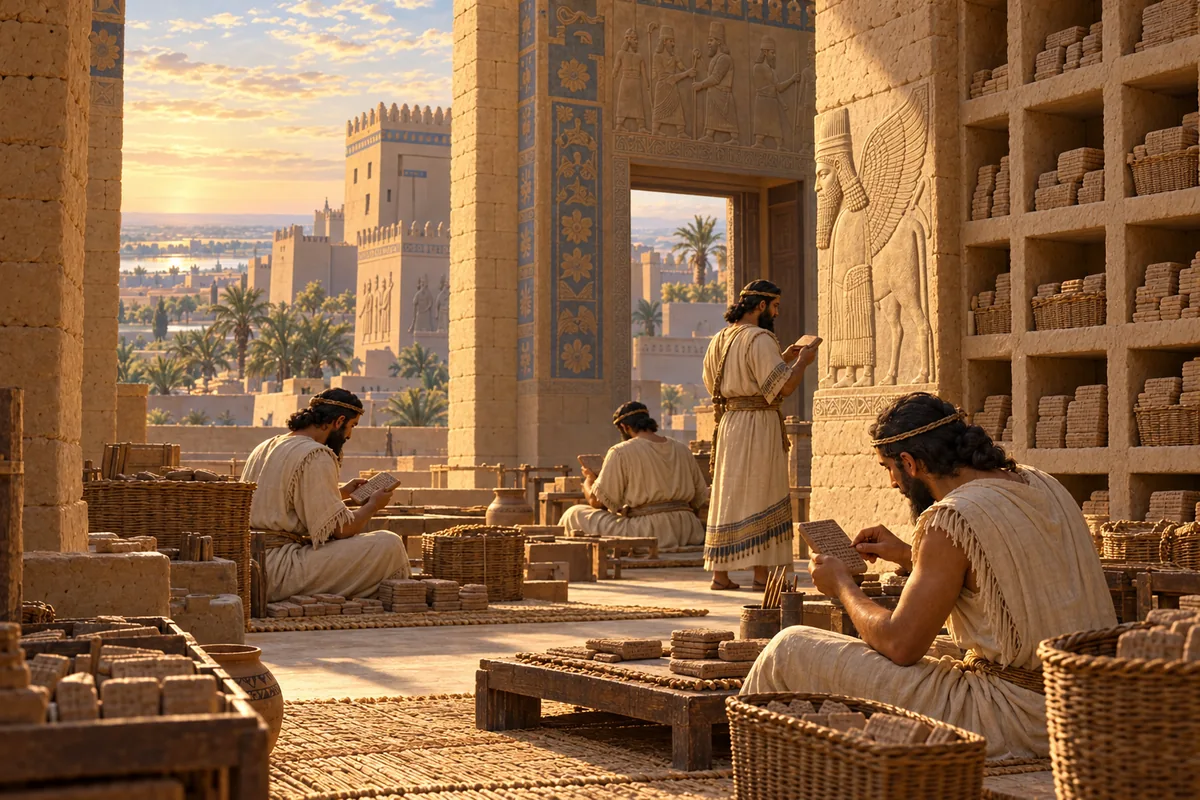
~735 BCE · Reconstructed composite — see ORACC entry for manuscript witnesses
Tiglath-pileser III 1004
“(1) Palace of Tiglath-pileser, king of the world, king of Assyria.”
Source: Tadmor, H. & Yamada, S. 2011. The Royal Inscriptions of Tiglath-pileser III (744–727 BC) and Shalmaneser V (726–722 BC), Kings of Assyria. RINAP 1. University Park, PA: Eisenbrauns. https://oracc.museum.upenn.edu/rinap/rinap1/Q003613/
Read the full tablet entry~735 BCE · Reconstructed composite — see ORACC entry for manuscript witnesses
Tiglath-pileser III 12
“After overlap, continued from text no. 11 (1') elephant hides, ivory, red-purple (and) blue-purple wool, multi-colored garments, linen garment[s], numerous [ves]tments [of] their lands, ..., military equipment, a spindle, ..., (and) ... — I received (all of these things) in the city Arpad. (3') [Tutammû, king of the land Unqi], neglected [the loyalty oath (sworn by) the great gods] (and thereby) disregarded his life. On my campaign [... he did not con]sult me. In my fury, (5´) [I ...] of Tutammû, together with [his] nobles, [...] I captured the city Kinalia (Kunalua), his royal city. (6'b) I…”
Source: Tadmor, H. & Yamada, S. 2011. The Royal Inscriptions of Tiglath-pileser III (744–727 BC) and Shalmaneser V (726–722 BC), Kings of Assyria. RINAP 1. University Park, PA: Eisenbrauns. https://oracc.museum.upenn.edu/rinap/rinap1/Q003425/
Read the full tablet entry~735 BCE · Reconstructed composite — see ORACC entry for manuscript witnesses
Tiglath-pileser III 13
“After gap, continued from text no. 12 (1) [...] ... [...] ... [...] ... [...] Azriyau (Azrī-Iāu) [... I] seized and [...] ... [...] ... [... I imposed upon them] payment like that of [the Assyrians]. (3b) [...] ... the city Kur... [...] ... [...] his helper(s), the cities El[..., (5) ..., Usn]û, Siʾannu, Ma[...], Kašpūna, [which is] on the sea[coast], together with citi[es ..., as far as Mount Saue — which a]buts [Mount Lebanon] — Mount Ba[ʾali]-ṣapūna, as far as Mount Amma[nā]na — the boxwood mountain — [Mount] Sa[ue in its entirety, the province of the city Kār-Adad, the city Ḫatarikka, the…”
Source: Tadmor, H. & Yamada, S. 2011. The Royal Inscriptions of Tiglath-pileser III (744–727 BC) and Shalmaneser V (726–722 BC), Kings of Assyria. RINAP 1. University Park, PA: Eisenbrauns. https://oracc.museum.upenn.edu/rinap/rinap1/Q003426/
Read the full tablet entry~735 BCE · Reconstructed composite — see ORACC entry for manuscript witnesses
Tiglath-pileser III 14
“After overlap, continued from text no. 13 (1) [... they plundered (those cities) and] brought (that booty) [to the land Ḫatti (Syria-Palestine), be]fore me. A eunuch of mine, the provincial governor of the land Naʾiri, captured (and) plundered the cities Supurgillu, [..., (and) ...]aš, together with cities in its environs. [He ...] Šiqilâ, a fortress commander. [He captured (and) plundered ... and] brought (that booty) [to the land Ḫat]ti (Syria-Palestine), before me. (3b) [I settled] 600 captives of the city Amlāte of the (tribe) Damūnu (and) 5,400 captives of the city Dēr (Bīt-Dērāya) [in…”
Source: Tadmor, H. & Yamada, S. 2011. The Royal Inscriptions of Tiglath-pileser III (744–727 BC) and Shalmaneser V (726–722 BC), Kings of Assyria. RINAP 1. University Park, PA: Eisenbrauns. https://oracc.museum.upenn.edu/rinap/rinap1/Q003427/
Read the full tablet entry~735 BCE · Reconstructed composite — see ORACC entry for manuscript witnesses
Tiglath-pileser III 15
“Continued from text no. 14 (1) (Dadīlu) of the the city Kasku, Uassurme of the land Tabal, Ušḫitti of the land (A)tuna, Urpallâ of the land Tuḫana, Tuḫam[me of the city Ištunda], Urimmi of the city Ḫubišna (Ḫubušnu), (and) Zabibê, queen of the Arabs: gold, silver, tin, iron, elephant hides, ivo[ry], multi-colored garments, linen garments, blue-purple (and) [red]-purple wool, ebony, boxwood, all kinds of precious things from the royal treasure, li[ve] sheep [whose wool] is dyed red-purple, flying birds of the sky whose wings are dyed blue-purple, horses, mules, oxen and she[ep and goats,…”
Source: Tadmor, H. & Yamada, S. 2011. The Royal Inscriptions of Tiglath-pileser III (744–727 BC) and Shalmaneser V (726–722 BC), Kings of Assyria. RINAP 1. University Park, PA: Eisenbrauns. https://oracc.museum.upenn.edu/rinap/rinap1/Q003428/
Read the full tablet entry~735 BCE · Reconstructed composite — see ORACC entry for manuscript witnesses
Tiglath-pileser III 16
“Continued from text no. 15 (1) (Completely destroyed) (3) [... I carried] off their [bo]oty. [...] He assembled [...] and ... to Mount [...] ... [...] ... [... (5) I] went up af[ter them], defeat[ed] them, (and) carried off their [bo]oty. [I ...] Yabittarru [...] ... [(As for) the rest] of them, who had fled to the land Amāte, a district opposite Mount Rūa, and who ... [...], I went after [them], defeated them, (and) took them away as one (group). (7b) (As for) the people of the land Karzibra, ... [...], they abandoned [...]. I pursued them and in the very course of (that) march I swept over…”
Source: Tadmor, H. & Yamada, S. 2011. The Royal Inscriptions of Tiglath-pileser III (744–727 BC) and Shalmaneser V (726–722 BC), Kings of Assyria. RINAP 1. University Park, PA: Eisenbrauns. https://oracc.museum.upenn.edu/rinap/rinap1/Q003429/
Read the full tablet entry~735 BCE · Reconstructed composite — see ORACC entry for manuscript witnesses
Tiglath-pileser III 17
“Continued from text no. 16 (1) I conquered (and) defeated the lands [Uppuria, Bustus], Ariarma — the land of roosters — Saksuk[ni, Araquttu, Karzibra, Gukinnana, (and) Bīt-Sagbat, Mount Silḫazi, which] they call [the fort]ress of the Babylonian(s), [... (and) I carried off] their booty. I carried off [..., their horses, their mules, their Bactrian camels, their oxen], (and) their sheep and goats, without number. [I destroyed, devastated, (and) burned with fire their] cit[ies; I reduced (them) to mounds and ruins]. (5) [I annexed to Assyria the lands Namri, Bīt-Sangibūti, Bīt-Ḫamban], Sumurzu,…”
Source: Tadmor, H. & Yamada, S. 2011. The Royal Inscriptions of Tiglath-pileser III (744–727 BC) and Shalmaneser V (726–722 BC), Kings of Assyria. RINAP 1. University Park, PA: Eisenbrauns. https://oracc.museum.upenn.edu/rinap/rinap1/Q003430/
Read the full tablet entry~735 BCE · Reconstructed composite — see ORACC entry for manuscript witnesses
Tiglath-pileser III 18
“After gap, continued from text no. 17 (1) I captured (and) defeated the cities [...], Ḫista, Ḫarbisinna, Barbaz, (and) Tasa, as far as the Uluruš River. I carried off 8,650 people, [... hors]es, 300 mules, 660 asses, 1,350 oxen, (and) 19,000 sheep. (Those cities) I destroyed, devastated, (and) burned with fire. [...] I annexed their [...] to Assyria, rebuilt those cities, (and) settled therein the people of (foreign) lands conquered by me. [...] (and) set up [the weapon of (the god) Aššur], my [lord], therein. I added it (the area) to the province of the land Naʾiri. (4b) [I captured (and)…”
Source: Tadmor, H. & Yamada, S. 2011. The Royal Inscriptions of Tiglath-pileser III (744–727 BC) and Shalmaneser V (726–722 BC), Kings of Assyria. RINAP 1. University Park, PA: Eisenbrauns. https://oracc.museum.upenn.edu/rinap/rinap1/Q003431/
Read the full tablet entry