Chapter 07 · 911 – 609 BCE
Neo-Assyrian
Empire, library, terror, scholarship.
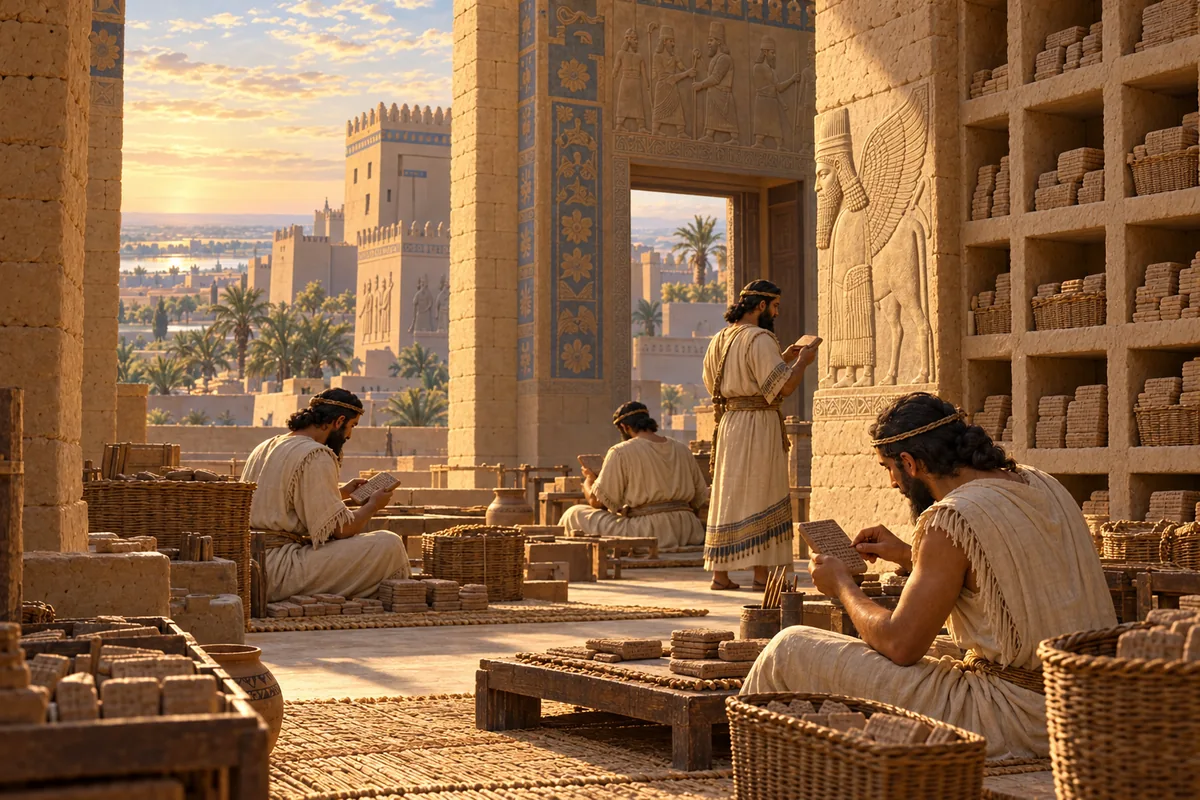
~735 BCE · Reconstructed composite — see ORACC entry for manuscript witnesses
Tiglath-pileser III 05
“After gap, continued from text no. 4 (1) [... I] adorned them (statues of the gods) and they (the gods) went (back) to their land. I rebuilt th[ose] cities. I built a city on top of a tell (lit. “a heaped-up ruin mound”) called [Ḫumut]. I b[uilt (and) co]mpleted (it) from its foundations to its parapets. [Inside (it), I founded] a palace for my royal residence. I named it Kār-Aššur, set up the weapon of (the god) Aššur, my lord, therein, (and) settled the people [of (foreign) lands] conquered by me therein. [I] imposed upon them [tax (and) tribute], (and) considered them as inhabitants of…”
Source: Tadmor, H. & Yamada, S. 2011. The Royal Inscriptions of Tiglath-pileser III (744–727 BC) and Shalmaneser V (726–722 BC), Kings of Assyria. RINAP 1. University Park, PA: Eisenbrauns. https://oracc.museum.upenn.edu/rinap/rinap1/Q003418/
Read the full tablet entry~735 BCE · Reconstructed composite — see ORACC entry for manuscript witnesses
Tiglath-pileser III 06
“Continued from text no. 5 (1) I restored and [...] Assyria to [...]. I built a city [... Inside (it), I founded] a palace for [my] royal residence. [...]. I named it [..., set up] the weapon of (the god) Aššur, my lord, th[erein, (and) settled the people of (foreign) lands conquered by me therein. I imposed upon them tax (and) tribute], (and) considered them as inhabitants of Assyria. (4b) [I fashioned (on a stele) my royal] image [and the image(s) of the great gods, my lords, inscribed on it the mighty victories (lit. “victory and might”)] (5) that I had [achieved again and again] over…”
Source: Tadmor, H. & Yamada, S. 2011. The Royal Inscriptions of Tiglath-pileser III (744–727 BC) and Shalmaneser V (726–722 BC), Kings of Assyria. RINAP 1. University Park, PA: Eisenbrauns. https://oracc.museum.upenn.edu/rinap/rinap1/Q003419/
Read the full tablet entry~735 BCE · Reconstructed composite — see ORACC entry for manuscript witnesses
Tiglath-pileser III 07
“Continued from text no. 6 (1) [...] the cities Kušianaš, Ḫaršu, Šanaštiku, Kiškitara, Ḫaršaya, Ayubak, [...]. They (the enemy) took to a high mountain peak in the mountainous terrain of Mount Ḫaliḫadri. I pursued them and defeated them. [...] I burned with fire [the ... of the people (...) who] entered the ravines of the mountains. I surrounded (and) captured the city Uzḫari of the land Bīt-Zatti. (3b) [I ...] Kākî, [king of ...]. I surrounded, captured, (and) plund[ered (... and)] the city Kitpattia (Kitpat) of the land Bīt-Abdadāni, which Tunaku had seized. (5) [...] I rebuilt [the city]…”
Source: Tadmor, H. & Yamada, S. 2011. The Royal Inscriptions of Tiglath-pileser III (744–727 BC) and Shalmaneser V (726–722 BC), Kings of Assyria. RINAP 1. University Park, PA: Eisenbrauns. https://oracc.museum.upenn.edu/rinap/rinap1/Q003420/
Read the full tablet entry~735 BCE · Reconstructed composite — see ORACC entry for manuscript witnesses
Tiglath-pileser III 08
“Continued from text no. 7 (1) (and) I plundered (it). Ramateia of the land Arazi[aš ...]. He fled furtively (lit. “like a centipede”) and no one fou[nd his (hiding) place. ...] I offered [...], horses, oxen, sheep and goats, lapis lazuli hewn from its mountain, [... to the] great [gods], my lords. (4b) Tunî of the land Sumurzu ... [...]. (5) I captured [...]. I impaled his warriors, [...]. I an[nexed] the lands Sumurzu (and) Bīt-Ḫamban to Assyria. [(...)] I settled [the people of (foreign) lands conquered by me therein] (and) placed a eunuch of mine as provincial governor over them. I…”
Source: Tadmor, H. & Yamada, S. 2011. The Royal Inscriptions of Tiglath-pileser III (744–727 BC) and Shalmaneser V (726–722 BC), Kings of Assyria. RINAP 1. University Park, PA: Eisenbrauns. https://oracc.museum.upenn.edu/rinap/rinap1/Q003421/
Read the full tablet entry~735 BCE · Reconstructed composite — see ORACC entry for manuscript witnesses
Tiglath-pileser III 09
“After gap, continued from text no. 8 (1') [... I] bro[ught] (those) people [to Assyria. ...]. (2'b) [In] my [third palû, (the god) Aššur, my lord, encourag]ed me [and ...] ... [...] ... [...] ... [... Sulumal of the land Mel]id, Tarḫu-lara of [the land Gurgu]m, [... (5´) ...] ... in all lands, [they trusted] in one another’s strength, [... With] the power and might of (the god) Aššur, my lord, [I fought] with [them (and) defeated them. ...] I killed their [warriors] (and) I filled the mountain gorges with them (their corpses). I took without number [their] chariots, [...], (and) their [...].…”
Source: Tadmor, H. & Yamada, S. 2011. The Royal Inscriptions of Tiglath-pileser III (744–727 BC) and Shalmaneser V (726–722 BC), Kings of Assyria. RINAP 1. University Park, PA: Eisenbrauns. https://oracc.museum.upenn.edu/rinap/rinap1/Q003422/
Read the full tablet entry~735 BCE · Reconstructed composite — see ORACC entry for manuscript witnesses
Tiglath-pileser III 10
“After gap, continued from text no. 9 (1') [I captured the cities ..., Alin]zirānu, [Tašliana, (and) Tirḫim, as far as Mount] Sinie (Sinia), (and) I added (them) [to the province of the chief] cupbearer. (4') [(As for) the land ..., from] the cities Ququsanšu (and) [Barzunna to the cities Ḫa]rbisinna, [Abbissâ, (and) Tasa, as far as the land Uluruš], (which is) above the bank [of the Tigris River, the land Lusia — the land of (the metal) lead — the land Ama]dīnu, [..., the cities Qilissa], Ezzēda, Continued in text no. 11”
Source: Tadmor, H. & Yamada, S. 2011. The Royal Inscriptions of Tiglath-pileser III (744–727 BC) and Shalmaneser V (726–722 BC), Kings of Assyria. RINAP 1. University Park, PA: Eisenbrauns. https://oracc.museum.upenn.edu/rinap/rinap1/Q003423/
Read the full tablet entry~735 BCE · Reconstructed composite — see ORACC entry for manuscript witnesses
Tiglath-pileser III 1002
“(1) Palace of Tiglath-pileser, king of Assyria.”
Source: Tadmor, H. & Yamada, S. 2011. The Royal Inscriptions of Tiglath-pileser III (744–727 BC) and Shalmaneser V (726–722 BC), Kings of Assyria. RINAP 1. University Park, PA: Eisenbrauns. https://oracc.museum.upenn.edu/rinap/rinap1/Q003611/
Read the full tablet entry~735 BCE · Reconstructed composite — see ORACC entry for manuscript witnesses
Tiglath-pileser III 1003
“(1) Palace of Tiglath-pileser, king of Assyria.”
Source: Tadmor, H. & Yamada, S. 2011. The Royal Inscriptions of Tiglath-pileser III (744–727 BC) and Shalmaneser V (726–722 BC), Kings of Assyria. RINAP 1. University Park, PA: Eisenbrauns. https://oracc.museum.upenn.edu/rinap/rinap1/Q003612/
Read the full tablet entry