Chapter 07 · 911 – 609 BCE
Neo-Assyrian
Empire, library, terror, scholarship.
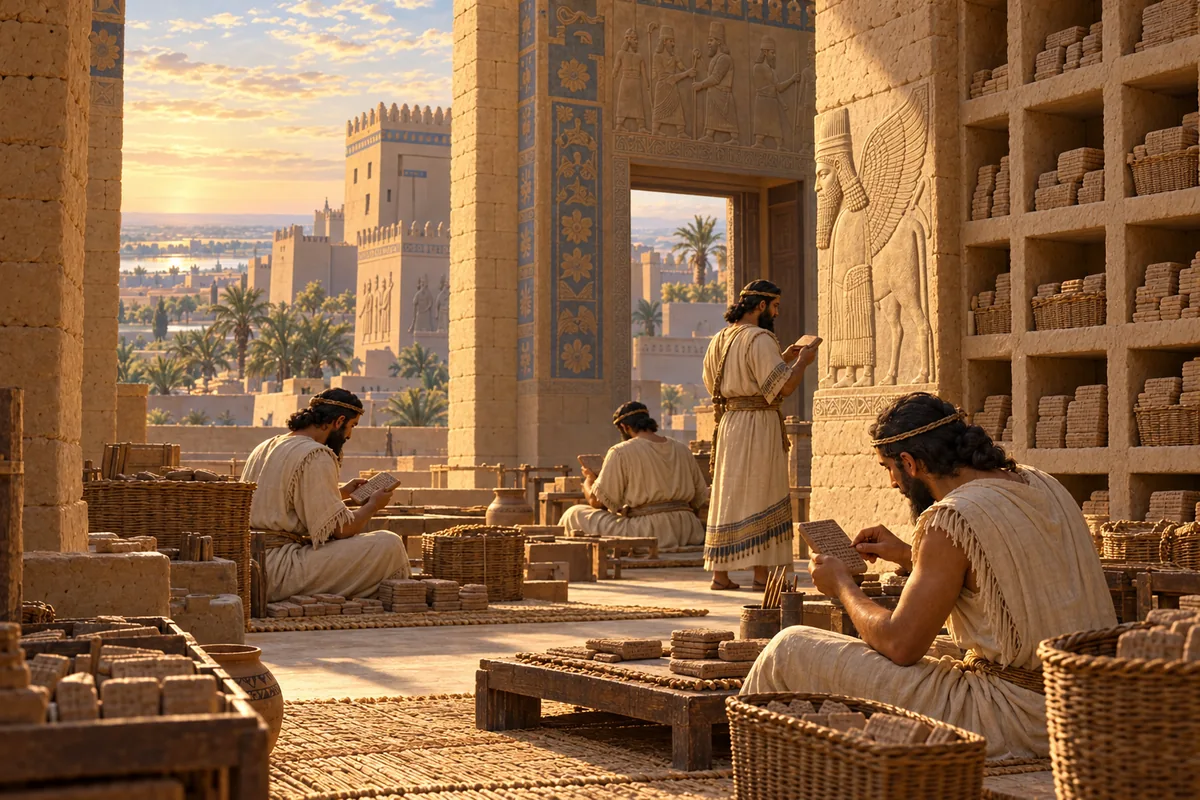
~735 BCE · Reconstructed composite — see ORACC entry for manuscript witnesses
Tiglath-pileser III 19
“Continued from text no. 18 (1) which is in midst of the land Muṣurni[..., ...] their sons, their daughters, [their] fam[ily, ...] I cut off [their hands] and I [released] (them) in their (own) land. [I carried off ...] horses, mules, [...]. (5) I destroyed, devastated, (and) burned with fire [...]. I captured, destroyed, devastated, (and) [burned] with fire [...]. I captured (and) defeated him ... [...] After gap, continued in text no. 20”
Source: Tadmor, H. & Yamada, S. 2011. The Royal Inscriptions of Tiglath-pileser III (744–727 BC) and Shalmaneser V (726–722 BC), Kings of Assyria. RINAP 1. University Park, PA: Eisenbrauns. https://oracc.museum.upenn.edu/rinap/rinap1/Q003432/
Read the full tablet entry~735 BCE · Reconstructed composite — see ORACC entry for manuscript witnesses
Tiglath-pileser III 20
“After gap, continued from text no. 19 (1') [of] Raḫiānu (Rezin) [of the land Damascus ... I carried off his he]avy [booty. ...] his advisor [... With the blood of his] war[riors I] dyed the [...] River, [..., a] raging [torrent], red [like a fl]ower. [I ...] his [lead]ers, (5´) charioteers, and [...]. I broke their weapons. I cap[tur]ed ... their horses, [their] mul[es], his [war]riors, archers, (as well as his) shield [bea]rers (and) lancers, and [I disper]sed their battle array. (8'b) In order to save his life, he (Raḫiānu) fled alone and entered the gate of his city [like] a mongoose.…”
Source: Tadmor, H. & Yamada, S. 2011. The Royal Inscriptions of Tiglath-pileser III (744–727 BC) and Shalmaneser V (726–722 BC), Kings of Assyria. RINAP 1. University Park, PA: Eisenbrauns. https://oracc.museum.upenn.edu/rinap/rinap1/Q003433/
Read the full tablet entry~735 BCE · Reconstructed composite — see ORACC entry for manuscript witnesses
Tiglath-pileser III 2001
“(1) [I, Ninurta-bēlu]-uṣur, provincial governor of the city Kār-Shalma[neser], erected solid basalt [lions ...] ... (which are) in the gate[s of] the city Ḫadattu. (4b) Ninurta-bēlu-uṣur, of the city Ṣirani, which is (in the area of) the city Ḫalaḫḫi, which is in front of the city Lipapan in the mountains, (and) my ancestral city: (6b) At that time, I created, built, (and) completed the city Ḫadattu. (8) (As for) a future ruler who repairs its dilapidated section(s but) erases my inscribed name and inscribes his (own) name (in its place), may (the god) Aššur, the great lord, (10) in the assembly of the gods verily order his destruction, ... and his name ...”
Source: Tadmor, H. & Yamada, S. 2011. The Royal Inscriptions of Tiglath-pileser III (744–727 BC) and Shalmaneser V (726–722 BC), Kings of Assyria. RINAP 1. University Park, PA: Eisenbrauns. https://oracc.museum.upenn.edu/rinap/rinap1/Q003617/
Read the full tablet entry~735 BCE · Reconstructed composite — see ORACC entry for manuscript witnesses
Tiglath-pileser III 2002
“(1) To the god Adad, canal inspector of heaven and earth, his lord: Aššur-rēmanni presented (this object) for the life of Tiglath-pileser (III), king of Assyria, his lord, and for his (own) life.”
Source: Tadmor, H. & Yamada, S. 2011. The Royal Inscriptions of Tiglath-pileser III (744–727 BC) and Shalmaneser V (726–722 BC), Kings of Assyria. RINAP 1. University Park, PA: Eisenbrauns. https://oracc.museum.upenn.edu/rinap/rinap1/Q003618/
Read the full tablet entry~735 BCE · Reconstructed composite — see ORACC entry for manuscript witnesses
Tiglath-pileser III 2003
“(1) On the life of the god Šamaš, the goddess Ereškigal, (and) the Anunnakū gods, the great gods of the netherworld, the destiny of a (mortal) life took Yabâ, the queen, into death and she went the way of her (text: “his”) ancestors. (5) (As for) anyone in the future — whether (she be) a queen who sits on a throne or a palace lady who is beloved by the king — who removes me from my tomb, or places anybody else with me, and (10) lays her (text: “his”) hand on my jewelry with evil intent (or) opens the seal of that tomb, above (on the earth), under the rays of the sun, may her (text: “his”)…”
Source: Tadmor, H. & Yamada, S. 2011. The Royal Inscriptions of Tiglath-pileser III (744–727 BC) and Shalmaneser V (726–722 BC), Kings of Assyria. RINAP 1. University Park, PA: Eisenbrauns. https://oracc.museum.upenn.edu/rinap/rinap1/Q003619/
Read the full tablet entry~735 BCE · Reconstructed composite — see ORACC entry for manuscript witnesses
Tiglath-pileser III 2004
“(1) Belonging to Yabâ, queen (and) wife of Tiglath-pileser (III), king of Assyria.”
Source: Tadmor, H. & Yamada, S. 2011. The Royal Inscriptions of Tiglath-pileser III (744–727 BC) and Shalmaneser V (726–722 BC), Kings of Assyria. RINAP 1. University Park, PA: Eisenbrauns. https://oracc.museum.upenn.edu/rinap/rinap1/Q003620/
Read the full tablet entry~735 BCE · Reconstructed composite — see ORACC entry for manuscript witnesses
Tiglath-pileser III 2005
“(1) Belonging to Yabâ, queen of Tiglath-pileser (III), king of Assyria.”
Source: Tadmor, H. & Yamada, S. 2011. The Royal Inscriptions of Tiglath-pileser III (744–727 BC) and Shalmaneser V (726–722 BC), Kings of Assyria. RINAP 1. University Park, PA: Eisenbrauns. https://oracc.museum.upenn.edu/rinap/rinap1/Q003621/
Read the full tablet entry~735 BCE · Reconstructed composite — see ORACC entry for manuscript witnesses
Tiglath-pileser III 2006
“(1) To Tiglath-pil[eser, ... magnificent] king of the lands, [...]: (3) Kīdītê, provincial gove[rnor of ...] and of (the city) Arrapḫa [...], protégé of Ti[glath-pileser, king of Assyria, (...) ...] for the palace of j[oy ...] ... [... dedicated/built]. Lacuna?”
Source: Tadmor, H. & Yamada, S. 2011. The Royal Inscriptions of Tiglath-pileser III (744–727 BC) and Shalmaneser V (726–722 BC), Kings of Assyria. RINAP 1. University Park, PA: Eisenbrauns. https://oracc.museum.upenn.edu/rinap/rinap1/Q004178/
Read the full tablet entry