Chapter 07 · 911 – 609 BCE
Neo-Assyrian
Empire, library, terror, scholarship.
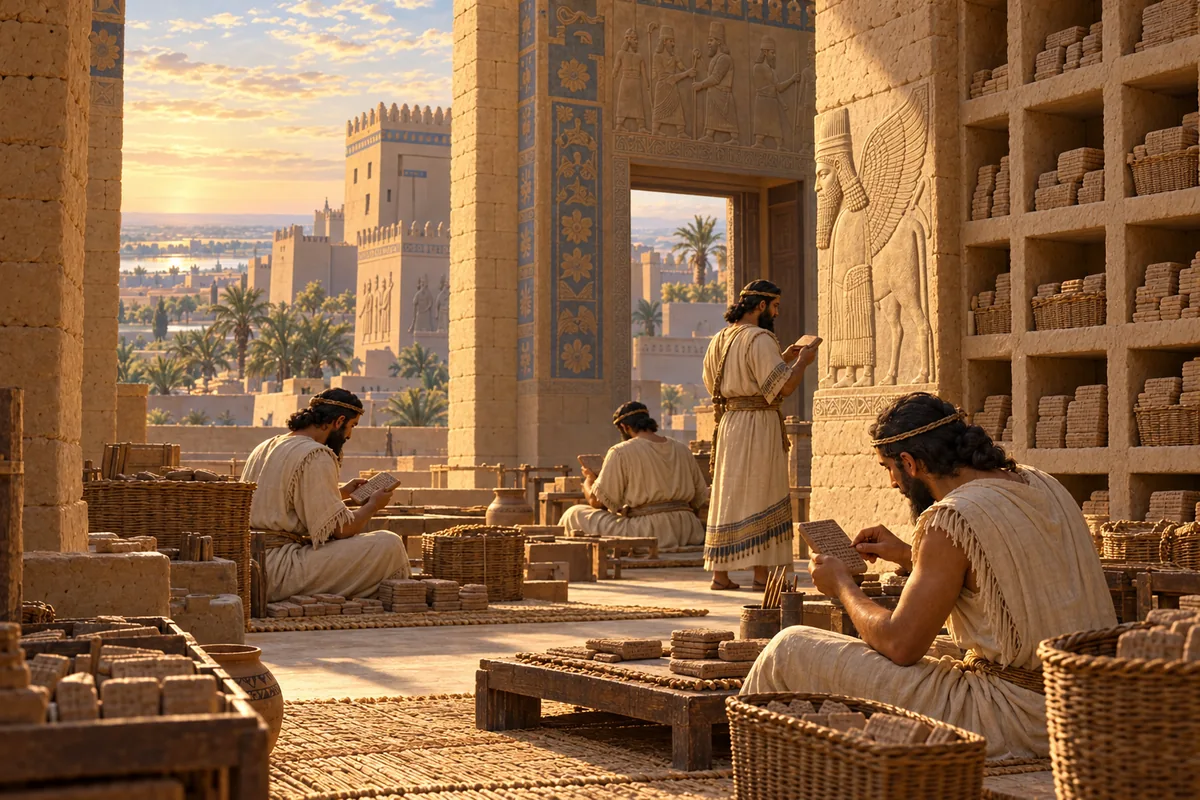
~900 BCE · Reconstructed composite — see ORACC entry for manuscript witnesses
Adad-nerari II 1
In plain English
Adad-nerari II identifies himself as great king, strong king, king of the world, king of Assyria, and ruler of all four quarters — chosen by the god Aššur, attentive in his rule, and acting with the backing of the great gods Aššur and Ninurta, who helped him strike down his enemies. He traces his lineage through three generations: his father Aššur-dan II, his grandfather Tiglath-pileser II, and his great-grandfather Aššur-resha-ishi II, each also titled king of the world and king of Assyria. The inscription then turns to his accession year and first regnal year, beginning an account of when he took the throne — but the surface breaks off there.
AI-generated reading paraphrase; compare with the translation below.
“(1) Adad-nārārī (II), great king, strong king, king of the world, king of Assyria, king of all the four quarters (of the world), the one selected by (the god) Aššur, attentive ruler, the one who acts with the support of the gods Aššur and Ninurta, the great gods, his lords, and (thereby) has struck down his foes; (5) son of Aššur-dān (II), king of the world, king of Assyria, son of Tiglath-pileser (II), king of the world, king of Assyria, son of Aššur-rēša-iši (II), (who was) also king of the world (and) king of Assyria. (8) In my accession year (and) in my first regnal year, when I sat on…”
Source: Royal Inscriptions of Assyria online (RIAo), Munich Open-access Cuneiform Corpus Initiative (MOCCI), Ludwig-Maximilians-Universität München; in association with the RINAP Project, University of Pennsylvania. https://oracc.museum.upenn.edu/riao/Q006020/
Read the full tablet entry~900 BCE · Reconstructed composite — see ORACC entry for manuscript witnesses
Adad-nerari II 1002
In plain English
Adad-nārārī II identifies himself as strong king, king of the world, and king of Assyria — son of Aššur-dān II, who was likewise king of the world and king of Assyria, and grandson of Tiglath-pileser II, who held the titles king of the universe and king of Assyria. The opening label 'Image of Adad-nārārī II' is partially broken, and several phrases in the lineage are damaged but recoverable.
AI-generated reading paraphrase; compare with the translation below.
“(1) [Image of Adad-nārārī (II)], strong [king], king of the world, [king of] Assyria, son of Aššur-d[ān (II), king of the world, king of] Assyria, son of Ti[glath-piles]er (II), (who was) also [king of the universe (and) king of] Assyria.”
Source: Royal Inscriptions of Assyria online (RIAo), Munich Open-access Cuneiform Corpus Initiative (MOCCI), Ludwig-Maximilians-Universität München; in association with the RINAP Project, University of Pennsylvania. https://oracc.museum.upenn.edu/riao/Q006029/
Read the full tablet entry~900 BCE · Reconstructed composite — see ORACC entry for manuscript witnesses
Adad-nerari II 2
In plain English
The inscription opens by invoking a long roster of great gods: Aššur and Enlil (both names damaged), then Sîn king of the lunar disk and lord of brilliance, Šamaš judge of heaven and netherworld and commander of all, Marduk sage of the gods and lord of oracles, Ninurta warrior of the Igīgū and Anunnakū gods, Nergal the perfect one and king of battle, Nusku bearer of the holy scepter, the goddess Mullissu spouse of Enlil and mother of the great gods, and the goddess Ištar foremost in heaven and netherworld and supreme in the arts of war. The list breaks off mid-sentence — the text is lost before the gods' role or action is stated.
AI-generated reading paraphrase; compare with the translation below.
“(1) [The god Aššur, ...; the god Enlil, ...]; the god [Sîn, king of the lunar disk], lord of brilliance; [the god Šamaš, judge of] heaven and netherworld, commander of all; the god Marduk, sage of the gods, lord of oracles; the god Nin[urta, warrior of] the Igīgū and Anunnakū gods; the god Nergal, perfect one, king of battle; the god Nusku, bearer of the holy scepter, circumspect god; the goddess Mullissu, spouse of the god Enlil, mother of the great gods; (and) the goddess Ištar, foremost in heaven and netherworld, who is consummate in the canons of combat; (5) the great gods who take firm…”
Source: Royal Inscriptions of Assyria online (RIAo), Munich Open-access Cuneiform Corpus Initiative (MOCCI), Ludwig-Maximilians-Universität München; in association with the RINAP Project, University of Pennsylvania. https://oracc.museum.upenn.edu/riao/Q006021/
Read the full tablet entry~900 BCE · Reconstructed composite — see ORACC entry for manuscript witnesses
Adad-nerari II 3
In plain English
The opening lines are too damaged to translate. What survives is a closing formula: the king deposited his commemorative inscriptions here, and calls on any future ruler who finds the monument to restore it and return his inscribed name to its place — if he does, Aššur, the great lord, will hear his prayers. Any ruler who removes the inscriptions or erases the king's name will have his kingship overthrown by Aššur and his name and descendants wiped from the land. The date at the end is missing.
AI-generated reading paraphrase; compare with the translation below.
“(r 1') (No translation possible.) (r 11'b) [... and deposited] my [commemorative inscrip]tions. (r 12'b) [May a future ruler restore it (and) return my inscribed name t]o its place. [(The god) Aššur, the great lord, will (then) listen to his prayers]. (r 13'b) [(As for) the one who removes] my [insc]riptions [and my name, may (the god) Aššur overthrow his kingship (and)] make [his name (and) his seed] disappear [from the land]. (r 15') (Date missing)”
Source: Royal Inscriptions of Assyria online (RIAo), Munich Open-access Cuneiform Corpus Initiative (MOCCI), Ludwig-Maximilians-Universität München; in association with the RINAP Project, University of Pennsylvania. https://oracc.museum.upenn.edu/riao/Q006022/
Read the full tablet entry~900 BCE · Reconstructed composite — see ORACC entry for manuscript witnesses
Adad-nerari II 4
In plain English
Adad-nārārī II speaks in the first person: he is radiant, heroic, a warrior, a raging lion, foremost and exalted. He is strong king of Assyria, king of the four quarters of the world, crusher of enemies, overwhelmer of cities, and scorcher of foreign mountain lands. He controls those who oppose him and burns with fury against the evil and the wicked. He scorches like the god Gīra and overwhelms like a flood — the text breaks off there, the remainder lost.
AI-generated reading paraphrase; compare with the translation below.
“(1') [I am enormously radiant, I am a hero], I am a warrior, [I am a virile] lion, [I am foremost, I am exalted, (and) I am raging]. (2') Adad-nārārī (II), strong king, king of [Assyria, king of the four quarters (of the world), the one who defeats his enemies, am I]. The king capable in battle, overwhelmer [of cities, (and) the one who scorches the mountains of (foreign) lands, am I]. The virile warrior, [the one who controls those opposed to him, (and the one) who is inflamed against the evil] and the wicked, am I. I scorch] like the god Gīra, [I overwhelm like the deluge, ...], (and) I…”
Source: Royal Inscriptions of Assyria online (RIAo), Munich Open-access Cuneiform Corpus Initiative (MOCCI), Ludwig-Maximilians-Universität München; in association with the RINAP Project, University of Pennsylvania. https://oracc.museum.upenn.edu/riao/Q006023/
Read the full tablet entry~900 BCE · Reconstructed composite — see ORACC entry for manuscript witnesses
Adad-nerari II 6
In plain English
Adad-nārārī II identifies himself as strong king, king of the world, and king of Assyria, son of Aššur-dān II — likewise king of the world and king of Assyria — and grandson of Tiglath-pileser II, who also held those same titles. The rest of the inscription is too damaged to read.
AI-generated reading paraphrase; compare with the translation below.
“(1) [(Palace of) Adad-nār]ārī (II), strong king, king of the wor[ld, king of Assyria, son of Aššur-d]ān (II), king of the world, king of Assyria, [son of Tiglath]-pileser (II), (who was) also king of the wor[ld (and) king of Assyria: ...] ... [...]”
Source: Royal Inscriptions of Assyria online (RIAo), Munich Open-access Cuneiform Corpus Initiative (MOCCI), Ludwig-Maximilians-Universität München; in association with the RINAP Project, University of Pennsylvania. https://oracc.museum.upenn.edu/riao/Q006025/
Read the full tablet entry~900 BCE · Reconstructed composite — see ORACC entry for manuscript witnesses
Adad-nerari II 7
Attests the royal titulary of Adad-nārārī II — 'king of the world, king of Assyria' — and anchors his lineage through Aššur-dān II to Tiglath-pileser II, fixing the dynastic continuity of the early Neo-Assyrian restoration.
In plain English
This is the palace of Adad-nerari II, king of the universe and king of Assyria. He was the son of Aššur-dān II, likewise king of the universe and king of Assyria, and the grandson of Tiglath-pileser I, who held those same titles before him. The rest of the inscription is lost.
AI-generated reading paraphrase; compare with the translation below.
“Palace of Adad-nerari II, king of the universe, king of Assyria, son of Aššur-dān [II], king of the universe, king of Assyria, son of Tiglath-pileser [I], king of the universe, king of Assyria.”
Source: engine:claude-sonnet-4-6 (2026-05-28/v6-glossary-aware) · claude-sonnet-4-6 · medium confidence
Read the full tablet entry~900 BCE · Reconstructed composite — see ORACC entry for manuscript witnesses
Adad-nerari II 8
Standard titulary of Adad-nārārī II anchoring his legitimacy through two generations of royal descent, attesting the formulaic language by which Assyrian kings asserted dynastic continuity around 900 BCE.
In plain English
This is the palace of Adad-nārārī II, great king, strong king, king of the world, and king of Assyria. He was the son of Aššur-dān II, king of the world and king of Assyria, who was himself the son of Tiglath-pileser II, likewise king of the world and king of Assyria.
AI-generated reading paraphrase; compare with the translation below.
“(1) Palace of Adad-nārārī (II), great king, strong king, king of the world, king of Assyria, son of Aššur-dān (II), [king of the world], king of Assyria, son of Tigla[th-piles]er (II), [(who was) also] king of the world (and) [king of Assyria].”
Source: Royal Inscriptions of Assyria online (RIAo), Munich Open-access Cuneiform Corpus Initiative (MOCCI), Ludwig-Maximilians-Universität München; in association with the RINAP Project, University of Pennsylvania. https://oracc.museum.upenn.edu/riao/Q006027/
Read the full tablet entry