Chapter 07 · 911 – 609 BCE
Neo-Assyrian
Empire, library, terror, scholarship.
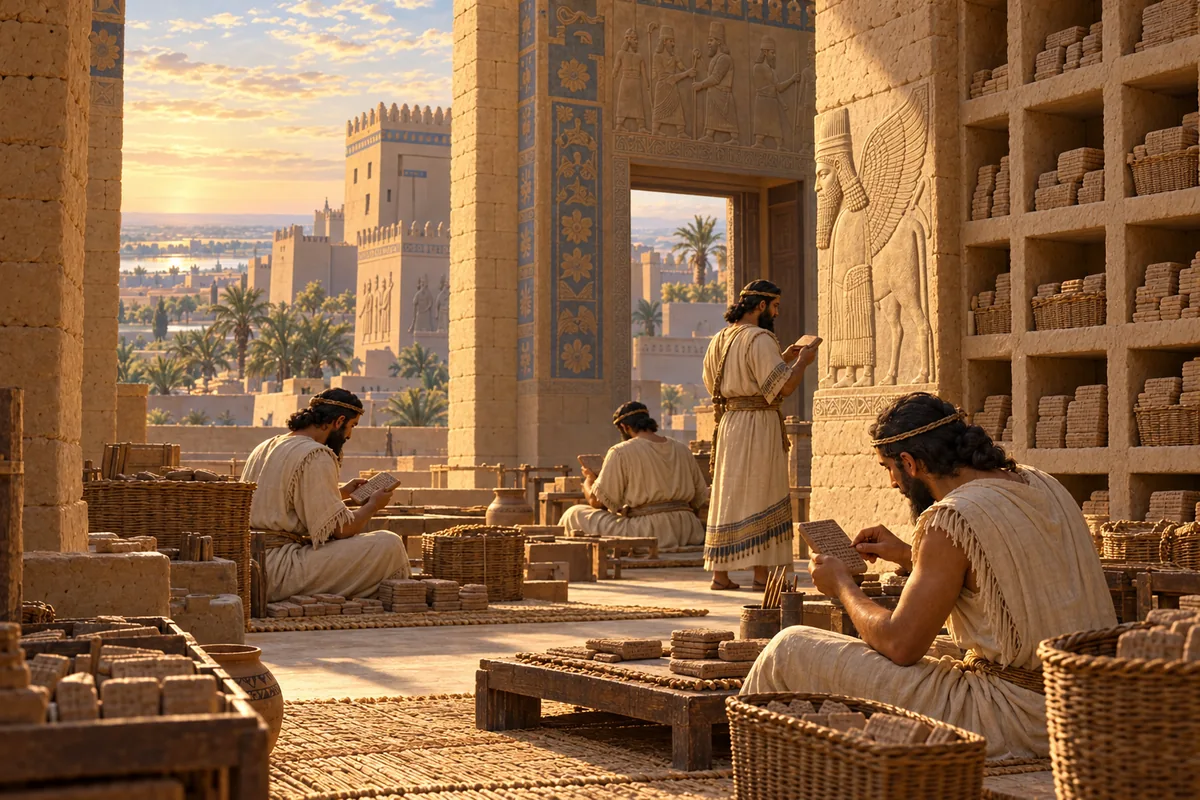
~885 BCE · Reconstructed composite — see ORACC entry for manuscript witnesses
Tukulti-Ninurta II 02
“(1) [(The god) Aššur, king of al]l the [great] gods; [the god Anu, king of] the Igīgū and Anun[nakū gods; lord of the lands, the god Enlil, exalted one], father of the god[s; the god Ea, king of the a]psû, the one who decre[es destinies; the god Sîn, king of the lunar d]isk, lord of [brilliance; the god Adad, the] exceptionally [stron]g, lord of [abundance; the god Šamaš, ju]dge of heaven and netherworld, [commander of all; the god Marduk], sage of the gods (and) [lord of omens; the god Ninurta], warrior of the Igīgū and Anun[nakū gods; god] Nergal, perfect one, [king of battle]; the god…”
Source: Royal Inscriptions of Assyria online (RIAo), Munich Open-access Cuneiform Corpus Initiative (MOCCI), Ludwig-Maximilians-Universität München; in association with the RINAP Project, University of Pennsylvania. https://oracc.museum.upenn.edu/riao/Q006032/
Read the full tablet entry~885 BCE · Reconstructed composite — see ORACC entry for manuscript witnesses
Tukulti-Ninurta II 03
“(1) [(the god) Aššur, king of all the great gods; god Anu, king of the Igīgū and Anunnakū gods]; lord of the lands; the god Enlil, exalted one, [father of the gods; the god Ea, king of the apsû, who decrees destinies; the god Sîn, king of the lunar disk, lord of brilliance]; the god Adad, the exceptionally strong, lo[rd of abundance; the god Šamaš, judge of heaven and netherworld, commander of all; the god Marduk, sage of the gods (and) lord of omens]; the god Ninurta, warrior of the Igīgū and [Anunnakū gods; the god Nergal, perfect one, king of battle; the god Nusku, bearer of the holy…”
Source: Royal Inscriptions of Assyria online (RIAo), Munich Open-access Cuneiform Corpus Initiative (MOCCI), Ludwig-Maximilians-Universität München; in association with the RINAP Project, University of Pennsylvania. https://oracc.museum.upenn.edu/riao/Q006033/
Read the full tablet entry~885 BCE · Reconstructed composite — see ORACC entry for manuscript witnesses
Tukulti-Ninurta II 04
“(1') [the god Marduk], sage of [the gods (and) lord of omens; the god Nin]urta, warrior of the Igīgū and Anun[nakū gods; the god Nerga]l, perfect one, [king of battle; the god Nus]ku, bearer of the holy scepter, [circumspect god; the goddess Mill]issu, spouse of the god Enlil, mother of the [great] god[s; (and) the goddess Ištar], foremost in heaven and netherworld, [who is consummate] in the canon[s of combat]. (7') the great [gods], who take firm decisions, [who decree destinies, who ...] ... attent[ive] ruler, [...; (the gods) who] faithful[ly noticed me in] my mother’s womb (and) [altered] my [bi]rth to be a lordly birth; [...] ... people [...] holy ... [... they rightly made perfect my fe]atu[res ...] (r 1') No translation possible.”
Source: Royal Inscriptions of Assyria online (RIAo), Munich Open-access Cuneiform Corpus Initiative (MOCCI), Ludwig-Maximilians-Universität München; in association with the RINAP Project, University of Pennsylvania. https://oracc.museum.upenn.edu/riao/Q006034/
Read the full tablet entry~885 BCE · Reconstructed composite — see ORACC entry for manuscript witnesses
Tukulti-Ninurta II 05
“(1) I [entered] the mountains of the Naʾiri lands. I crossed Mount Sueia. I changed [direction] (and), on my return march, from the Naʾiri lands [I burned] fire [(...)] the city Ki[...]. I [uprooted] his sons, his daughters, his wives, the property of his palace, (and) his horses [and brought them to my city, Aššur]. (4) With the support of (the god) Aššur, my lord, I overwhelmed the lands, all of them, with my fear. Bi[..., ...].... of Ammi-Ba[ʾal], wrote to me: “With regard to Bialasi, I have sent my forces against him. [They pursued him and] he went from the city Udu to the city…”
Source: Royal Inscriptions of Assyria online (RIAo), Munich Open-access Cuneiform Corpus Initiative (MOCCI), Ludwig-Maximilians-Universität München; in association with the RINAP Project, University of Pennsylvania. https://oracc.museum.upenn.edu/riao/Q006035/
Read the full tablet entry~885 BCE · Reconstructed composite — see ORACC entry for manuscript witnesses
Tukulti-Ninurta II 06
“(1) [Palace of Tukultī-Ninurta (II), king of the world, king of Assyria], son of Adad-nārārī (II), king of the world, king of Assyria, son of Aššur-dān (II), (who was) also king of the world (and) king of Assyria; [...] to its full extent. The king who [...] (the territory stretching) from the opposite bank of the Tigris River to the land Ḫatti, [...] the Naʾiri lands to their (text: “its”) full extent, the land Sūḫu, including [the city Rapiqu, [(...); he] captured [... from the passes of] the land Ḫabruri to the land Gilzānu, Apâ, king of the city Ḫubuškia, [... H]e conquered (the territory…”
Source: Royal Inscriptions of Assyria online (RIAo), Munich Open-access Cuneiform Corpus Initiative (MOCCI), Ludwig-Maximilians-Universität München; in association with the RINAP Project, University of Pennsylvania. https://oracc.museum.upenn.edu/riao/Q006036/
Read the full tablet entry~885 BCE · Reconstructed composite — see ORACC entry for manuscript witnesses
Tukulti-Ninurta II 07
Preserves Tukulti-Ninurta II's own account of a building project — specifying brick-course increments — adding measurable detail to the archaeological record of Assyrian royal construction between Adad-nārārī II and Aššurnasirpal II.
“(1') [Palace of Tukultī-Ninurta (II), vice-regent of (the god) Aššur, son of Adad-nārārī (II), vice-regent of (the god) Ašš]ur, son of Aššur-dān (II), (who was) also vice-regent of (the god) Aššur. At that time, the towers of [...]. I raised (its height) [N layers of] brick; [I added] thirty-five layers of brick more than before. [...]”
Source: Royal Inscriptions of Assyria online (RIAo), Munich Open-access Cuneiform Corpus Initiative (MOCCI), Ludwig-Maximilians-Universität München; in association with the RINAP Project, University of Pennsylvania. https://oracc.museum.upenn.edu/riao/Q006037/
Read the full tablet entry~885 BCE · Reconstructed composite — see ORACC entry for manuscript witnesses
Tukulti-Ninurta II 09
“(1) Palace of Tukultī-Ninurta (II), king of the world, king of Assyria, son of Adad-nārārī (II), king of the world, king of Assyria, son of Aššur-dān (II), (who was) also king of the world (and) king of Assyria: stone slab belonging to the city Kaḫat.”
Source: Royal Inscriptions of Assyria online (RIAo), Munich Open-access Cuneiform Corpus Initiative (MOCCI), Ludwig-Maximilians-Universität München; in association with the RINAP Project, University of Pennsylvania. https://oracc.museum.upenn.edu/riao/Q006039/
Read the full tablet entry~885 BCE · Reconstructed composite — see ORACC entry for manuscript witnesses
Tukulti-Ninurta II 10
“(1) Palace of Tukultī-Ninurta (II), [king of the world, king of Assyria], son of Adad-nārārī (II), king of the world, king of Assyria, son of Aššur-dān (II), (who was) also king of the world (and) king of Assyria: two-thirds mina of a … of a stone ...”
Source: Royal Inscriptions of Assyria online (RIAo), Munich Open-access Cuneiform Corpus Initiative (MOCCI), Ludwig-Maximilians-Universität München; in association with the RINAP Project, University of Pennsylvania. https://oracc.museum.upenn.edu/riao/Q006040/
Read the full tablet entry