Chapter 07 · 911 – 609 BCE
Neo-Assyrian
Empire, library, terror, scholarship.
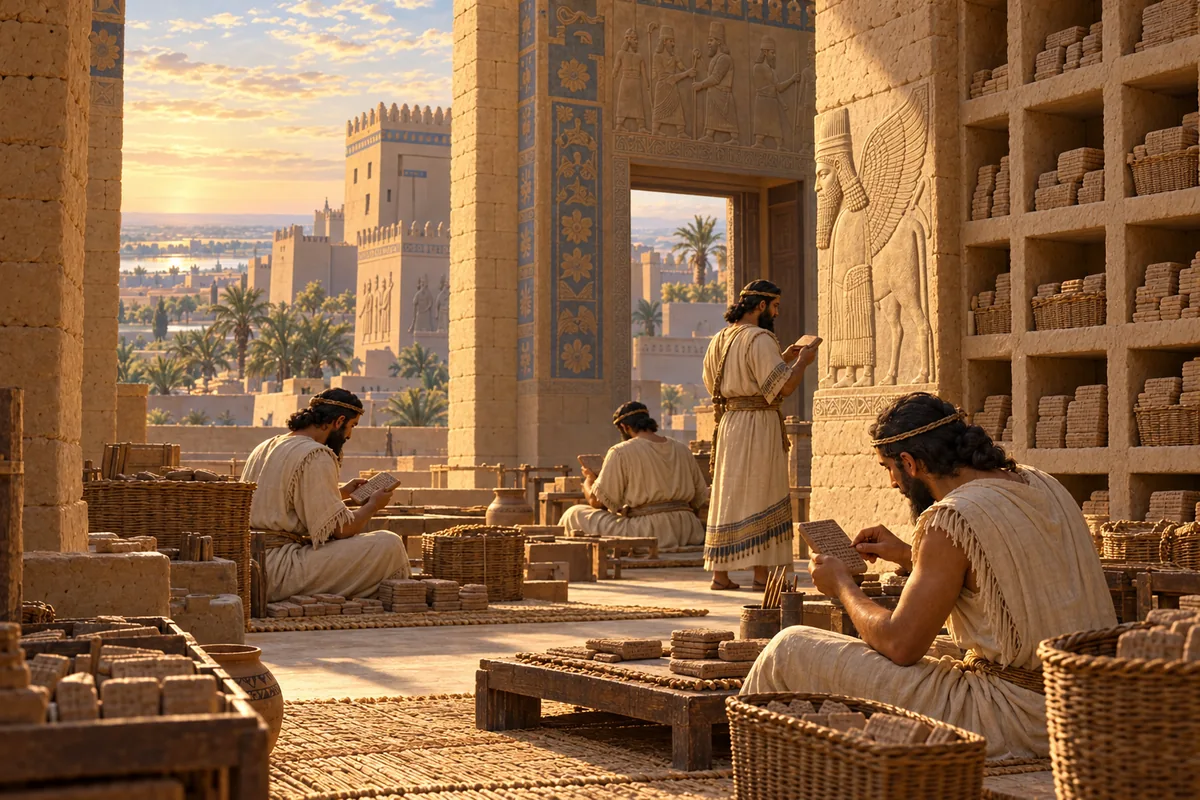
~885 BCE · Reconstructed composite — see ORACC entry for manuscript witnesses
Tukulti-Ninurta II 1001
“(1) Palace of [...], son of Aššur-[dān (II), …] al[l …] to [...] as far as the land [...]”
Source: Royal Inscriptions of Assyria online (RIAo), Munich Open-access Cuneiform Corpus Initiative (MOCCI), Ludwig-Maximilians-Universität München; in association with the RINAP Project, University of Pennsylvania. https://oracc.museum.upenn.edu/riao/Q006048/
Read the full tablet entry~885 BCE · Reconstructed composite — see ORACC entry for manuscript witnesses
Tukulti-Ninurta II 1002
Fragmentary royal inscription of Tukulti-Ninurta II attesting Assyrian claims over Sūḫu and Dūr-Kurigalzu, tracing the mid-Euphrates frontier his son Aššurnaṣirpal II would later consolidate.
“(1') [...] … [... the land S]ūḫu, includ[ing … the city T]īl-bāri, [... the city Dū]r-Kurigalzu, [...] at (his) feet. [...] the god [...]”
Source: Royal Inscriptions of Assyria online (RIAo), Munich Open-access Cuneiform Corpus Initiative (MOCCI), Ludwig-Maximilians-Universität München; in association with the RINAP Project, University of Pennsylvania. https://oracc.museum.upenn.edu/riao/Q006049/
Read the full tablet entry~885 BCE · Reconstructed composite — see ORACC entry for manuscript witnesses
Tukulti-Ninurta II 1003
“(1) (1 - 3) Palace of [...] king of the world, king of [...], son of Adad-nār[ārī (II), ...]”
Source: Royal Inscriptions of Assyria online (RIAo), Munich Open-access Cuneiform Corpus Initiative (MOCCI), Ludwig-Maximilians-Universität München; in association with the RINAP Project, University of Pennsylvania. https://oracc.museum.upenn.edu/riao/Q006050/
Read the full tablet entry~885 BCE · Reconstructed composite — see ORACC entry for manuscript witnesses
Tukulti-Ninurta II 11
“(1) Necklace of Tukultī-Ninurta (II), king of Assyria, son of Adad-nārārī (II), king of Assyria.”
Source: Royal Inscriptions of Assyria online (RIAo), Munich Open-access Cuneiform Corpus Initiative (MOCCI), Ludwig-Maximilians-Universität München; in association with the RINAP Project, University of Pennsylvania. https://oracc.museum.upenn.edu/riao/Q006041/
Read the full tablet entry~885 BCE · Reconstructed composite — see ORACC entry for manuscript witnesses
Tukulti-Ninurta II 12
“(1) [ Palace of Tukultī]-Ninurta (II), great king, [strong king, king of the world, king of Assyria, son of Adad-nārārī (II)], great king, [strong king, king of the world, king of Assyria, son of Aššur-dān (II), (who was) also] great king, [strong king, king of the world (and) king of Assyria].”
Source: Royal Inscriptions of Assyria online (RIAo), Munich Open-access Cuneiform Corpus Initiative (MOCCI), Ludwig-Maximilians-Universität München; in association with the RINAP Project, University of Pennsylvania. https://oracc.museum.upenn.edu/riao/Q006042/
Read the full tablet entry~885 BCE · Reconstructed composite — see ORACC entry for manuscript witnesses
Tukulti-Ninurta II 13
Royal titulary of Tukulti-Ninurta II naming three generations of Assyrian kings, anchoring the dynastic continuity claims that legitimised early Neo-Assyrian imperial expansion before Ashurnasirpal II.
“(1) [Palace of] Tukultī-Ninurta (II), strong [king], king of the world, king of Assyria, [son of Adad]-nārārī (II), king of the world, king of Assyria, [son of Aššur]-dān (II), (who was) also king of the world(and) king of Assyria.”
Source: Royal Inscriptions of Assyria online (RIAo), Munich Open-access Cuneiform Corpus Initiative (MOCCI), Ludwig-Maximilians-Universität München; in association with the RINAP Project, University of Pennsylvania. https://oracc.museum.upenn.edu/riao/Q006043/
Read the full tablet entry~885 BCE · Reconstructed composite — see ORACC entry for manuscript witnesses
Tukulti-Ninurta II 14
“(1) Palace of Tukultī-Ninurta (II), king of the world, king of Assyria, son of Adad-nārārī (II), king of Assyria: I/he restored the dilapidated section(s) of the tower(s) of the gate of the god Enpi.”
Source: Royal Inscriptions of Assyria online (RIAo), Munich Open-access Cuneiform Corpus Initiative (MOCCI), Ludwig-Maximilians-Universität München; in association with the RINAP Project, University of Pennsylvania. https://oracc.museum.upenn.edu/riao/Q006044/
Read the full tablet entry~885 BCE · Reconstructed composite — see ORACC entry for manuscript witnesses
Tukulti-Ninurta II 15
Preserves Tukulti-Ninurta II's three-generation royal genealogy, anchoring his legitimacy to Adad-nārārī II and Aššur-dān II within the standard titulary of early Neo-Assyrian kingship.
“(1) Palace of Tukultī-Ninurta (II), strong king, king of the world, [king of] Assyria, son of Adad-nārārī (II) strong king, king of the world, king of Assyria, son of Aššur-dān (II), (who was) also king of the world (and) king of Assyria.”
Source: Royal Inscriptions of Assyria online (RIAo), Munich Open-access Cuneiform Corpus Initiative (MOCCI), Ludwig-Maximilians-Universität München; in association with the RINAP Project, University of Pennsylvania. https://oracc.museum.upenn.edu/riao/Q006045/
Read the full tablet entry