Chapter 07 · 911 – 609 BCE
Neo-Assyrian
Empire, library, terror, scholarship.
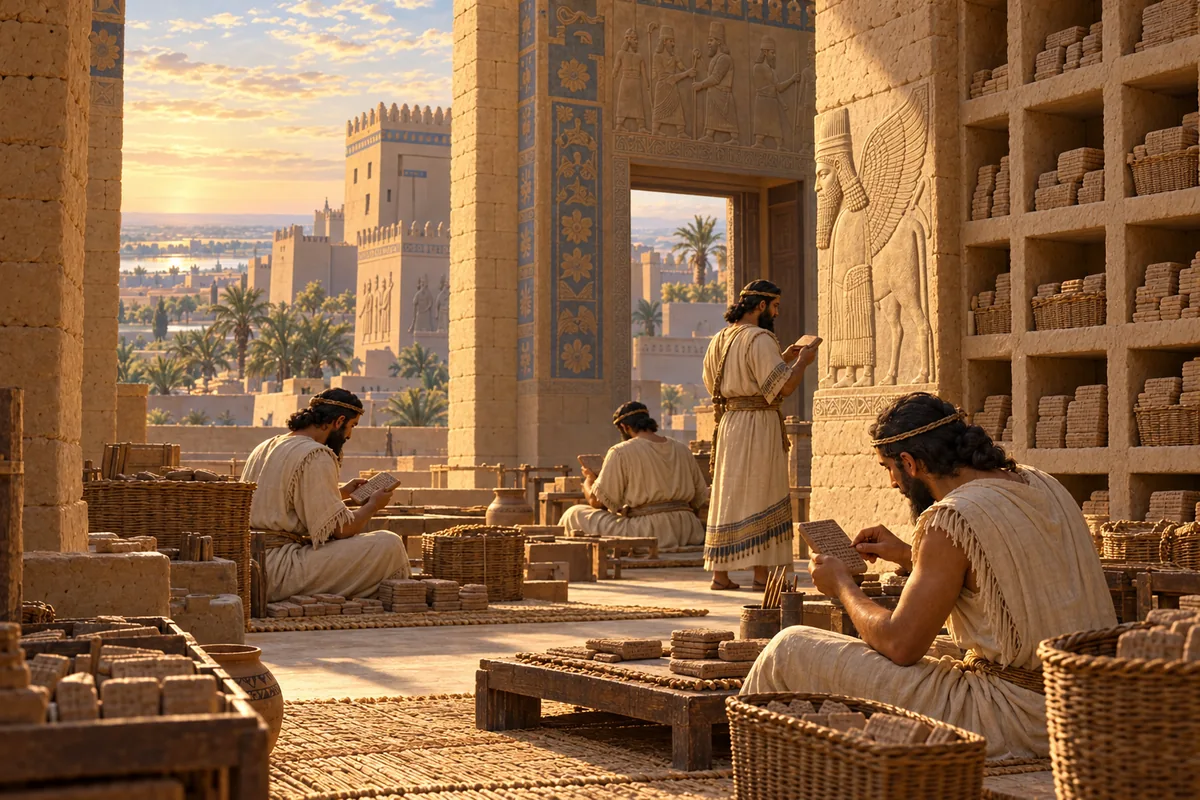
~715 BCE · Reconstructed composite — see ORACC entry for manuscript witnesses
SAA 15 130. The King of Elam Mobilizes his Troops (ABL 1315)
“(1) [To the governor, my lord: your servant Nabû-duru-uṣur. Good health to my lord! The city of Der and] the for[t] are [well]. (5) [NN and] his associate have writ[ten to me]: (6) ["The king of Ela]m is mob[ilizing] troops. (7) ["......] on the bord[er] (8) ["......] the exit of water [...... are] with him. (9) "Now then [the ... who relie]ved me [......]: 'Go and pro[tect] your lord! [...] I am your servant. The servant [of ...] is returning home (and) [...]. If [he proceeds] to battle, [...].' (15) "On account of this the king of Elam [......]. The sheikhs [of Hupapa]ni (and) Pillat [ha]d…”
Source: Fuchs, A. & Parpola, S. 2001. The Correspondence of Sargon II, Part III: Letters from Babylonia and the Eastern Provinces. SAA 15. Helsinki: Helsinki University Press. https://oracc.museum.upenn.edu/saao/saa15/P334847/
Read the full tablet entry~715 BCE · Reconstructed composite — see ORACC entry for manuscript witnesses
SAA 15 131. A Chance to Recapture Bit-Ha’ir (ABL 1093)
“(1) To the governor, my lord: your servant Nabû-duru-uṣur. Good health to my lord! The city of Der and the fort are well. (6) Lu-ahu'a, a man from Bit-Ha'ir, and Ahu-iaqar from Bit-Sîn-ibni, had an audience with me and Bel-emuranni, and spoke with us as follows: "[C]ome with al[l the men] in yo[ur] hands, [gather] wha[tever can] go with y[ou t]o Bit-Ha'ir, all those w[ho] are devoted to Eṭiru and [do not g]o with the Elamites, and come! [W]e shall give up the city [and deliv]er it [into your hands]!" (b.e. 20) [I said: "I] shall send [Bel-e]muran[ni to the Palace. Bit-H]a'ir be[longs] to the…”
Source: Fuchs, A. & Parpola, S. 2001. The Correspondence of Sargon II, Part III: Letters from Babylonia and the Eastern Provinces. SAA 15. Helsinki: Helsinki University Press. https://oracc.museum.upenn.edu/saao/saa15/P334731/
Read the full tablet entry~715 BCE · Reconstructed composite — see ORACC entry for manuscript witnesses
SAA 15 132. The King is Coming to Der (CT 53 917)
“(1) [To] the kin[g, my lord: your servant] Nabû-[duru-uṣur. Good health] to [the king, my lord]! The city of D[er and the fo]rt [are well]. (6) The bod[yguard NN ...] (7) [... in(to) my p]resence [......] (8) [...] N[N ......] (Break) (r 2) Let the king [my lord] send [to] us [for ...] days [NN and ...]zû, the eunuchs [of ...], and let them [......] to the patient. (r 6) [...] should go [to De]r [...]. (r 7) [Alternatively], the king, my l[ord], should come with [......]; he should sp[e]ak [with the king], my lord. (r 10) [... the cit]y of Der with the ki[ng] (r 11) [...] 5 Babylonians (r.e. 12) [...] are going up (r.e. 13) [...] a Babylonian (r.e. 14) [...] the royal seal (r.e. 15) [...]”
Source: Fuchs, A. & Parpola, S. 2001. The Correspondence of Sargon II, Part III: Letters from Babylonia and the Eastern Provinces. SAA 15. Helsinki: Helsinki University Press. https://oracc.museum.upenn.edu/saao/saa15/P314326/
Read the full tablet entry~715 BCE · Reconstructed composite — see ORACC entry for manuscript witnesses
SAA 15 133. The Messenger Should not Tarry (CT 53 285)
“(1) [To] the governor, my l[ord: your servant Nabû-duru-uṣur. Good he]alth to [my] lord! [The city of Der and] the fort are [well]. (Break) (r 2) [...... it has] rained; the wat[er ...] (r 3) [I have written] to the [governor], my [lo]rd; let my lord do as [the gover]nor, my lord, finds [acceptab]le. The messenger should not tarry; let my lord [quickly] give him orders, [and let him] come here. (r 8) Pe[rhaps] my [lord] will say: "[...] are covered" — (r 10) the servant[s ...] (r 11) [w]hat their work [...] (r 12) cattle [...]”
Source: Fuchs, A. & Parpola, S. 2001. The Correspondence of Sargon II, Part III: Letters from Babylonia and the Eastern Provinces. SAA 15. Helsinki: Helsinki University Press. https://oracc.museum.upenn.edu/saao/saa15/P313700/
Read the full tablet entry~715 BCE · Reconstructed composite — see ORACC entry for manuscript witnesses
SAA 15 134. “My Father Went to Assyria” (CT 53 388)
“(Beginning destroyed) (1) ["...] I shall fini[sh ......] (2) "My [fa]ther who [was] the pr[elate of ...] (3) wen[t t]o Assyria [......] (4) [...] ... [......] (5) [...] where the king [......] (6) [... h]e wrot[e ......] (7) [......] (8) [...] ... [......] (9) [Conc]erning the chief [......] (10) [he has sen]t his whole [arm]y [......] (11) they are go[ing ......] (12) their [......] (Break) (r 5) I shall go to Bit-Hu[......] (r 6) If [......], I shall go [to ...] (r 7) 12 magnate[s ......] (r 8) [hor]ses [......] (Break) (e. 4) his [...] before [......] (e. 5) [...] people in [......]”
Source: Fuchs, A. & Parpola, S. 2001. The Correspondence of Sargon II, Part III: Letters from Babylonia and the Eastern Provinces. SAA 15. Helsinki: Helsinki University Press. https://oracc.museum.upenn.edu/saao/saa15/P313802/
Read the full tablet entry~715 BCE · Reconstructed composite — see ORACC entry for manuscript witnesses
SAA 15 135. The God Enters his House (CT 53 886)
“(Beginning destroyed) (1) [Concerning what] my [lo]rd, wrote to me: "Be on the alert until the god has entered [the inner sanc]tum, and let your guard be strong" — (Rest destroyed)”
Source: Fuchs, A. & Parpola, S. 2001. The Correspondence of Sargon II, Part III: Letters from Babylonia and the Eastern Provinces. SAA 15. Helsinki: Helsinki University Press. https://oracc.museum.upenn.edu/saao/saa15/P314295/
Read the full tablet entry~715 BCE · Reconstructed composite — see ORACC entry for manuscript witnesses
SAA 15 136. Lahiru Honors its Assyrian Lord; Sketching and Manning a Fort (ABL 0685)
“(1) [To the ki]ng, my lord: [your servant] Nabû-šumu-iddina. [Good hea]lth to the king, my lord! The fort, the exempts, and the servants of the king my lord are well. (6) [They have hon]oured the palace [super]intendent whom the king, my lord, placed [in charge of M]ahumaya. Lahiru, the towns [bey]ond and those around them are [extr]emely glad, saying: "Now we know [th]at [w]e are servants of the king, our lord." (12) Concerning what the king, my lord, wrote to me: "[Inspe]ct in detail (the area) around the fort (suitable) for cultivating the st[eppe]" — I have inspected it, there is very…”
Source: Fuchs, A. & Parpola, S. 2001. The Correspondence of Sargon II, Part III: Letters from Babylonia and the Eastern Provinces. SAA 15. Helsinki: Helsinki University Press. https://oracc.museum.upenn.edu/saao/saa15/P334483/
Read the full tablet entry~715 BCE · Reconstructed composite — see ORACC entry for manuscript witnesses
SAA 15 137. I have Broken Through the City-Wall
“(1) To the king, [my lord]: your servant Na[bû-šumu-iddina]. Good heal[th to the king, my lord]! (4) I have br[oken through] the city-wall of [......] (Break) (r 2) "[......] (r 3) hors[es ...] (r 4) he op[ened ...] (r 5) he too[k ...] (r 6) before [...] (r 7) until alongside the road [...] (r 8) another to [...] (r 9) pro[duced ...] (r 10) The king, [my] lord, [should know it].”
Source: Fuchs, A. & Parpola, S. 2001. The Correspondence of Sargon II, Part III: Letters from Babylonia and the Eastern Provinces. SAA 15. Helsinki: Helsinki University Press. https://oracc.museum.upenn.edu/saao/saa15/P336768/
Read the full tablet entry