Chapter 02 · 2900 – 2334 BCE
Early Dynastic
City-states, kings, the first wars.
~2400 BCE · AO 13247 — Louvre Museum, Paris, France
DP 039
In plain English
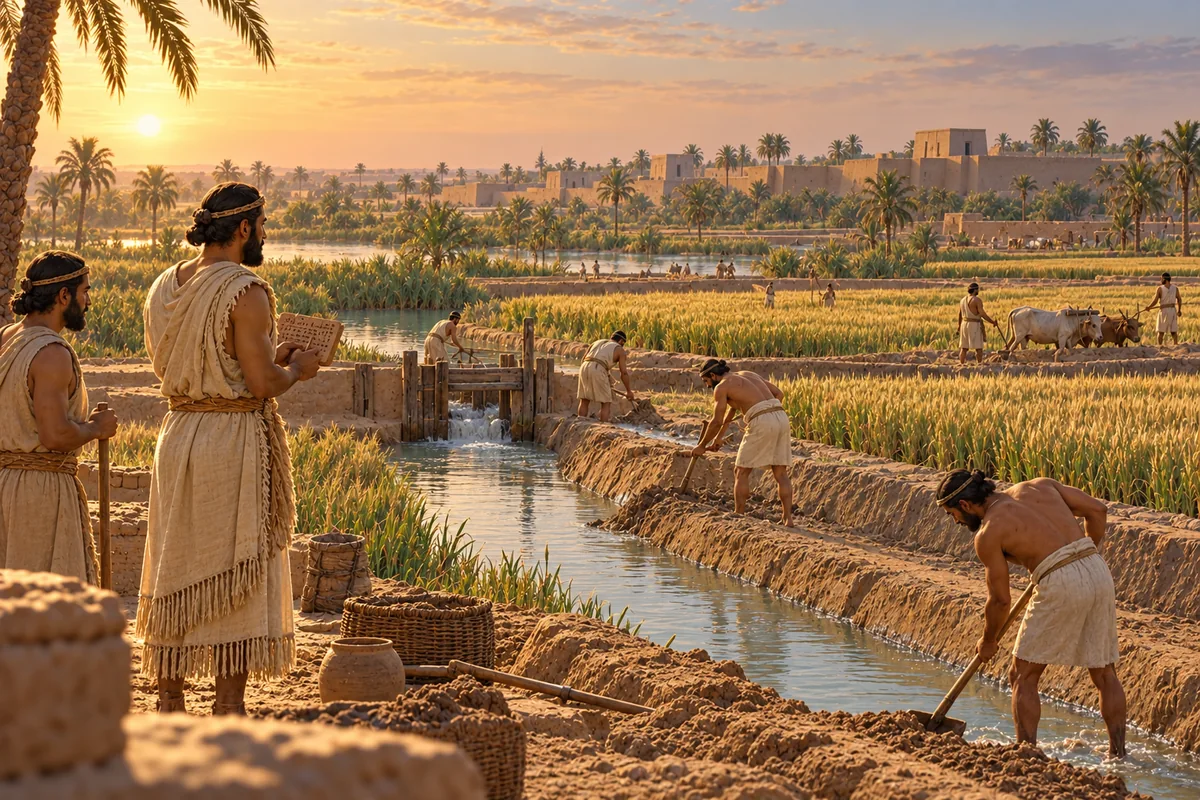
From the Kiti field, land set aside to support Enentarzi, ruler of Lagaš, the harvest came to 353 large gur of barley, 193 gur of white emmer, 53 gur of gu-nida emmer and 10 gur of wheat, 609 large gur in all. The grain was threshed at Kiti, and Ur-šerda handed it over to him. Year 4.
AI-generated reading paraphrase; compare with the translation below.
“353 gur-saggal of barley, 193 (gur) of white emmer, 53 (gur) of gu-nida (emmer), 10 (gur) of wheat; total: 609 gur-saggal. The Kiti field, sustenance (field) of Enentarzi, ruler of Lagaš. At Kiti, after (the grain) was threshed, Ur-šerda delivered (it) to him. Year 4.”
Source: engine:claude-opus-5-5 (2026-11-08/v10-evolved) · claude-opus-5-5 · medium confidence
Read the full tablet entry~2400 BCE · AO 13260 — Louvre Museum, Paris, France
DP 052
In plain English
Ten loaves of gu-sig bread are set aside as food. The goddess Nanše receives 50 sur vessels, 10 nig-banda bowls of milk and 40 mud jars of milk. Her consort Nindar receives 30 sur vessels and 20 mud jars of milk. These are offerings of bread and pure milk from Baranamtara, wife of Lugalanda, ruler of Lagaš, in his fourth year.
AI-generated reading paraphrase; compare with the translation below.
“Obverse 1. 10 gu-sig loaves (of bread) 2. (as) food; 3. 50 sur (vessels), 4. 10 nig-banda (bowls) of milk, 5. 40 mud (jars) of milk: 6. (for) Nanše. 7. 30 sur (vessels), 8. 20 mud (jars) of milk: 9. (for) Nindar. 10. [Bread] (and) pure milk 11. (of) Baranamtara, 12. wife of Lugalanda, 13. ruler 14. of Lagaš. (Year) 4.”
Source: engine:claude-opus-5-5 (2026-11-08/v10-evolved) · claude-opus-5-5 · medium confidence
Read the full tablet entry~2400 BCE · AO 13269 — Louvre Museum, Paris, France
DP 061
In plain English
One sheep, returned to the stock, is booked to the Abzu-guka shrine. When the governor went off to the nig2-šagan, Baranamtara made the offering herself. The sheep was consumed in the ceremony, and it is charged to the account of En-ku, the animal fattener. Dated year 2.
AI-generated reading paraphrase; compare with the translation below.
“1 sheep, returned, is of the Abzu-guka. When the governor went to the nig2-šagan, Baranamtara made the offering. Sheep consumed; it is of En-ku, the fattener. Year 2.”
Source: engine:claude-opus-5-5 (2026-11-08/v10-evolved) · claude-opus-5-5 · medium confidence
Read the full tablet entry~2400 BCE · AO 13272 — Louvre Museum, Paris, France
DP 064
In plain English
Three sheep were offered: a ram for Nindar, a sheep for Ninmušbar, and a sheep for Ninmar. The occasion was probably the day the goddess was brought into her new house. Baranamtara, wife of Lugalanda, ruler of Lagaš, made the offering. The sheep are recorded as used up, charged to Enku the animal fattener, in year 2.
AI-generated reading paraphrase; compare with the translation below.
“1 ram: (for) Nin[dar]; 1 sheep: (for) Nin[muš]bar(?); 1 sheep: (for) Nin[mar]; [on the day when Nindar(?)] [was brought into] her new [house], [Baranam]tara, wife of Lugalanda, ruler [of Lagaš], made offering (of them). Sheep consumed: Enku, the fattener, is (responsible). Year 2.”
Source: engine:claude-opus-5-5 (2026-11-08/v10-evolved) · claude-opus-5-5 · medium confidence
Read the full tablet entry~2400 BCE · AO 13287 — Louvre Museum, Paris, France
DP 079
In plain English
One sheep for the bar-nigin offering, for the goddess Baba. Barag-namtara, the governor's wife, had it brought in to her while she was staying at the Ka-pirig-turgindu. On the back, the tablet files this under consumed sheep and names Ur-du, the chief herdsman, as the official responsible, although these last words are largely broken and restored.
AI-generated reading paraphrase; compare with the translation below.
“Obverse 1 sheep (of the) bar-nigin offering, (for the goddess) Baba. Barag-namtara, (wife of) the governor, at the Ka-pirig-tur[gin]du, when she was stay[ing there], [brought (it) in to her]. Reverse [Sheep consumed]. [Ur-du], the chief herd[sman] ([it is]).”
Source: engine:claude-opus-5-5 (2026-11-08/v10-evolved) · claude-opus-5-5 · medium confidence
Read the full tablet entry~2400 BCE · AO 13288 — Louvre Museum, Paris, France
DP 080
In plain English
Record of animals eaten. One sheep was charged to the ruler, one billy goat to the chief administrator of Nanše's temple, and a lamb and a billy goat to the chief administrator of Ninmar's temple. All of these were eaten at the river bank. On the day of the gešbu rite, one sheep belonging to the ruler and one belonging to the chief scribe were eaten at the libation place. One more sheep, whose assignment is now broken away, was taken to be eaten at the bank of Šunigin(a). Summary: these are the sheep that were consumed.
AI-generated reading paraphrase; compare with the translation below.
“1 sheep: the ruler; 1 billy goat: the temple administrator of Nanše; 1 lamb, 1 billy goat: the temple administrator of Ninmar; were consumed at the bank. 1 sheep of the ruler, 1 sheep of the chief scribe, on the day of the gešbu, at the place of water-drinking (libation) were consumed. 1 sheep, ... [...], to be consumed at the bank of [Šu]nigin(a) was brought. (These are) sheep consumed.”
Source: engine:claude-opus-5-5 (2026-11-08/v10-evolved) · claude-opus-5-5 · medium confidence
Read the full tablet entry~2400 BCE · AO 13293 — Louvre Museum, Paris, France
DP 085
In plain English
Delivery record (maš-da-ri-a gifts): one lamb, then a line now lost, then one goat from Nin-uma, wife of Lala the herald, and one goat from Lugudda, administrator of the temple of Nanše. At the end of the month of the Festival of Lugal-urub, these animals were brought to Baranamtara. Enku, the animal fattener, then took them away to be kept. Dated year 5.
AI-generated reading paraphrase; compare with the translation below.
“Obverse 1. 1 lamb, 2. [maš-da-ri-a delivery] 3. [...] 4. [1 goat]: (UD) Nin-uma, 5. wife of Lala, 6. the herald; 7. 1 goat: Lugudda, 8. temple administrator of Nanše. Reverse 9. At the end of the month of the Festival of Lugal-urub, 10. to Baranamtara 11. they brought (them). 12. Enku, 13. the fattener, 14. took (them) away. Year 5.”
Source: engine:claude-opus-5-5 (2026-11-08/v10-evolved) · claude-opus-5-5 · medium confidence
Read the full tablet entry~2400 BCE · AO 13298 — Louvre Museum, Paris, France
DP 090
In plain English
One plucked ram, brought as a festival gift. Nin-bur, the surveyor's wife, delivered it to Baranamtara at the Woman's Household in the month of Lugal-urub's malt-eating festival. En-ku, the man who fattens the animals, took it away. Recorded in year 2.
AI-generated reading paraphrase; compare with the translation below.
“1 ram, plucked, as a mašdarea-offering Nin-bur, wife of the surveyor, (to) Baranamtara in the month of the festival of eating malt of Lugal-urub (at) the Woman's Household brought. En-ku, the fattener, took it away. (Year) 2.”
Source: engine:claude-opus-5-5 (2026-11-08/v10-evolved) · claude-opus-5-5 · medium confidence
Read the full tablet entry