Chapter 02 · 2900 – 2334 BCE
Early Dynastic
City-states, kings, the first wars.
~2350 BCE · NMSDeZ Bey 94-034 — National Museum of Syria, Der-ez-Zor, Syria
Subartu 02, 102
In plain English
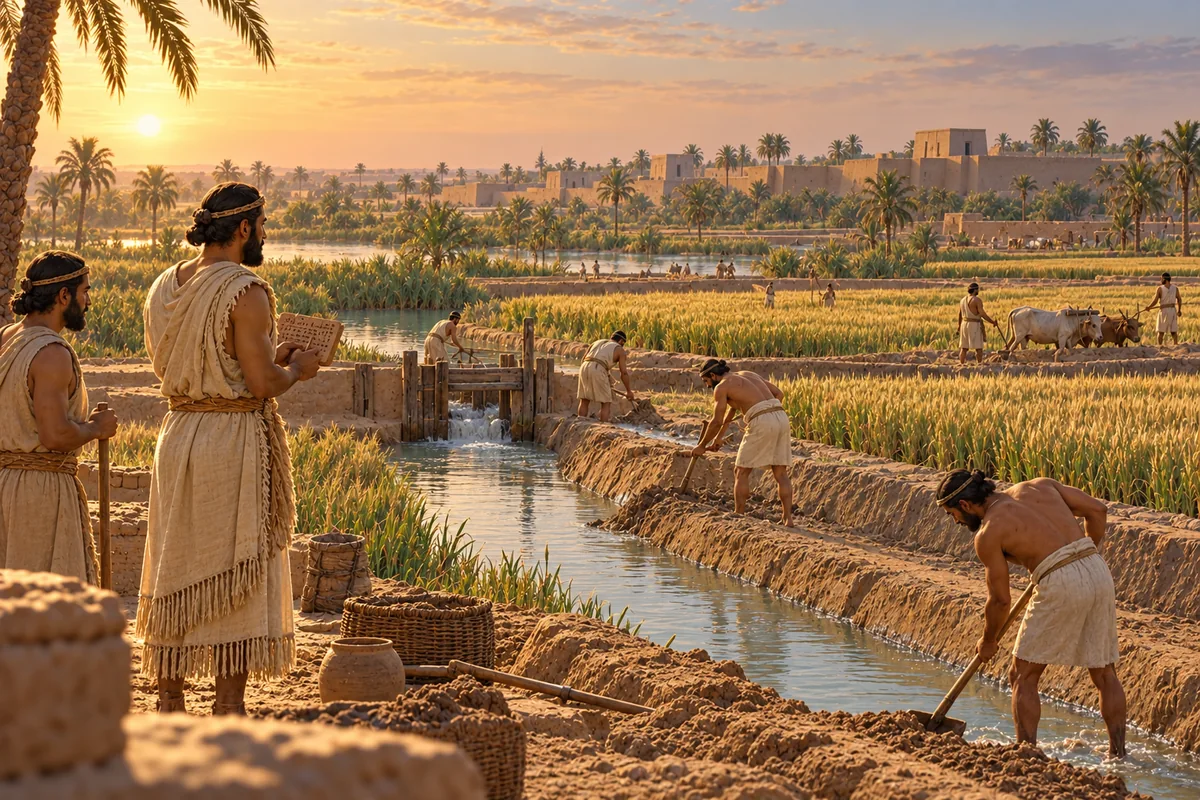
Under the supervision of (name lost): barley harvested at the town wall. The account then runs down a list of men and their amounts — 2 and 1 for Tabla-alim, 240 for Arši-aḫu, 200 for Arrum, then a figure in the hundreds plus 30 for a man whose name is broken away, 131 for Kur-ilum, and a final entry of 200 whose owner is lost with the rest of the tablet. Several of the commodity signs after the numbers are chipped off, so we cannot always say exactly what was being counted out.
AI-generated reading paraphrase; compare with the translation below.
“At the disposal of(?) — the fortification wall: barley has been harvested. Ḫal-ti(?). 2 [units], 1 [unit] — [Tab]-la-a-lim. 240 [units] — Ar-ši-a-ḫu. 200 — Ar-rum. [n] hundred (and) 30 — [... (name lost)]. 131 [units] — Kur-i-[lum]. 2 hun[dred] — (remainder lost).”
Source: engine:claude-opus-5 (2026-07-12/v7-evolved) · claude-opus-5 · low confidence
Read the full tablet entry~2350 BCE · NMSDeZ Bey 94-035 — National Museum of Syria, Der-ez-Zor, Syria
Subartu 02, 103
In plain English
Wool account — shearing. Under A'šalum: 100, [100], 100, 100, and 63 units. Separately, three units of bar-ASZ-grade wool, clean. The tally comes to 463 units of the main lot, entered in five batches; the last line adds a small quantity of a different, washed or picked grade. Several signs on the edges of the tablet are visible but not included in the edition.
AI-generated reading paraphrase; compare with the translation below.
“Wool, plucked (shearing); (of/for) A'šalum: 1 gešʾ2 40 (= 100); [1 gešʾ2] 40 (= 100); 1 gešʾ2 40 (= 100); 1 gešʾ2 40 (= 100); 1 gešʾ2 3 (= 63); wool of the bar-ASZ (grade): 3, SIKIL (clean/pure).”
Source: engine:claude-opus-5 (2026-07-12/v7-evolved) · claude-opus-5 · low confidence
Read the full tablet entry~2350 BCE · NMSDeZ Bey 94-037 — National Museum of Syria, Der-ez-Zor, Syria
Subartu 02, 105
In plain English
Livestock received: ewes, entered as a delivery on the account of ...-šum — one hundred and two head of sheep, ten lambs on pasture feed, and two she-goats. Recorded in the month of iti-sar; Beli-ZI. The back of the tablet was left blank.
AI-generated reading paraphrase; compare with the translation below.
“Ewes (female sheep), delivery; account of (lit. "with/from"): |HIxDISZ|-šum; 1 hundred (and) 2 sheep; 10 grass-fed lambs; 2 she-goats (LAK020). Month: iti-sar. Beli-ZI. (Reverse: uninscribed.)”
Source: engine:claude-opus-5 (2026-07-12/v7-evolved) · claude-opus-5 · medium confidence
Read the full tablet entry~2350 BCE · NMSDeZ Bey 94-045 — National Museum of Syria, Der-ez-Zor, Syria
Subartu 02, 113
In plain English
Month of Ne-nengar. Travel account for the ruler's journey to Udara: eleven donkeys plus the work-crew, fodder issued — 7 barig of barley. Then the ruler moved on: twelve donkeys plus the crew, fodder issued — 2 gur, 4 barig, 2 ban of barley, covering a three-day halt. In short, an ancient expense sheet for the animals and men of a royal trip.
AI-generated reading paraphrase; compare with the translation below.
“Month: Sar-nenegar (NE.NE.GAR). The lord (en), on the journey (to?) Udara: donkeys: 11; work-troop (erin₂); barley consumed: 7 barig. The lord went (ba-gin). Donkeys: 12; work-troop (erin₂); barley consumed: 2 gur 4 barig 2 ban₂. 3 days he/they stayed (al-tuš).”
Source: engine:claude-opus-5 (2026-07-12/v7-evolved) · claude-opus-5 · medium confidence
Read the full tablet entry~2350 BCE · NMSDeZ Bey 94-046 — National Museum of Syria, Der-ez-Zor, Syria
Subartu 02, 114
In plain English
Dated to the new moon (of Belim?). The ruler travelled out and remained three days. Fodder and rations issued: barley for the donkeys and for a work gang of 22 men, totalling 2 gur, 1 barig, 3 ban. A further 2 ban was charged to purchases, stored in a container. Several signs in the opening lines are damaged or of uncertain meaning.
AI-generated reading paraphrase; compare with the translation below.
“New-moon day of Be-lim(?); šu, u₂, šim(?); the ruler (en) went (there); 3 days he stayed. Donkeys (and) 22 work-troop (men) — barley consumed: 2 gur 1 barig 3 ban₂. Purchase goods(?): |GA₂×NE+E₂| (vessel/container): 2 ban₂.”
Source: engine:claude-opus-5 (2026-07-12/v7-evolved) · claude-opus-5 · low confidence
Read the full tablet entry~2350 BCE · NMSDeZ Bey 94-047 — National Museum of Syria, Der-ez-Zor, Syria
Subartu 02, 115
In plain English
Grain issued: Lu-geš-DU, 5 units; goods, 1 gur 5 ban; overseer Lu-geš-DU, 1 gur 1 barig 3 ban; Bari of the sheep, 4 gur 5 barig 3 ban; the wife, 6 units; goods, 4 barig; Aḫatum, 2 barig; Šu-kabba, 2 barig; Azazu, 1 barig; charged to Ḫar-da-nu, 8 units; goods, 8 barig 2 ban. Two plough-donkeys and the work crew: 5 barig of barley eaten as feed. Grand total 4 gur 2 ban. Filed for the month, under Bēlī-ZI.
AI-generated reading paraphrase; compare with the translation below.
“Lu-geš-DU: 5. Goods (nig₂): 1 gur 5 ban₂. The overseer Lu-geš-DU: 1 (gur) 1 barig 3 ban₂. Bari, (of the) sheep: 4 (gur) 5 barig 3 ban₂. The wife: 6. Goods (nig₂): 4 barig. Aḫatum: 2 barig. Šu-kabba: 2 barig. Azazu: 1 barig. Receipt (šu) of Ḫar-da-nu: 8. Goods (nig₂): 8 barig 2 ban₂. Plough-donkeys: 2 — the work-gang (erin₂). Barley consumed (as fodder/rations): 5 barig. Total: 4 gur 2 ban₂. Month-record (iti-sar): Bēlī-ZI.”
Source: engine:claude-opus-5 (2026-07-12/v7-evolved) · claude-opus-5 · medium confidence
Read the full tablet entry~2350 BCE · NMSDeZ Bey 94-048 — National Museum of Syria, Der-ez-Zor, Syria
Subartu 02, 116
In plain English
Grain issued: Lu-geš-DU, 5 gur; goods, 1 gur 5 ban; the foreman of Lu-geš-DU's crew, 1 gur 1 barig 3 ban; Bari of the sheep, 4 gur 5 barig 3 ban; Šu-kabba, 1 gur 2 barig; his wife, 6 gur 4 barig; Aḫatum, 1 gur 2 barig; Azazu, 1 gur 1 barig; the daughter, 1 gur 4 ban. Set aside for milling: 2 gur. Dated to the month of Belim.
AI-generated reading paraphrase; compare with the translation below.
“Lu-geš-DU: 5 (gur). Goods(?): 1 gur 5 ban. The overseer of the lu-geš-DU men: 1 (gur) 1 barig 3 ban. Bari, (of the) sheep: 4 (gur) 5 barig 3 ban. Šu-kabba: 1 (gur) 2 barig. (His) wife: 6 (gur) 4 barig. Aḫatum: 1 (gur) 2 barig. Azazu: 1 (gur) 1 barig. The female child (daughter): 1 (gur) 4 ban. Milling work (nig₂-KIN-KIN): 2 gur. Month: sar of Belim.”
Source: engine:claude-opus-5 (2026-07-12/v7-evolved) · claude-opus-5 · medium confidence
Read the full tablet entry~2350 BCE · NMSDeZ Bey 94-053 — National Museum of Syria, Der-ez-Zor, Syria
Subartu 02, 121
In plain English
A grain ledger: Ḫalti gets 2 gur 3 barig (the first figure is partly broken, so it may have been more); Tab-la-alim, 5 gur; Arši-aḫu, 3 gur 4 barig; Arrum, 4 gur 3 barig plus a figure now lost; and Kur-ilum, 1 gur 3 barig 3 ban. Five names, five allotments — the kind of routine disbursement list a palace storehouse would keep. The beginning of the first line and the end of the fifth are damaged, so a couple of the numbers are incomplete.
AI-generated reading paraphrase; compare with the translation below.
“[Ḫal]-ti: [n+]2 gur 3 barig (of grain). Tab-la-a-lim: 5 gur. Ar-ši-a-ḫu: 3 gur 4 barig. Ar-rum: 4 gur 3 barig [+ n]. kur(?) Kur-i-lum: 1 gur 3 barig 3 ban.”
Source: engine:claude-opus-5 (2026-07-12/v7-evolved) · claude-opus-5 · medium confidence
Read the full tablet entry