Chapter 04 · 2112 – 2004 BCE
Ur III · Neo-Sumerian
A bureaucratic golden age, the Code of Ur-Nammu.
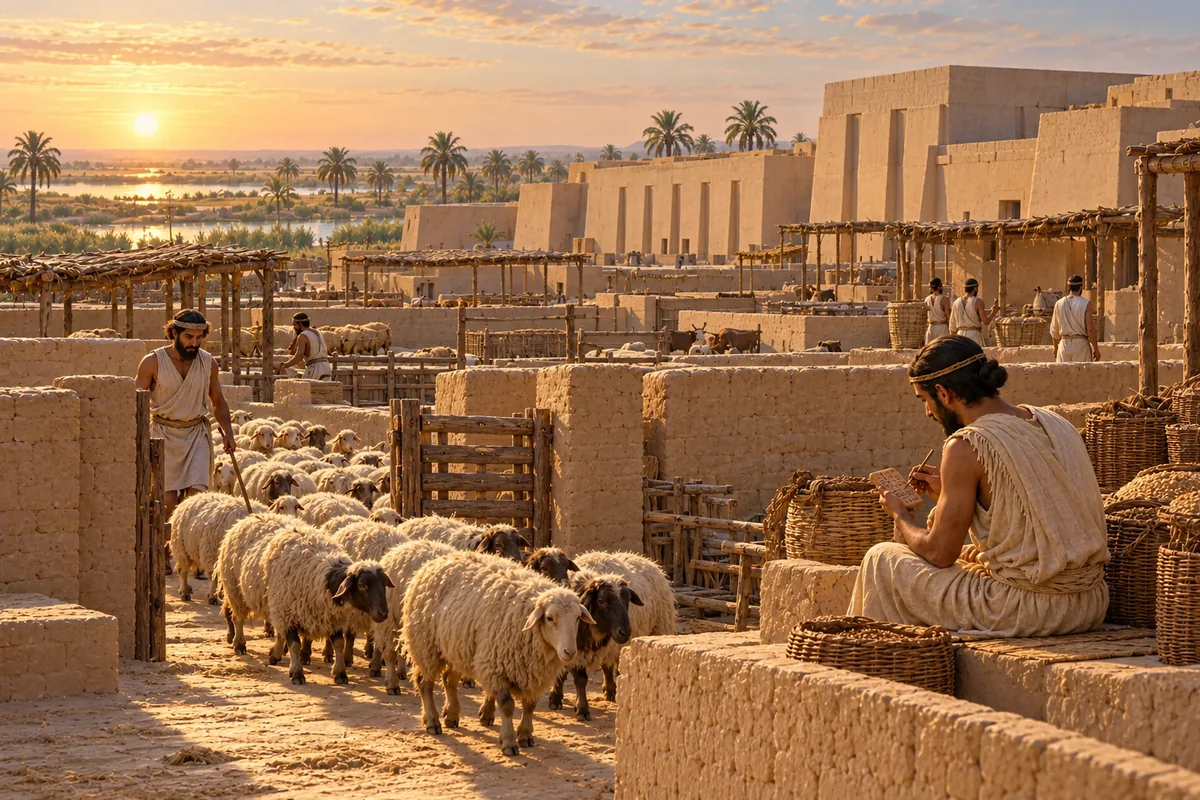
~2050 BCE · TUL LH 21 — Tsurumi University Library, Yokohama, Japan
JAC 24, 061 08
In plain English
Two sheep that had been fattened on grain were transferred out of the palace's livestock house. They came from Amar-šuba and were formally taken into custody by an official named Imtidam, bound for the household or institution called 'EN.' The transaction was recorded on the 5th day of the month GANmaš, in the year following the year Huhnuri was destroyed — a standard Ur III date formula used to fix the transaction in time.
AI-generated reading paraphrase; compare with the translation below.
“2 grain-fed sheep, for the house of EN, from the sheep-house of the palace, from Amar-šuba, Imtidam received (took in charge). Month: GANmaš, day 5 passed. Year following the year: Huhnuri (was destroyed).”
Source: engine:claude-sonnet-5 (2026-07-12/v7-evolved) · claude-sonnet-5 · medium confidence
Read the full tablet entry~2050 BCE · Anonymous 478822 — private: anonymous, Jerusalem
JAC 29, 023-030 02
In plain English
This is a receipt: one bowl of soup and one fish were issued to Puzur-Iškur, a royal messenger, on the day he traveled from Duran to report to the king. Another identical ration — soup and one fish — went to Šu-Suen, also a royal messenger, on the day he set out to round up runaway workers and palace slaves. Both disbursements were formally booked as expenditure. The record is dated to the 27th day of the month of the Šulgi festival, in the year Huhnuri was destroyed.
AI-generated reading paraphrase; compare with the translation below.
“1 sila3 soup, 1 fish — Puzur-Iškur, the king's messenger, on the day he went from BAD₃.AN to the king; 1 sila3 soup, 1 fish — Šu-Suen, the king's messenger, on the day he went to seize the fugitive troops, the palace slaves — booked expenditure. Month: festival of Šulgi. Year: Huhnuri was destroyed. Day 27.”
Source: engine:claude-sonnet-5 (2026-07-12/v7-evolved) · claude-sonnet-5 · medium confidence
Read the full tablet entry~2050 BCE · Kress 198 — private: anonymous, Germany
Kress 198
In plain English
This receipt records a food offering for a monthly temple festival: two loaves of gug-bread at two sila each, twelve small loaves at half a sila each (one ban2 of bread total), three sila of an oil-based food preparation, and two loaves of oil-bread. These were supplied for the eshesh-festival at the shrine called the House of the 15th Day, sent from the king's stores and delivered under the responsibility of Ur-Šulgi, the royal cupbearer. The transaction was formally booked as an expenditure. It is dated to the month of Kirsiak, in the year the en-priest of Eridu was installed in office.
AI-generated reading paraphrase; compare with the translation below.
“2 gug-bread(loaves), 2 sila each; 12 bread(loaves), 1/2 sila each; its bread: 1 ban2; 3 sila of nig-idea (oil-poured food); 2 oil-bread(loaves) — for the eshesh-festival of the House-of-the-15th-Day; [from the king]; via Ur-Šulgi, the cupbearer; booked out (as expenditure). Month: Kirsiak. Year: 'the en-priest(ess) of Eridu was installed.'”
Source: engine:claude-sonnet-5 (2026-07-12/v7-evolved) · claude-sonnet-5 · medium confidence
Read the full tablet entry~2050 BCE · Kress 203 — private: anonymous, Germany
Kress 203
In plain English
A certain amount of barley, measured in the royal gur-standard, was delivered from Ur-gigir to Lugal-bara-e. Silašu handled the transfer, and the barley was duly received. The transaction is dated to the month of Dumuzi, in the year when Karhar was destroyed for the second time.
AI-generated reading paraphrase; compare with the translation below.
“[n] gur barley, royal (measure), [from?] Ur-gigir, Lugal-bara-e, via Silašu, received. Month: Dumuzi, Year: “Karhar was destroyed for the second time.””
Source: engine:claude-sonnet-5 (2026-07-12/v7-evolved) · claude-sonnet-5 · medium confidence
Read the full tablet entry~2050 BCE · Kress 226 — private: anonymous, Germany
Kress 226
In plain English
One grain-fed gazelle died on the 25th of the month. It came from Utamišaram, and Šulgi-irimu recorded receiving it into the account. The entry is dated to the month called (tentatively) 'festival of Meki-gal,' in the year that Ḫuḫnuri was destroyed — a standard bookkeeping note from the royal livestock office at Puzriš-Dagan.
AI-generated reading paraphrase; compare with the translation below.
“1 gazelle, grain-fed, slaughtered/dead, 25th day; from Utamišaram, Šulgi-irimu received it. Month: 'festival of Meki-gal' (?); year: Ḫuḫnuri was destroyed.”
Source: engine:claude-sonnet-5 (2026-07-12/v7-evolved) · claude-sonnet-5 · medium confidence
Read the full tablet entry~2050 BCE · Kress 228 — private: anonymous, Germany
Kress 228
In plain English
The tablet records two days of rationed supplies. On day 11: 5 sila (a small liquid/dry measure) of an unspecified commodity, another 5 ban2 of something now lost, and a further 1 ban2 6 1/2 sila of beer (reading uncertain). On day 12: 2 ban2 5 sila of ordinary beer. The goods came from or were credited to a person named Šara-izu, and the transaction was sealed by the city governor of Umma. The record is dated to the month Pa'ue, in a year identified only as 'the year following' a year-name honoring a king whose name ended in '-Suen' — the specific king and full year formula are broken away.
AI-generated reading paraphrase; compare with the translation below.
“5 sila3 [...] 5 ban2 [...] day 11. 1 ban2(?) 6 1/2 sila3 beer(?) 2 ban2 5 sila3 ordinary beer. day 12. from Šara-izu; under seal of the governor (ensi2). Month: Pa'ue. Year following (the year): '...-Suen, the king, [...]'”
Source: engine:claude-sonnet-5 (2026-07-12/v7-evolved) · claude-sonnet-5 · low confidence
Read the full tablet entry~2050 BCE · Kress 230 — private: anonymous, Germany
Kress 230
In plain English
This tablet records that fifteen laborers worked for five days, assigned to two work sites: one connected to the builders'/masons' establishment, and another connected to the goat-house. The crew was overseen by a foreman named Ukkene, the matter was handled through an official named Lu-girizal, and the record was sealed and authorized by Bidugga. The document is dated to the year that Kimash was destroyed — a standard year-name used in the Ur III period, under King Shulgi's reign.
AI-generated reading paraphrase; compare with the translation below.
“15 workmen, for 5 days, stationed at the e2-szitim (the builders'/brickmasons' house), stationed at the e2-masz (the goat-house), foreman: Ukkene, via Lu-girizal, under seal of Bidugga. Year: "Kimash was destroyed."”
Source: engine:claude-sonnet-5 (2026-07-12/v7-evolved) · claude-sonnet-5 · medium confidence
Read the full tablet entry~2050 BCE · Kress 244 — private: anonymous, Germany
Kress 244
In plain English
The tablet is badly broken. What survives is part of a field-measurement record: an area of land measured at 2 iku, with a rate of 11 (units per iku, most likely a seed or yield rate) attached to it. A subtotal follows ('among these'), listing a smaller plot of 1 eše3 belonging to some field, again with a rate of 11 each, followed by more text that is now illegible. The tablet ends with a fragmentary reference to a field described by the term 'u2-du,' whose meaning here — possibly a fodder or pasture designation — cannot be pinned down from what remains. The rest of the tablet, including whatever preceded and any reverse or further detail, is lost.
AI-generated reading paraphrase; compare with the translation below.
“1. [...]-ta ("from/by ...", broken) 2. [...] x (illegible sign, broken) 3. [...] x x [...] (two illegible signs, broken) 4. n(?) 2(iku) field-area(GAN2), 1(u) 1(disz)-ta ("11 each") 5. therein (sza3-ba): 1(esze3) field-area(GAN2), field(a-sza3) [...], 1(u) 1(disz)-ta ("11 each"), i3-[...] (broken) 6. field(a-sza3): u2-du-[...] (broken)”
Source: engine:claude-sonnet-5 (2026-07-12/v7-evolved) · claude-sonnet-5 · low confidence
Read the full tablet entry