Chapter 05 · 2000 – 1600 BCE
Old Babylonian
Hammurabi, the Epic of Gilgamesh, mathematics.
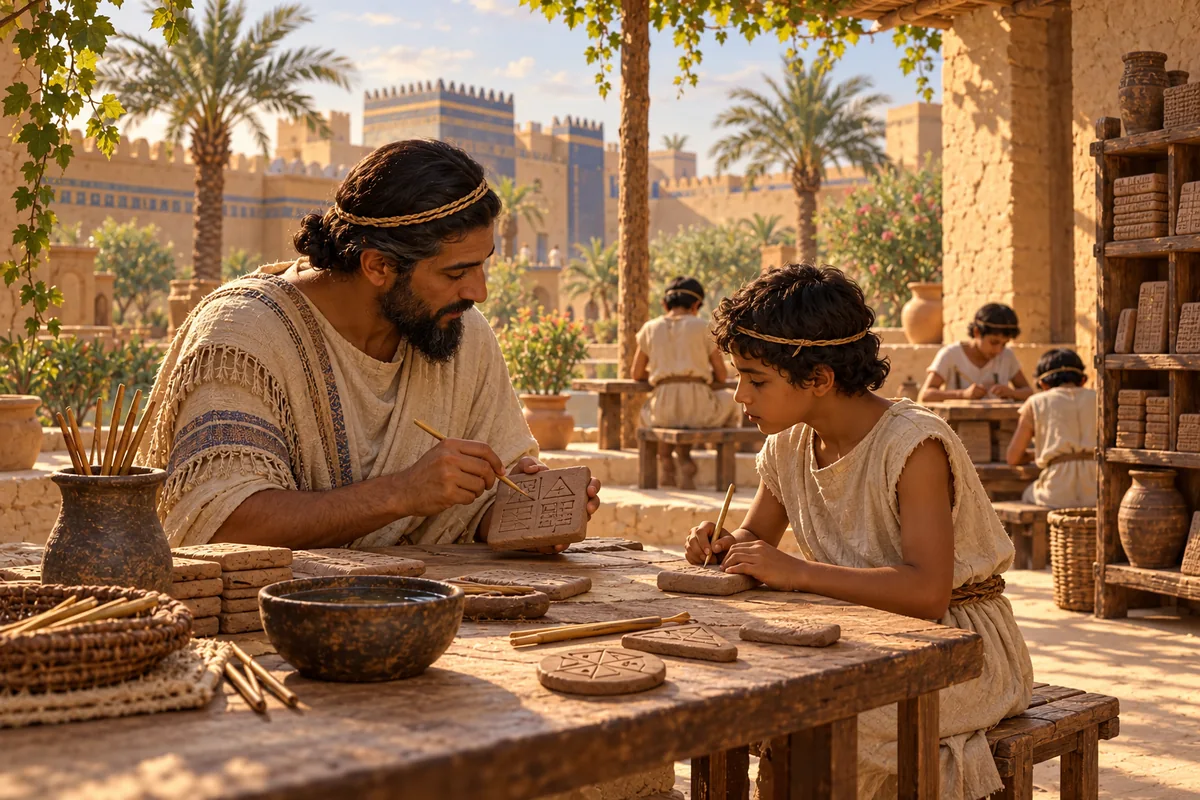
~1800 BCE · Multiple manuscripts across collections; see ETCSL bibliography for witnesses
A praise poem of Shulgi (Shulgi Y)
In plain English
An unknown number of lines are missing at the top, and two more are too damaged to read. What remains has Enki, the lord whose decrees are final, entering proudly to make Shulgi's kingship last and to fill his reign with abundance. Enki assigned Utu — whose word stands above all others — to serve as a constable over Shulgi. Because Ninlil had given Shulgi her joyful blessing throughout the Land and had made his voice ring out in the assembly, Shulgi, the faithful shepherd of Sumer, praised her in the Ja-jiš-šua — her temple where lawsuits are decided fairly — in her august E-papah, a place charged with awe and admired by all foreign lands. The passage then breaks off mid-sentence.
AI-generated reading paraphrase; compare with the translation below.
“unknown no. of lines missing 2 lines fragmentary To make my kingship longlasting, to make abundance conspicuous in my reign, Enki, the lord whose utterances cannot be altered, entered it proudly. He assigned Utu, whose words are pre-eminent, as a constable to me. Since Ninlil had given me her joyful blessing in the Land, and had caused me to be heard in the assembly, I, Culgi, the faithful shepherd of Sumer, praised her in the Ja-jic-cua, in her temple where lawsuits are decided justly, in her august temple befitting her ladyship, in her E-papah imbued with terrible awesomeness, a place admired by all the foreign countries, within .......”
Source: ETCSL c.2.4.2.25: A praise poem of Shulgi (Shulgi Y). Black, J.A., Cunningham, G., Robson, E. & Zólyomi, G. (eds.), The Electronic Text Corpus of Sumerian Literature, Faculty of Oriental Studies, University of Oxford. https://etcsl.orinst.ox.ac.uk/cgi-bin/etcsl.cgi?text=c.2.4.2.25
Read the full tablet entry~1800 BCE · Multiple manuscripts across collections; see ETCSL bibliography for witnesses
A praise poem of Ur-Namma (Ur-Namma C)
In plain English
Ur is a city of supreme divine power, its royal throne-dais towering high, built on pure ground and beautiful as the sky — richly decorated, radiant. Its great wall rises from the abzu, the cosmic underground waters, and the jipar shrine at its heart is the dwelling place of An and Enlil. The palace called E-kish-nugal is where destinies are decided; its pilasters blaze with light visible across every land. The great terrace floats like a white cloud in the midst of the sky, and something else — the surface is damaged here — flashes like lightning inside a shrine.
AI-generated reading paraphrase; compare with the translation below.
“City of the finest divine powers, lofty royal throne-dais! Shrine Urim, pre-eminent in Sumer, built in a pure place! City, your well-founded great wall has grown out of the abzu! City, beautiful as the sky, endowed with beauty, colourfully decorated in a great place! Shrine Urim, well-founded jipar, dwelling of An and Enlil! Your lofty palace is the E-kic-nujal, in which the fates are determined! Your pilasters heavy with radiance tower over all the countries! Its terrace like a white cloud is a spectacle in the midst of heaven. Its ...... like flashing lightning shines (?) inside a shrine.…”
Source: ETCSL c.2.4.1.3: A praise poem of Ur-Namma (Ur-Namma C). Black, J.A., Cunningham, G., Robson, E. & Zólyomi, G. (eds.), The Electronic Text Corpus of Sumerian Literature, Faculty of Oriental Studies, University of Oxford. https://etcsl.orinst.ox.ac.uk/cgi-bin/etcsl.cgi?text=c.2.4.1.3
Read the full tablet entry~1800 BCE · Multiple manuscripts across collections; see ETCSL bibliography for witnesses
A praise poem of Ur-Namma (Ur-Namma H)
In plain English
Ur-Namma, king of the Land, is praised in terms that are almost entirely lost. A few phrases survive: something made of ebony, objects decorated with silver and lapis lazuli, a comparison to silver, a reference to the desert, and the images of a lion and a dragon. His name and title appear again near the end — 'Ur-Namma, king of the Land, far and distant' — but everything around those words is gone, with multiple lines missing above and below.
AI-generated reading paraphrase; compare with the translation below.
“Ur-Namma, king of the Land ....... ...... far and distant (?) ....... ...... ebony ....... 1 line fragmentary unknown no. of lines missing 1 line fragmentary ...... with silver and lapis lazuli ....... ...... like silver ...... in the Land. ...... in (?) the desert. Lion (?) and dragon ....... Ur-Namma, king of the Land, far and distant (?) unknown no. of lines missing”
Source: ETCSL c.2.4.1.8: A praise poem of Ur-Namma (Ur-Namma H). Black, J.A., Cunningham, G., Robson, E. & Zólyomi, G. (eds.), The Electronic Text Corpus of Sumerian Literature, Faculty of Oriental Studies, University of Oxford. https://etcsl.orinst.ox.ac.uk/cgi-bin/etcsl.cgi?text=c.2.4.1.8
Read the full tablet entry~1800 BCE · Multiple manuscripts across collections; see ETCSL bibliography for witnesses
A prayer for Hammu-rabi (Hammu-rabi D)
In plain English
Several lines are damaged at the opening. The surviving text shows the gods being addressed with a command to give Hammu-rabi the sceptre, to exalt the name of Babylon as a city of lordship, and to make him pre-eminent in the world. Asarluhi is then invoked to fix a great destiny for Hammu-rabi. An, Enlil, and Enki act together with him, and once they have reached their decision, all the great gods go joyfully to Marduk. Marduk then speaks to them, declaring that they have chosen this tireless shepherd to exercise lordship over the Land, and calls on the assembled gods to proclaim his destiny with their holy mouths — though several phrases throughout are lost where the tablets are broken.
AI-generated reading paraphrase; compare with the translation below.
“1 line damaged ...... the reverent one, who takes care ......, 1 line damaged (The gods are addressed:) "Give him the sceptre ......! ...... the name of Babylon, the city of lordship! Make the king pre-eminent in the world ......!" O Asarluhi, ...... destiny for my Hammu-rabi! An, Enlil and Enki ...... with him. When they had decided ......, all the great gods together ...... joyfully to Marduk. (Marduk speaks to the great gods:) "You have ...... the shepherd of your hearts to exercise the lordship in the Land. Determine his destiny grandly, ...... with your holy mouths. Appoint ...... your word ...... for him, the indefatigable shepherd."”
Source: ETCSL c.2.8.2.4: A prayer for Hammu-rabi (Hammu-rabi D). Black, J.A., Cunningham, G., Robson, E. & Zólyomi, G. (eds.), The Electronic Text Corpus of Sumerian Literature, Faculty of Oriental Studies, University of Oxford. https://etcsl.orinst.ox.ac.uk/cgi-bin/etcsl.cgi?text=c.2.8.2.4
Read the full tablet entry~1800 BCE · Multiple manuscripts across collections; see ETCSL bibliography for witnesses
A prayer for Hammu-rabi (Hammu-rabi E)
In plain English
The opening thirty-seven lines are missing, and one further line is only partially legible. What survives describes someone lifting his head high, a figure rejoicing before him and embracing him, and a destiny being fixed. The text then turns to direct address: may Hammu-rabi exercise lordship over his people unchallenged, may the gifts bestowed on him never cease, and may the time granted to him be long. His destiny has been set and his name has been called — may he have no rival.
AI-generated reading paraphrase; compare with the translation below.
“37 lines missing 1 line fragmentary ...... raised his head high. ...... before him ...... rejoiced at him. ...... embraced him. Your ...... has determined the destiny. May you be their ......, exercising lordship over them. May ...... which has been bestowed on you never cease. You are well-suited for ......, and may its time be prolonged for you. A destiny has been determined for you and you have been called by name; may you have no rival!”
Source: ETCSL c.2.8.2.5: A prayer for Hammu-rabi (Hammu-rabi E). Black, J.A., Cunningham, G., Robson, E. & Zólyomi, G. (eds.), The Electronic Text Corpus of Sumerian Literature, Faculty of Oriental Studies, University of Oxford. https://etcsl.orinst.ox.ac.uk/cgi-bin/etcsl.cgi?text=c.2.8.2.5
Read the full tablet entry~1800 BCE · Multiple manuscripts across collections; see ETCSL bibliography for witnesses
A prayer for Rim-Sîn (Rim-Sîn F)
In plain English
Rim-Sîn is addressed directly as a king of princely divine powers, a leader who holds all divine powers and carries his head high. The abzu — the sacred underground waters beneath the E-kiš-nugal temple — is described as a vast and awe-inspiring holy shrine, deep and wide, forming the foundation of the innermost pure sanctuaries, and fragrant like a forest of cedar and hachur trees. It underpins the temple from within, sheltering and protecting it, while the temple itself radiates terrifying splendour from its great, holy corner deep in its solid interior. The doorway is designed as a magical seal: a solar disc crowned by a standard bearing a predatory eagle violently gripping stags that twist left and right, with gods standing guard on either side.
AI-generated reading paraphrase; compare with the translation below.
“Rim-Sîn, king with princely divine powers, leader with all the divine powers, raising high your princely head! The abzu is the august holy shrine of the E-kic-nujal, a great vastness in depth and breadth, the foundation of the innermost holy pure buildings, with a pleasant odour like a forest of aromatic cedars and hachur trees. It forms the foundations (?) of the temple, within the temple, a protection for the temple; the terrifying splendour of the temple, a great corner, a holy corner within the solid interior. The design of the doorway is a magic bond: a solar disc at whose top is a standard representing a rapacious eagle, violently seizing stags which turn to the left and right. Gods stand guard over the doorway.”
Source: ETCSL c.2.6.9.6: A prayer for Rim-Sîn (Rim-Sîn F). Black, J.A., Cunningham, G., Robson, E. & Zólyomi, G. (eds.), The Electronic Text Corpus of Sumerian Literature, Faculty of Oriental Studies, University of Oxford. https://etcsl.orinst.ox.ac.uk/cgi-bin/etcsl.cgi?text=c.2.6.9.6
Read the full tablet entry~1800 BCE · Multiple manuscripts across collections; see ETCSL bibliography for witnesses
A prayer for Rim-Sin entering the gate (Rim-Sin D)
In plain English
Rim-Sin, king of abundance and foremost among rulers, is wished right and justice as his constant companions. When he passes through the Great Gate of Ur, the gate's divine guardians — a protective god and a protective goddess of peace — are asked to shine favorably upon him. Several phrases are too damaged to read. The guardians are then asked to carry his greeting before the moon god Nanna and his consort Ningal, and to return to him an answer of life and peace, along with good news that will lift his spirits.
AI-generated reading paraphrase; compare with the translation below.
“Rim-Sîn, king of abundance, august doyen of rulers, may right and justice be your helpers. May they make a good ...... for you. May they make ...... for you. Rim-Sîn, named with a name by An and Enlil, when you enter the Great Gate, the gate of Urim, may the favourable protective god and the protective goddess of peace, gatekeepers of the Great Gate, shine upon you ....... May they bring you back an answer of life and peace ...... to your greeting which they bring before Nanna and Ningal. May they cause a good ...... that brings happiness, a mood of encouragement, to issue for you…”
Source: ETCSL c.2.6.9.4: A prayer for Rim-Sin entering the gate (Rim-Sin D). Black, J.A., Cunningham, G., Robson, E. & Zólyomi, G. (eds.), The Electronic Text Corpus of Sumerian Literature, Faculty of Oriental Studies, University of Oxford. https://etcsl.orinst.ox.ac.uk/cgi-bin/etcsl.cgi?text=c.2.6.9.4
Read the full tablet entry~1800 BCE · Multiple manuscripts across collections; see ETCSL bibliography for witnesses
A prayer (?) for Rim-Sin (Rim-Sin A)
In plain English
The text calls on Enlil, king of heaven and earth, whose words are reliable, to bless the shepherd Rim-Sin — the speaker's king. May Enlil stand before whoever provides him life-giving offerings at Nippur, and grant him grain, the sustenance of humankind. May Rim-Sin rule in joy, his royal throne made strong, his reign extended, his sceptre reaching both the southern lowlands and the uplands, and his subjects bowed before him. His offerings at Nippur's E-kur temple — whether small or great — are mentioned, though that line breaks off; syrup shall drip from its fingers like ghee. The speaker then compares himself to the cherished son of a man, sweet as honey and ghee, and asks that offerings proceed in joy — a final line mentions silver being given, but the surface is too damaged to read the rest.
AI-generated reading paraphrase; compare with the translation below.
“May Enlil, king of heaven and earth, whose utterances are trusty and whose words are ......, ...... the shepherd Rim-Sîn, ...... my king ....... May he who gives him life-giving (?) food-offerings in Nibru stand in prayer before him. May Enlil bestow upon him grain, the benefit of mankind. May he pass his time in joy in the ...... of his country. They will ...... Rim-Sîn my king. May he strengthen for him his royal throne and extend his reign. May he decree his sceptre for the south and the uplands. May he make the king's inferiors bow down before him. The offerings of Rim-Sîn my king, small or great, at Nibru in the E-kur ....... Syrup shall drip like ghee from its fingers. I am as the son of one man, honey and ghee. My king, let offerings ...... in my joy. They give me silver .......”
Source: ETCSL c.2.6.9.1: A prayer (?) for Rim-Sin (Rim-Sin A). Black, J.A., Cunningham, G., Robson, E. & Zólyomi, G. (eds.), The Electronic Text Corpus of Sumerian Literature, Faculty of Oriental Studies, University of Oxford. https://etcsl.orinst.ox.ac.uk/cgi-bin/etcsl.cgi?text=c.2.6.9.1
Read the full tablet entry