Chapter 05 · 2000 – 1600 BCE
Old Babylonian
Hammurabi, the Epic of Gilgamesh, mathematics.
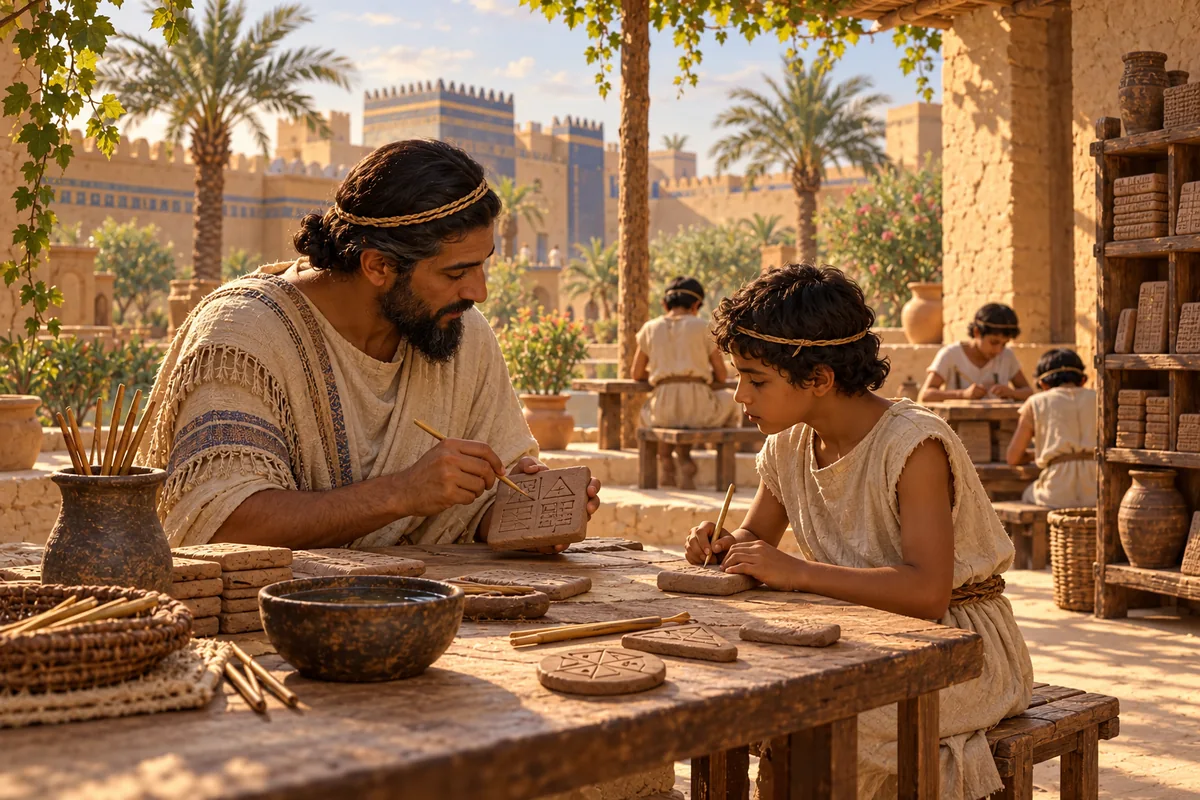
~1800 BCE · Multiple manuscripts across collections; see ETCSL bibliography for witnesses
A balbale (?) to Inana and Dumuzid (Dumuzid-Inana P)
In plain English
Several opening lines are too damaged to read, but Inana speaks in first person, describing her body and divine authority — her genitals, her buttocks, her brightly colored adornments — as holy, perfect for godhood, and fit for the palace. Three lines in the middle are fragmentary, and a handful of individual words throughout are lost. What comes through clearly is that Inana surveyed all the people and chose Dumuzid as god of the Land; because Enlil loved him, she exalted his name and decreed his destiny. Her mother cherishes Dumuzid without ceasing, and her father praises him.
AI-generated reading paraphrase; compare with the translation below.
“...... of my ...... is holy. I am she who directs ....... ...... genitals ....... ...... is perfect for august status. Subduing ......, fixing my gaze ......, I am she who directs ....... 3 lines fragmentary ...... my genitals ......, my ...... which is seemly for a deity, ...... of my buttocks, my brightly coloured ......, ...... of my buttocks, my ...... established by ......, my ...... ordered by ......, my ...... which befits the palace, my ...... which passes the time ......, ...... is crawling. Dumuzid brings ....... I gazed over all the people, and chose Dumuzid as god of the Land. For Dumuzid, beloved by Enlil, I exalted his name and decreed his destiny. My mother cherishes him constantly, and my father speaks his praises.”
Source: ETCSL c.4.08.16: A balbale (?) to Inana and Dumuzid (Dumuzid-Inana P). Black, J.A., Cunningham, G., Robson, E. & Zólyomi, G. (eds.), The Electronic Text Corpus of Sumerian Literature, Faculty of Oriental Studies, University of Oxford. https://etcsl.orinst.ox.ac.uk/cgi-bin/etcsl.cgi?text=c.4.08.16
Read the full tablet entry~1800 BCE · Multiple manuscripts across collections; see ETCSL bibliography for witnesses
A balbale to Inana and Dumuzid (Dumuzid-Inanna C)
In plain English
Someone — a brother, perhaps — asks the young woman what she has been doing alone in the house. She answers in detail: she bathed, scrubbed herself with soap from a white stone bowl, rinsed with water from the sacred kettle, and rubbed good oil from a stone bowl into her skin. She dressed herself in Inana's formal robes, lined her eyes heavily with kohl, arranged her hair at the nape of her neck, and washed her long hanging locks. She also readied the weapons that bring good fortune to her lover's reign. The passage breaks off there, with at least one line too damaged to read.
AI-generated reading paraphrase; compare with the translation below.
“"My sister, what have you been doing in the house? Little one, what have you been doing in the house?" "I was bathing, I was rubbing myself with soap. I was washing myself with water from the holy kettle, I was rubbing myself with the soap from the white stone bowl. I was anointing myself with good oil from the stone bowl, and dressing myself in the formal dress proper to Inana. That is how I was busying myself in the house. "I have put lots of kohl on my eyes, I have arranged ...... the nape of my neck. I have washed my dangling hair, I have tested my weapons that make his reign propitious.…”
Source: ETCSL c.4.08.03: A balbale to Inana and Dumuzid (Dumuzid-Inanna C). Black, J.A., Cunningham, G., Robson, E. & Zólyomi, G. (eds.), The Electronic Text Corpus of Sumerian Literature, Faculty of Oriental Studies, University of Oxford. https://etcsl.orinst.ox.ac.uk/cgi-bin/etcsl.cgi?text=c.4.08.03
Read the full tablet entry~1800 BCE · Multiple manuscripts across collections; see ETCSL bibliography for witnesses
A balbale to Inana as Nanaya (Inana H)
In plain English
The poem opens by praising a goddess worthy of An, her mastery of ladyship without equal — though several lines are too damaged to read, glimpses survive of a throne set for a man in the house, a throne set for a woman in the shrine, and a gold ornament on a garment fastened with a pin. A voice — likely the speaker addressing Nanaya directly — asks to touch her in intimate ways: at her breast, where something sweet as flour waits, and at her navel, though those lines break off before completing the thought. The speaker then urges her to come away from the entrance to the shrine, and one manuscript adds a single extra line: 'Come, my beloved sister, let my heart rejoice.' The surviving fragment ends mid-description, with her hand called womanly and her foot — the surface cracks there and the rest is lost.
AI-generated reading paraphrase; compare with the translation below.
“"Worthy of An, ......, ...... unsurpassed in ladyship, a throne ...... a man in the house, a throne ...... a woman in the shrine, a gold ornament ...... on the dress, a ...... pin ...... the nijlam garment. "Let me ...... on your ...... -- Nanaya, its ...... is good. Let me (?) ...... on your breast -- Nanaya, its ...... flour is sweet. Let me put ...... on your navel -- Nanaya, ....... Come with me, my lady, come with me, come with me from the entrance to the shrine. May ...... for you. (ms. c adds 1 line: Come my beloved sister, let my heart rejoice.) "Your hand is womanly, your foot is…”
Source: ETCSL c.4.07.8: A balbale to Inana as Nanaya (Inana H). Black, J.A., Cunningham, G., Robson, E. & Zólyomi, G. (eds.), The Electronic Text Corpus of Sumerian Literature, Faculty of Oriental Studies, University of Oxford. https://etcsl.orinst.ox.ac.uk/cgi-bin/etcsl.cgi?text=c.4.07.8
Read the full tablet entry~1800 BCE · Multiple manuscripts across collections; see ETCSL bibliography for witnesses
A balbale to Nanna (Nanna A)
In plain English
Suen's herd is vast — his dark cattle gleam like lapis lazuli, and his pale cows shine like moonrise. The calves scatter like scattered barleycorns; the full-grown bulls press together in a dense crowd. Suen has unloosed the halters of the whole teeming herd and poured fresh milk onto the offering table, his bright hands pouring it without stopping. After the king completes his work, Suen does something with a shining halter and the cows — three lines follow, but the text is damaged and the verbs are lost — and then he takes up his role as the herd's shepherd.
AI-generated reading paraphrase; compare with the translation below.
“How many there are! How many cows there are! How many cattle of Suen there are! The dark ones are translucent lapis lazuli; the pale cows are the light of the risen moon. The little ones trickle down like barleycorns for you; the large ones throng together like wild bulls for you. The Glory of Heaven (Suen) has undone the halters of the numerous cows in his teeming herd. He has poured out milk from the beautiful cows at the offering table; his bright hands ever pour the milk. After my king has completed the work, Suen ...... the shining halter ...... the cows, he ...... the cows, he ...... the cows. He acts as the herder of the cows.”
Source: ETCSL c.4.13.01: A balbale to Nanna (Nanna A). Black, J.A., Cunningham, G., Robson, E. & Zólyomi, G. (eds.), The Electronic Text Corpus of Sumerian Literature, Faculty of Oriental Studies, University of Oxford. https://etcsl.orinst.ox.ac.uk/cgi-bin/etcsl.cgi?text=c.4.13.01
Read the full tablet entry~1800 BCE · Multiple manuscripts across collections; see ETCSL bibliography for witnesses
A balbale to Nanna (Nanna B)
In plain English
Ningal speaks first, but roughly nineteen lines are missing before her words become readable, and even then most of what survives is fragments: something about her spouse's embrace, a young man among his cows, and her intention to go somewhere and be with the lord — the surface is too damaged to give more. Then Nanna addresses Ningal directly: he praises her, mentions butter from the holy cows and her pure hands and feet, though those lines also break off. He then promises to take her to the reed-beds, which he calls a playground, and to bring sharp knives, pointed reeds, and freshly cut young reeds. He will gather eggs from the ubi birds for her and tends to their nest, calling on the high priestess of Nanna to attend to the ubi birds as well.
AI-generated reading paraphrase; compare with the translation below.
“(Ningal speaks:) "I ...... for the ....... approx. 19 lines missing The embrace of my spouse ....... The young man ....... Among his cows ....... My beloved who ....... I shall go ......! There with the lord ......." (Nanna addresses Ningal:) "My spouse, ......, Ningal who ......, ...... butter from the holy cows. Pure hands and ...... feet ....... My lovely ....... "......, the reed-beds, the playground ....... I shall ...... sharp knives to the ...... and pointed reeds. I shall ...... to the beautiful young reeds. Mistress, ...... the treasures (?) of the ubi birds. I will gather their eggs for you, and I shall ...... the nest. High priestess of Nanna, ...... the ubi birds.”
Source: ETCSL c.4.13.02: A balbale to Nanna (Nanna B). Black, J.A., Cunningham, G., Robson, E. & Zólyomi, G. (eds.), The Electronic Text Corpus of Sumerian Literature, Faculty of Oriental Studies, University of Oxford. https://etcsl.orinst.ox.ac.uk/cgi-bin/etcsl.cgi?text=c.4.13.02
Read the full tablet entry~1800 BCE · Multiple manuscripts across collections; see ETCSL bibliography for witnesses
A balbale to Nanna (Nanna C)
In plain English
This is a hymn of praise addressed to the city of Ur and its great temple, the E-kish-nujal, house of the moon god Nanna. Ur is called the wisdom of An and Uraš, the city fit for the temple E-temen-ni-guru; together with An it bestows kingship, and its majesty reaches the foreign lands. The god keeps the lordly purification rites in order and has taken his seat in Ur — his name is sweet, his holy word pleasing to An. The text then calls on En-hedu-ana to surpass even An in glory, and mentions the purification rites of the jipar (the high priestess's residence) and the divine powers held there — but several lines break off, two are only partially legible, and at least one is lost entirely, leaving Nanna's epithet Asimbabbar mid-sentence with nothing following.
AI-generated reading paraphrase; compare with the translation below.
“O eastern (?) house of Sumer, I will declare your greatness! O E-kic-nujal, whose purification rites are brilliant, o house of Nanna! O shrine Urim, I shall glorify your name. Emerging from the holy heart of the pure hills, Urim, wisdom of An and Urac, appropriate for E-temen-ni-guru! With An you bestow kingship; your majesty ...... the foreign lands. I shall glorify your name far and wide! He keeps in order the lordly purification rites ....... He has taken his seat ...... in Urim. Your name is sweet! The Prince ....... Your holy word is pleasing to An. May my En-hedu-ana excel even An. ...... the purification rites of the jipar. ...... the lordly divine powers. ...... the excellent jipar. Acimbabbar ....... probably 1 line missing 2 lines fragmentary”
Source: ETCSL c.4.13.03: A balbale to Nanna (Nanna C). Black, J.A., Cunningham, G., Robson, E. & Zólyomi, G. (eds.), The Electronic Text Corpus of Sumerian Literature, Faculty of Oriental Studies, University of Oxford. https://etcsl.orinst.ox.ac.uk/cgi-bin/etcsl.cgi?text=c.4.13.03
Read the full tablet entry~1800 BCE · Multiple manuscripts across collections; see ETCSL bibliography for witnesses
A balbale to Nanna (Nanna D)
In plain English
The cattle are as countless as blades of grass pushing up through the soil. Nanna's herds are that vast. Their — something, the surface is damaged — shines like translucent lapis lazuli; something else about them is the color of the rising moon. The cows with their calves are precious as cuba stone. He who loves the cows drives them into the pen and rounds up the herd. He has dedicated his great cows to her, and seven churns — one manuscript adds the word 'small' — ring out with sweet butter made for her. Their butter is holy butter; their milk is holy milk.
AI-generated reading paraphrase; compare with the translation below.
“They are as numerous, as numerous as the grasses which break through the earth. Nanna, in the ...... they are as numerous as the grasses which break through the earth. Their ...... are translucent lapis lazuli. Their ...... are the colour of the rising moon. The cows with their calves are numerous and are precious cuba stone. ...... built and ...... together. In their ...... he chooses ....... He who loves the cows herds them into the pen. ...... who loves the cows rounds up the cows. He has ...... his great cows for her, and their butter ....... Seven (1 ms. adds: small) churns resound with ...... and sweet butter for her. ...... their butter is holy butter, their milk is holy milk.”
Source: ETCSL c.4.13.04: A balbale to Nanna (Nanna D). Black, J.A., Cunningham, G., Robson, E. & Zólyomi, G. (eds.), The Electronic Text Corpus of Sumerian Literature, Faculty of Oriental Studies, University of Oxford. https://etcsl.orinst.ox.ac.uk/cgi-bin/etcsl.cgi?text=c.4.13.04
Read the full tablet entry~1800 BCE · Multiple manuscripts across collections; see ETCSL bibliography for witnesses
A balbale to Nanshe (Nanshe B)
In plain English
After two fragmentary opening lines and an unknown number of missing lines, the text describes the goddess holding a fish like a staff and wearing fish on her feet like sandals. Fish light the deep sea like torches, play music for her like temple priests, and bellow for her like oxen. She wears fish wrapped around her body as a royal robe. The runner-fish races to her side, the gurgur fish makes the sea churn and surge, the flash-fish makes it glitter. She piles up fish spawn so that new fish will grow for her in the sea, and fish swarm around her through the water like swallows through the air.
AI-generated reading paraphrase; compare with the translation below.
“2 lines fragmentary unknown no. of lines missing A fish is held in her hand as a staff ....... Fishes are put on her feet as sandals ....... Fishes light up the interior of the sea like fires ....... Fishes play on instruments for her like (?) sur priests. Fishes call out loudly for her like (?) oxen. She has fishes wrapped around her body as a regal garment. The runner-fish (kackac) hastens (kac) to her. The gurgur fish makes the sea surge up (gurgur) for her. The flash-fish (jiri) makes the sea sparkle (jir) for her. She heaps up fish spawn so that ...... fishes will grow for her in the sea. Fishes fly around for her like swallows.”
Source: ETCSL c.4.14.2: A balbale to Nanshe (Nanshe B). Black, J.A., Cunningham, G., Robson, E. & Zólyomi, G. (eds.), The Electronic Text Corpus of Sumerian Literature, Faculty of Oriental Studies, University of Oxford. https://etcsl.orinst.ox.ac.uk/cgi-bin/etcsl.cgi?text=c.4.14.2
Read the full tablet entry