Chapter 05 · 2000 – 1600 BCE
Old Babylonian
Hammurabi, the Epic of Gilgamesh, mathematics.
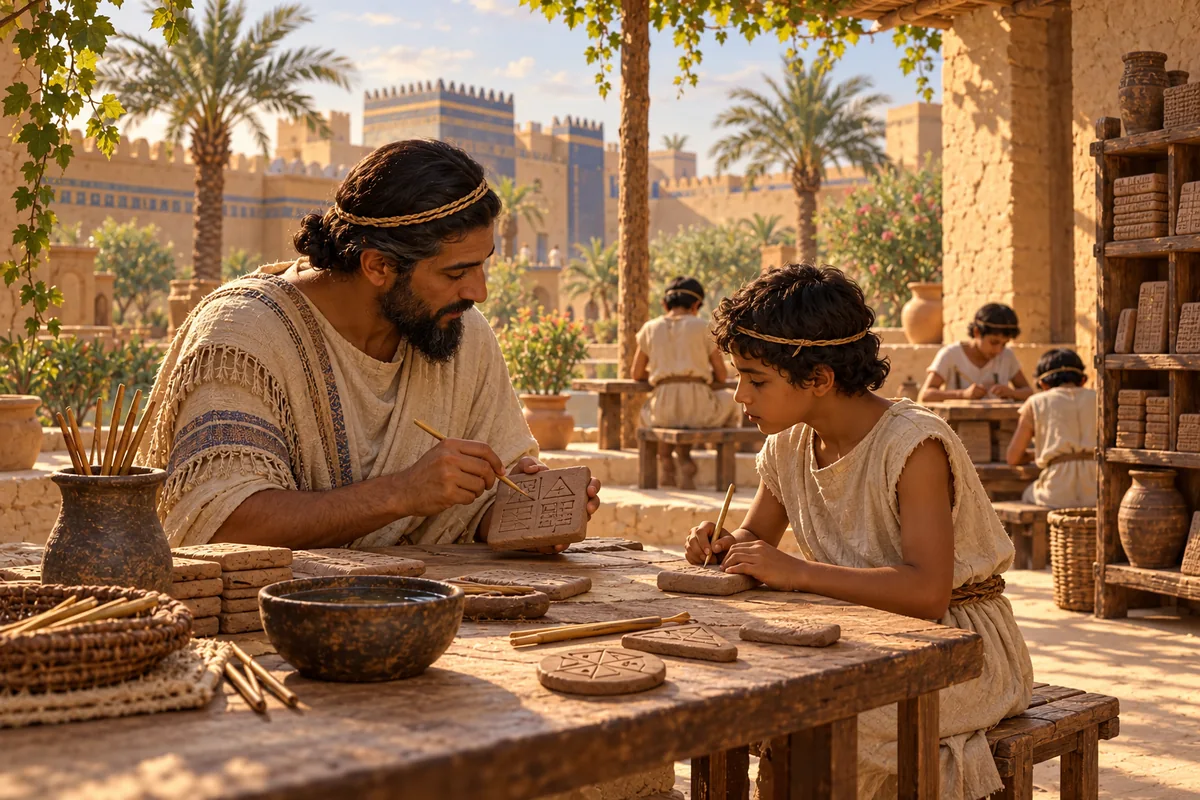
~1800 BCE · Multiple manuscripts across collections; see ETCSL bibliography for witnesses
A balbale to Enlil for Ur-Namma (Ur-Namma G)
In plain English
Six lines are missing before the text picks up with Enlil granting Ur-Namma early floodwaters, grain, and speckled barley. The surviving lines call on the king to let his people thrive and command him to work his fields: to drive the plough, tend the crops, and cultivate with oxen. The promise is repeated, almost like a refrain — plow with oxen, and the fields will be rich; let the oxen work the soil, and the harvest will be abundant. Several phrases mid-passage are damaged or untranslatable, leaving a few gaps in the sequence.
AI-generated reading paraphrase; compare with the translation below.
“6 lines missing Enlil ...... to Ur-Namma. He bestowed on him (?) early floods, grain and speckled barley. Ur-Namma, may the people flourish in prosperity under your rule. You (?) ...... the plough and good barley, and your cultivated fields will be rich. You (?) ...... trees, seeds, good barley, the plough, and the fields. You (?) ...... the plough and good barley ....... King, cultivate the fields with oxen, and your cultivated fields will be rich; Ur-Namma, cultivate the fields with them, and your cultivated fields will be rich. The oxen will make (?) your cultivated fields fertile; your cultivated fields will be rich.”
Source: ETCSL c.2.4.1.7: A balbale to Enlil for Ur-Namma (Ur-Namma G). Black, J.A., Cunningham, G., Robson, E. & Zólyomi, G. (eds.), The Electronic Text Corpus of Sumerian Literature, Faculty of Oriental Studies, University of Oxford. https://etcsl.orinst.ox.ac.uk/cgi-bin/etcsl.cgi?text=c.2.4.1.7
Read the full tablet entry~1800 BCE · Multiple manuscripts across collections; see ETCSL bibliography for witnesses
A balbale to Inana and Dumuzid (Dumuzid-Inana A)
In plain English
Utu speaks softly to his sister, holy Inana, telling her that the flax growing in the garden beds is beautiful — as lush and full of life as barley standing in its furrows. He knows she has set her heart on a fine length of linen, so he promises to pull up the flax plants himself and bring them to her straight from the beds. (One manuscript reads 'young lady' where another reads 'my sister' at two points in the speech, but the meaning runs the same either way.)
AI-generated reading paraphrase; compare with the translation below.
“The brother speaks gently to his sister, Utu speaks gently to his sister, he speaks tenderly to holy Inana: "Young lady, the flax in the garden beds is full of loveliness, Inana, the flax in the garden beds is full of loveliness, like the barley in the furrows, overflowing with loveliness and delight. Sister (1 ms. has instead: Young lady), you took a fancy to a grand length of linen; Inana, you took a fancy to a grand length of linen. I will dig up the plants for you and give them to you. Young lady (1 ms. has instead: My sister), I will bring you flax from the garden beds. Inana, I will bring you flax from the garden beds."”
Source: ETCSL c.4.08.01: A balbale to Inana and Dumuzid (Dumuzid-Inana A). Black, J.A., Cunningham, G., Robson, E. & Zólyomi, G. (eds.), The Electronic Text Corpus of Sumerian Literature, Faculty of Oriental Studies, University of Oxford. https://etcsl.orinst.ox.ac.uk/cgi-bin/etcsl.cgi?text=c.4.08.01
Read the full tablet entry~1800 BCE · Multiple manuscripts across collections; see ETCSL bibliography for witnesses
A balbale to Inana and Dumuzid (Dumuzid-Inana B)
In plain English
Dumuzid piles endearment on endearment for Inana — his darling, his honey, his sweet vine, his honey-mouthed one born of her mother. Her gaze is a pleasure to him, her words are a pleasure, her kisses are a pleasure; he calls her to him as his beloved sister again and again. The beer she brews from her own barley is good, he says, and the ale she makes from her beer-bread is good. Then the text begins to break down: a line about her luxuriance inside the house, another about her house itself likened to a storehouse, and a final address calling her 'princess' — but the surface is too damaged to recover the endings of these lines.
AI-generated reading paraphrase; compare with the translation below.
“"My dearest, my dearest, my dearest, my darling, my darling, my honey of her own mother, my sappy vine, my honey-sweet, my honey-mouthed of her mother! "The gazing of your eyes is pleasant to me; come my beloved sister. The speaking of your mouth is pleasant to me, my honey-mouthed of her mother. The kissing of your lips is pleasant to me; come my beloved sister. "My sister, the beer of your barley is good, my honey-mouthed of her mother. The ale of your beer-bread is good; come my beloved sister. In the house, your luxuriance ......, my honey-mouthed of her mother. My sister, your luxuriance ......, my beloved ....... Your house ...... a storehouse, my honey-mouthed of her mother. You princess, my ......."”
Source: ETCSL c.4.08.02: A balbale to Inana and Dumuzid (Dumuzid-Inana B). Black, J.A., Cunningham, G., Robson, E. & Zólyomi, G. (eds.), The Electronic Text Corpus of Sumerian Literature, Faculty of Oriental Studies, University of Oxford. https://etcsl.orinst.ox.ac.uk/cgi-bin/etcsl.cgi?text=c.4.08.02
Read the full tablet entry~1800 BCE · Multiple manuscripts across collections; see ETCSL bibliography for witnesses
A balbale to Inana and Dumuzid (Dumuzid-Inana D)
In plain English
While someone was out walking, Dumuzid caught sight of Inana. A voice recounts what followed: a man with a loving heart offered Inana a gift, met her, fell in love with her, and took her into his house, laying her down on a bed dripping with honey. The poem then describes their lovemaking in frank detail — he kissed her with his tongue again and again, made love to her fifty times until he was spent, while she trembled beneath him in silence, and he held his hands on her hips the whole while.
AI-generated reading paraphrase; compare with the translation below.
“As I was strolling, as I was strolling, as I was strolling ...... the house, as I was strolling, he caught sight of my Inana. "What did the brother say to you and speak to you? He of the loving heart and most sweet charms offered you a gift, my holy Inana. As I looked in that direction, my beloved man met you, and he fell in love with you, and he delighted in you alone! The brother brought you into his house and had you lie down on a bed dripping with honey." When my sweet precious, my heart, had lain down too, each of them in turn kissing with the tongue, each in turn, then my brother of the beautiful eyes did it fifty times to her, exhaustedly waiting for her, as she trembled underneath him, dumbly silent for him. My dear precious passed the time with my brother laying his hands on her hips.”
Source: ETCSL c.4.08.04: A balbale to Inana and Dumuzid (Dumuzid-Inana D). Black, J.A., Cunningham, G., Robson, E. & Zólyomi, G. (eds.), The Electronic Text Corpus of Sumerian Literature, Faculty of Oriental Studies, University of Oxford. https://etcsl.orinst.ox.ac.uk/cgi-bin/etcsl.cgi?text=c.4.08.04
Read the full tablet entry~1800 BCE · Multiple manuscripts across collections; see ETCSL bibliography for witnesses
A balbale to Inana and Dumuzid (Dumuzid-Inana E1)
In plain English
An unknown number of lines are missing at the start, and the next sixteen are too damaged to read clearly. What emerges is a young woman adorning herself with ornaments and a young man with his sword belt; the speaker asks that a girlfriend be brought to the place of the festival. Then a woman rides on a beast — the surface breaks up, but the words lion and great beast are still legible before more lines are lost. When the text becomes readable again, she is preparing herself: gathering something at her ears, blending kohl, letting her pinned-up hair fall loose, and bathing — rubbing herself with soap from a white bowl and rinsing with water, though the line breaks off there.
AI-generated reading paraphrase; compare with the translation below.
“unknown no. of lines missing 16 lines fragmentary or unclear The young maiden ...... ornaments. The young man ...... sword belt. Let my girlfriend ...... to the place of the festival. She rides on a beast, ...... on a beast. ...... on a lion ....... ...... on a great beast ....... unknown no. of lines missing 1 line fragmentary ...... gathers ......, ...... on her ears. She blends (?), she blends (?) ........ She blends (?) kohl. She lets down her hair which was combed up. She bathes and rubs herself with soap. She rubs herself with soap from the white bowl, she bathes with water from the…”
Source: ETCSL c.4.08.31: A balbale to Inana and Dumuzid (Dumuzid-Inana E1). Black, J.A., Cunningham, G., Robson, E. & Zólyomi, G. (eds.), The Electronic Text Corpus of Sumerian Literature, Faculty of Oriental Studies, University of Oxford. https://etcsl.orinst.ox.ac.uk/cgi-bin/etcsl.cgi?text=c.4.08.31
Read the full tablet entry~1800 BCE · Multiple manuscripts across collections; see ETCSL bibliography for witnesses
A balbale to Inana and Dumuzid (Dumuzid-Inana F)
In plain English
Inana declares that she will marvel at the fresh, soft foliage and lie down and run through it, longing for her bridegroom Ama-ucumgal-ana to speak tender words to her — the kind a farmer or shepherd would speak. Several lines break off here, their surfaces too damaged to read. She then describes a series of acts of nurturing: she will sprinkle water in Enlil's house and in his temple E-kur, making her mes tree put out new growth, and she will cause the king Ama-ucumgal-ana to flourish like a mes tree in the courtyard.
AI-generated reading paraphrase; compare with the translation below.
“I, the queen, will look with wonder at the foliage. I, Inana, will gaze at the soft foliage. May my bridegroom speak to me ...... kindly words such as a farmer or a shepherd would speak. I, the queen, will lie on the foliage. I, Inana, will run to the foliage. May they stand at my service ....... I will meet ...... Ama-ucumgal-ana. I will sprinkle water ....... I will make ...... shine. I will make my mes tree sprout forth. I will sprinkle water in the house of Enlil. I will make ...... shine. I will make my mes tree sprout forth. I will sprinkle water ...... in E-kur. I will make my king grow like a mes tree in the courtyard. I will sprinkle water in the house of Enlil. I will make the king Ama-ucumgal-ana grow like a mes tree in the courtyard.”
Source: ETCSL c.4.08.06: A balbale to Inana and Dumuzid (Dumuzid-Inana F). Black, J.A., Cunningham, G., Robson, E. & Zólyomi, G. (eds.), The Electronic Text Corpus of Sumerian Literature, Faculty of Oriental Studies, University of Oxford. https://etcsl.orinst.ox.ac.uk/cgi-bin/etcsl.cgi?text=c.4.08.06
Read the full tablet entry~1800 BCE · Multiple manuscripts across collections; see ETCSL bibliography for witnesses
A balbale to Inana and Dumuzid (Dumuzid-Inana G)
In plain English
The young man consults with his mother; the one with gentle eyes takes counsel with his father. He is addressed as brother — brother at the palace gate, captain of the barge, commander of the chariot, driver of the hunting chariot, city father and judge, son-in-law many times over. Their mother speaks well of him; he is the supreme son-in-law of their father. His arrival is life itself, his stepping into the house is abundance, and lying beside him is the greatest joy. 'Come to bed with me,' she says, 'and let us take our pleasure together.'
AI-generated reading paraphrase; compare with the translation below.
“The burgeoning one, he ...... with his own mother; the one with kindly eyes takes counsel with his father. You are our brother, you are our brother. You are our brother in charge of the palace gate, you are our captain of the barge, you are our commander of the chariot, you are our servant of the hunting chariot; you are our city father and judge, you are the son-in-law of five things, the son-in-law of ten things. Brother, you are the son-in-law of our father, you are our son-in-law supreme; our mother speaks favourably with you. Your coming here is life indeed, your entering the house is abundance; lying at your side is my utmost joy. My sweet, let us delight ourselves on the bed.”
Source: ETCSL c.4.08.07: A balbale to Inana and Dumuzid (Dumuzid-Inana G). Black, J.A., Cunningham, G., Robson, E. & Zólyomi, G. (eds.), The Electronic Text Corpus of Sumerian Literature, Faculty of Oriental Studies, University of Oxford. https://etcsl.orinst.ox.ac.uk/cgi-bin/etcsl.cgi?text=c.4.08.07
Read the full tablet entry~1800 BCE · Multiple manuscripts across collections; see ETCSL bibliography for witnesses
A balbale to Inana and Dumuzid (Dumuzid-Inana O)
In plain English
The speaker walks along the banks of a great river — the Euphrates — and passes through the bright, busy streets, calling out a string of blessings on the person addressed. One opening line is too damaged to read. May you be like a bending reed, like barley lying in the furrows; may you be Acnan, who brings beauty; may you be a nursing mother, a vine, a beloved. One manuscript reads 'my beloved,' another reads 'your beloved,' and a similar split exists in a following phrase. The blessing closes with the wish that your lot be 'there is enough, there is enough' — though the final lines break off before the text is complete.
AI-generated reading paraphrase; compare with the translation below.
“1 line fragmentary Your name ....... As I walk, as I walk, as I pass along the banks of the august river, as I roam along the banks of the Euphrates, as I stand ...... the lord, as I pass along the gaudy streets: May you be ...... a bending reed, may you be barley in the furrows, a beautiful ......, may you be Acnan, who beautifies ......, may you be a nursing mother of the womb, may you be your mother's ......, a vine, my (1 ms. has instead:) your beloved, your personal god's ......, acting grandly (1 ms. has instead:) humanely! May "There is enough, there is enough" be your blessing, and…”
Source: ETCSL c.4.08.15: A balbale to Inana and Dumuzid (Dumuzid-Inana O). Black, J.A., Cunningham, G., Robson, E. & Zólyomi, G. (eds.), The Electronic Text Corpus of Sumerian Literature, Faculty of Oriental Studies, University of Oxford. https://etcsl.orinst.ox.ac.uk/cgi-bin/etcsl.cgi?text=c.4.08.15
Read the full tablet entry