Chapter 07 · 911 – 609 BCE
Neo-Assyrian
Empire, library, terror, scholarship.
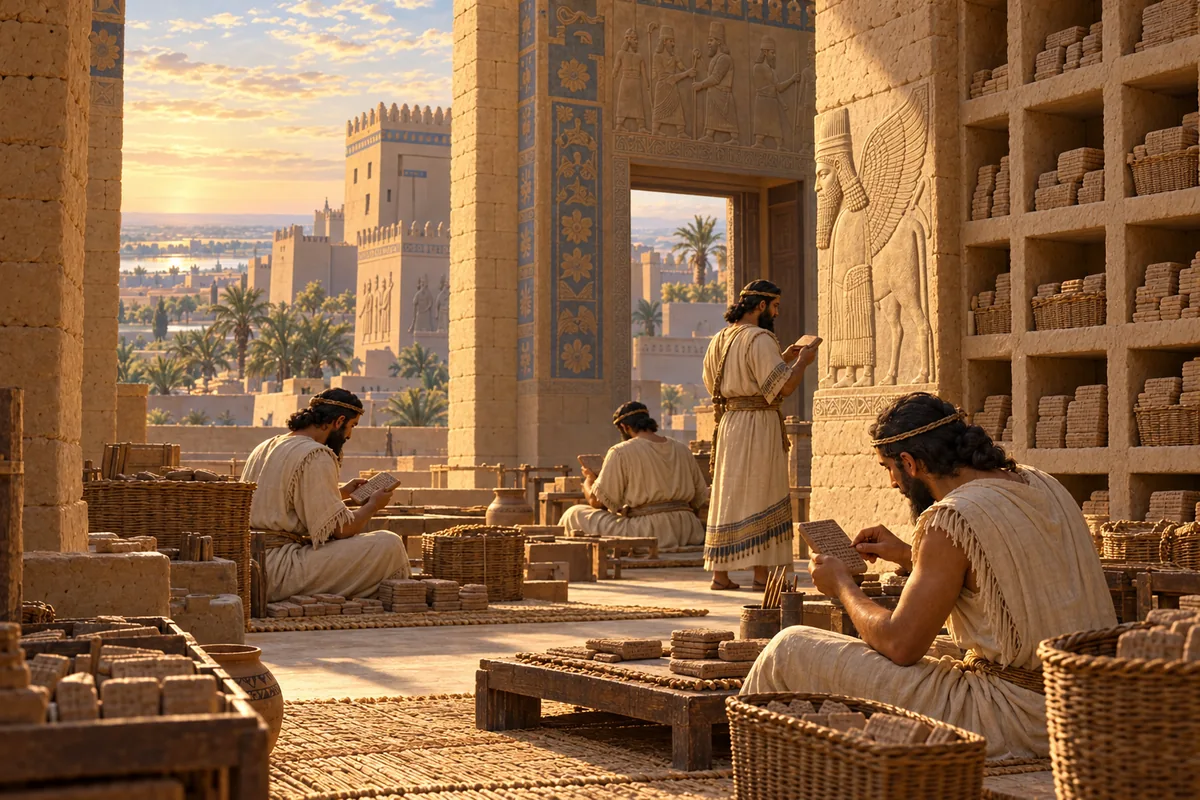
~715 BCE · Reconstructed composite — see ORACC entry for manuscript witnesses
SAA 01 132. Organizing the Cult of Dur-Šarruken (ABL 0841)
“(b.e. 1) To the king, [my lord]: (2) (This is) your servant Aha-lurš[i, your adorer], who [daily] prays [to Bel and Nabû] for the life of the king, [his lord]. May Nabû and Marduk [bless the king, my lord]! (5) As to what the king my lord wrote to me: "[As soon as the work has been finished] and the god has taken his seat (in the temple), [come to my presence]!" — (7) Mardî the eunuch said: "I [shall go; instead of] your going, stay and off[iciate here so that when ......] and the god takes his seats [......], you can recite the proper formulae" — (10) I told [him], however: "Write down [in a…”
Source: Parpola, S. 1987. The Correspondence of Sargon II, Part I: Letters from Assyria and the West. SAA 1. Helsinki: Helsinki University Press. https://oracc.museum.upenn.edu/saao/saa01/P334586/
Read the full tablet entry~715 BCE · Reconstructed composite — see ORACC entry for manuscript witnesses
SAA 01 133. Blessings and Flatteries (ABL 0216)
“(1) The very best of health to the king, my lord! May Aššur, Šamaš, Bel, Nabû, Sin and Nergal bless the king, my lord! (5) (This is from) your servant Hunnî, an adorer of the king his lord. (7) All the temples and palaces of Assyria are well; the crown prince Sennacherib is well; all the princes [who are in] Assyria are well; [the king], my lo[rd, can be very gl]ad [indeed]. (Break) (r 1) May he see the workmanship of the temples of his gods and kiss their beautiful feet; may those (gods) whose temples you have made shine like sunrise, bless the king my lord, and may we, the royal servants, kiss the feet of the king, our lord. (r 10) (This is from) your servant Hunnî, an adorer of the king his lord, who every morning and evening continually blesses the king, his lord.”
Source: Parpola, S. 1987. The Correspondence of Sargon II, Part I: Letters from Assyria and the West. SAA 1. Helsinki: Helsinki University Press. https://oracc.museum.upenn.edu/saao/saa01/P334158/
Read the full tablet entry~715 BCE · Reconstructed composite — see ORACC entry for manuscript witnesses
SAA 01 134. Blessings and Rituals (CT 53 043)
“(1) [To the king m]y lord: your servant [Hunnî]. Good health to the king, my lord! [May] Nabû and [Marduk bless the king, my lord]! May they give the king my lord a long life, peace of mind and good hea[lth, extreme old age], a strong army, a long reign and as many years as [......]; may they make all countries submit themselves [to you]! (6) May the king, my lord, the good shepherd [......] truly tend and shepherd them; may Aššur, Bel and Nabû [add] flocks to your flocks, give them to you, and enlarge your spacious fold; may the peoples of all the countries come into your presence! (10) O…”
Source: Parpola, S. 1987. The Correspondence of Sargon II, Part I: Letters from Assyria and the West. SAA 1. Helsinki: Helsinki University Press. https://oracc.museum.upenn.edu/saao/saa01/P313458/
Read the full tablet entry~715 BCE · Reconstructed composite — see ORACC entry for manuscript witnesses
SAA 01 135. Dividing an Inheritance (ABL 0179)
“(1) [To the ki]ng, my lord: your [servant] Amar-ili. [Good he]alth to the king, my lord! (4) As to the house of Mardû of which the king my lord told (me): "You and the governor of Arbela, divide it evenly between the sons of Mardû and give (each his share)!" (12) We did indeed find a writing-board inside (the house), [just as the king my lord had w]ritten; I sealed it and put it inside (...). (r 7) Now I am sending it to the king, my lord. What are the king my lord's instructions?”
Source: Parpola, S. 1987. The Correspondence of Sargon II, Part I: Letters from Assyria and the West. SAA 1. Helsinki: Helsinki University Press. https://oracc.museum.upenn.edu/saao/saa01/P334124/
Read the full tablet entry~715 BCE · Reconstructed composite — see ORACC entry for manuscript witnesses
SAA 01 136. No Jewels in the Temple (ABL 0643)
“(1) [To the king, my lord]: yo[ur servant Amar-ili. (3) [As to] the jewels [of which] the king my lord wrote to me, we searched in the temple but did not [find] (any) beautiful stones [...... (Rest destroyed)”
Source: Parpola, S. 1987. The Correspondence of Sargon II, Part I: Letters from Assyria and the West. SAA 1. Helsinki: Helsinki University Press. https://oracc.museum.upenn.edu/saao/saa01/P334444/
Read the full tablet entry~715 BCE · Reconstructed composite — see ORACC entry for manuscript witnesses
SAA 01 137. Clearing away Rubble from a Collapsed Wall (ABL 0329)
“(1) To the king, my lord: your servant Amar-ili. (3) We cleared away the wall of the palace which had fallen in and were starting to dig the foundations when the granary between the storehouse of the Palace Superintendent and the city wall fell down. The barley [...... (Break) (r 1) We have [...]ed and dumped it in the sto[rehouse of ...] and in the storehouse [of ...].”
Source: Parpola, S. 1987. The Correspondence of Sargon II, Part I: Letters from Assyria and the West. SAA 1. Helsinki: Helsinki University Press. https://oracc.museum.upenn.edu/saao/saa01/P334212/
Read the full tablet entry~715 BCE · Reconstructed composite — see ORACC entry for manuscript witnesses
SAA 01 138. The Wall Behind the Image of Ištar Collapses (ABL 1178)
“(1) [To the king], my [lord: your servant Ama]r-ili. (3) [As to the ... wall behind] (the image) of Ishtar [of which the king my lord] told (me): "Place the symbol [where it] goes up and [...]; if the wall is leaning, write me" — (10) Now on the 4th, the wall caved in by itself. [PN] and the master-builders [came] to see it, and they said: "[The wall] is ruined; let them remove [...] and change [...]. The [...] that the king ord[ered ...]." (19) A wall which [...] which the king [...] knows! [All] is well, [the king my lord can be] gl[ad]. (Break) (r 15) He should go [...]. [As far as] the wall behind the god is concerned, the king my lord can be glad.”
Source: Parpola, S. 1987. The Correspondence of Sargon II, Part I: Letters from Assyria and the West. SAA 1. Helsinki: Helsinki University Press. https://oracc.museum.upenn.edu/saao/saa01/P334774/
Read the full tablet entry~715 BCE · Reconstructed composite — see ORACC entry for manuscript witnesses
SAA 01 139. Getting Stone Slabs Across the River (ABL 1446)
“(Beginning destroyed) (1) ...... the Palace Herald and] the Chief [...] are keeping the boats for [them]selves. (4) Let the king, my lord, send word that they bring (boats) [to me] either from the Palace Herald or from the Ch[ief ...] so that I can get the stone slabs across. (Rest destroyed)”
Source: Parpola, S. 1987. The Correspondence of Sargon II, Part I: Letters from Assyria and the West. SAA 1. Helsinki: Helsinki University Press. https://oracc.museum.upenn.edu/saao/saa01/P334912/
Read the full tablet entry