Chapter 07 · 911 – 609 BCE
Neo-Assyrian
Empire, library, terror, scholarship.
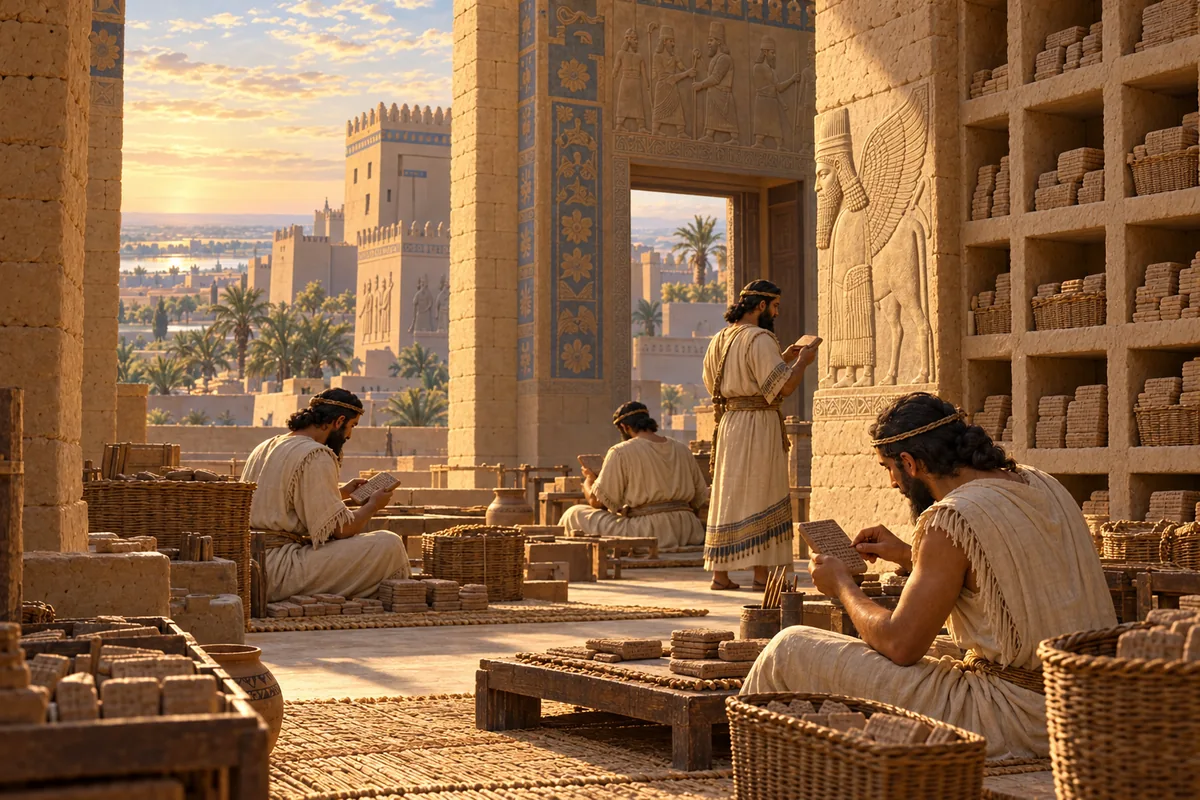
~800 BCE · Reconstructed composite — see ORACC entry for manuscript witnesses
Adad-nerari III 2009
In plain English
This object was given to Ištar-dūrī, a eunuch in the service of Nergal-ilāʾī and field marshal, who was Ištar-dūrī's protector. It is recorded as the property of Bīrtāyu, a eunuch of Adad-nārārī III, king of Assyria.
AI-generated reading paraphrase; compare with the translation below.
“(1) He gave (this) to Ištar-dūrī, eunuch of Nergal-ilāʾī (and) field marshal, his protector. Property of Bīrtāyu, eunuch of Adad-nārārī (III), king of Assyria.”
Source: Royal Inscriptions of Assyria online (RIAo), Munich Open-access Cuneiform Corpus Initiative (MOCCI), Ludwig-Maximilians-Universität München; in association with the RINAP Project, University of Pennsylvania. https://oracc.museum.upenn.edu/riao/Q004789/
Read the full tablet entry~800 BCE · Reconstructed composite — see ORACC entry for manuscript witnesses
Adad-nerari III 2010
In plain English
The inscription opens with a roll call of the great gods: Aššur, supreme lord and king of the gods, who decrees all destinies; Anu, the mighty forefather of the divine assembly; Enlil, father of the gods and lord of the lands, who exalts kingship; Ea, the wise king of the apsû, who grants wisdom; Marduk, sage of the gods, master of omens and commander of all; Nabû, scribe of Esagil and keeper of the tablet of destinies, who settles disputes; and Sîn, the luminary of heaven and the underworld, lord of the lunar disk — at which point the surface breaks off mid-sentence.
AI-generated reading paraphrase; compare with the translation below.
“(1) The god Aššur, the great lord, the king of the gods [who] decrees destinies; the god Anu, the mighty (and) foremost one, the ancestor of the great gods; the god Enlil, the father of the gods, the lord of the lands who makes kingship great; the god Ea, the wise one, the king of the apsû who grants wisdom; (5) the god Marduk, the sage of the gods, the lord of omens, the commander of all; the god Nabû, the scribe of Esagil, the possessor of the tablet of destinies of [the gods] who resolves differences; [the god] Sîn, the luminary [of heaven and netherworld], the lord of the lunar disk who…”
Source: Royal Inscriptions of Assyria online (RIAo), Munich Open-access Cuneiform Corpus Initiative (MOCCI), Ludwig-Maximilians-Universität München; in association with the RINAP Project, University of Pennsylvania. https://oracc.museum.upenn.edu/riao/Q004790/
Read the full tablet entry~800 BCE · Reconstructed composite — see ORACC entry for manuscript witnesses
Adad-nerari III 2011
In plain English
In a battle on or near a great river, Šamšī-ilu — described as a man without fear in combat — drove his horses against the enemy. Argišti was defeated in the thick of the fighting: he abandoned his camp and fled on a single horse. What followed involved the army of the land of Amurru and the people of Nir-something — several names and details are lost where the surface is damaged — but the picture is of spreading revolt and carnage, the blood of Argišti's warriors staining the ground red. Several lines in between are too broken to read continuously.
AI-generated reading paraphrase; compare with the translation below.
“(1') [...] troops [...] the river [...] wagon, might of the fearful flood, [...] strife. Šamšī-ilu, a man (who is) fearless [in battle, ...] ... upon his steeds, the extensive river [... (5´) ...] to him and Argišti, in the midst of battle, the bow [... he (Argišti) abandoned] his camp (and) with a single horse he [disappeared]. (6-b) [...] him and the army of the land Amurru, the people of Nir... [...] evil approaching (and) rebellion becoming rife (lit. “strong”) [...] his/its meadow like a ..., like a ... [... (10´) ...] ... the blood of his warriors being shed, with redness [it dyed ...]…”
Source: Royal Inscriptions of Assyria online (RIAo), Munich Open-access Cuneiform Corpus Initiative (MOCCI), Ludwig-Maximilians-Universität München; in association with the RINAP Project, University of Pennsylvania. https://oracc.museum.upenn.edu/riao/Q004791/
Read the full tablet entry~800 BCE · Reconstructed composite — see ORACC entry for manuscript witnesses
Adad-nerari III 2012
In plain English
He was chief of a vast army. He built a new city on the border of Aššur, beside Mount Ebiḫ on the bank of the Tigris, and enclosed it entirely with a wall, completing it from its foundations to its battlements. He named the city Šarru-iddina. He carved this commemorative inscription so that his name would last forever, and calls on those who come after to read it and honor his name — the line breaks off there.
AI-generated reading paraphrase; compare with the translation below.
“(1') the chief of the extensive army. (2') At that time, I built a city on the border of Baltil (Aššur), by Mount Ebiḫ, on the bank of the Tigris River, and surrounded it entirely (with a wall). I built (and) completed (it) from its foundations to its crenellations. I called the name of that city Šarru-iddina. (9') I wrote my commemorative inscription and (thus) established my name for eternity. May those who come after see this commemorative inscription of mine. May they heed my name and [...]”
Source: Royal Inscriptions of Assyria online (RIAo), Munich Open-access Cuneiform Corpus Initiative (MOCCI), Ludwig-Maximilians-Universität München; in association with the RINAP Project, University of Pennsylvania. https://oracc.museum.upenn.edu/riao/Q004792/
Read the full tablet entry~800 BCE · Reconstructed composite — see ORACC entry for manuscript witnesses
Adad-nerari III 2013
In plain English
Šamšī-ilu, the field marshal, dedicated this to the god Aššur, his lord, as an offering for his own life.
AI-generated reading paraphrase; compare with the translation below.
“(1) For (the god) Aššur, his lord, has Šamšī-ilu, the field marshal, dedicated (this) for his life.”
Source: Royal Inscriptions of Assyria online (RIAo), Munich Open-access Cuneiform Corpus Initiative (MOCCI), Ludwig-Maximilians-Universität München; in association with the RINAP Project, University of Pennsylvania. https://oracc.museum.upenn.edu/riao/Q004793/
Read the full tablet entry~800 BCE · Reconstructed composite — see ORACC entry for manuscript witnesses
Adad-nerari III 2014
In plain English
This object belonged to Šamšī-ilu, the field marshal.
AI-generated reading paraphrase; compare with the translation below.
“(1) Property of Šamšī-ilu, the field marshal.”
Source: Royal Inscriptions of Assyria online (RIAo), Munich Open-access Cuneiform Corpus Initiative (MOCCI), Ludwig-Maximilians-Universität München; in association with the RINAP Project, University of Pennsylvania. https://oracc.museum.upenn.edu/riao/Q004794/
Read the full tablet entry~800 BCE · Reconstructed composite — see ORACC entry for manuscript witnesses
Adad-nerari III 2015
In plain English
This is the seal of Nabû-šarru-uṣur, a eunuch in the service of Adad-nārārī III, king of Assyria.
AI-generated reading paraphrase; compare with the translation below.
“(1) Seal of Nabû-šarru-uṣur, eunuch of Adad-nārārī (III), king of Assyria.”
Source: Royal Inscriptions of Assyria online (RIAo), Munich Open-access Cuneiform Corpus Initiative (MOCCI), Ludwig-Maximilians-Universität München; in association with the RINAP Project, University of Pennsylvania. https://oracc.museum.upenn.edu/riao/Q004795/
Read the full tablet entry~800 BCE · Reconstructed composite — see ORACC entry for manuscript witnesses
Adad-nerari III 2016 / CDLI Seals 007055
In plain English
Pān-Aššur-lāmur, governor of the city of Aššur, dedicated this object to the goddess Gula, his lady, praying for the life of Adad-nārārī III, king of Assyria, and for his own life.
AI-generated reading paraphrase; compare with the translation below.
“(1) For the goddess Gula, his lady: Pān-Aššur-lāmur, the governor of Baltil (Aššur), dedicated (this) for the life of Adad-nārārī (III), king of Assyria, (and) his (own) life.”
Source: Royal Inscriptions of Assyria online (RIAo), Munich Open-access Cuneiform Corpus Initiative (MOCCI), Ludwig-Maximilians-Universität München; in association with the RINAP Project, University of Pennsylvania. https://oracc.museum.upenn.edu/riao/Q004796/
Read the full tablet entry