Chapter 07 · 911 – 609 BCE
Neo-Assyrian
Empire, library, terror, scholarship.
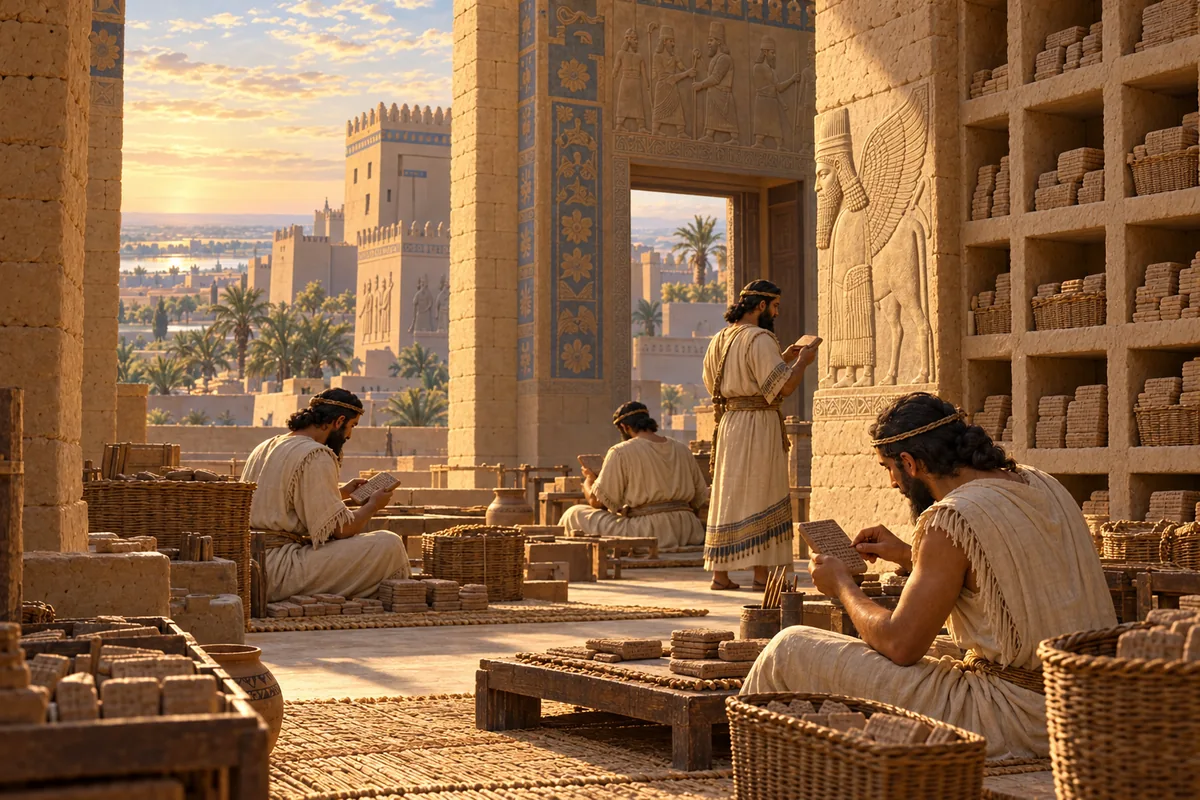
~800 BCE · Reconstructed composite — see ORACC entry for manuscript witnesses
Adad-nerari III 02
In plain English
Adad-nerari III identifies himself as great king, strong king, king of the world and king of Assyria, son of Shamshi-Adad V and grandson of Shalmaneser III. The inscription records a border settlement that Adad-nerari III and his field marshal Shamshi-ilu established between Zakkuru of Hamath and Attar-šumki son of Abi-ramu: the city of Nahlasi, along with all its fields, gardens, and dependent settlements, belongs to Attar-šumki, and the Orontes River was divided between the two parties as the boundary line. The text breaks off after Adad-nerari III's name is repeated.
AI-generated reading paraphrase; compare with the translation below.
“(1) Adad-nārārī (III), great king, strong king, king of the world, king of Assyria, son of Šamšī-Adad (V), strong king, king of the world, king of Assyria, son of Shalmaneser (III), king of the four quarters (of the world): (4) The boundary that Adad-nārārī (III), king of Assyria, (and) Šamšī-ilu, the field marshal established between Zakkūru of the land of Hamath and Attār-šumki, son of Abi-rāmu: the city Naḫlasi, together with all its fields, gardens, [and] settlements, is (the property) of Attār-šumki. They divided the Orontes River between them. This is the border. (8b) Adad-nārārī (III),…”
Source: Royal Inscriptions of Assyria online (RIAo), Munich Open-access Cuneiform Corpus Initiative (MOCCI), Ludwig-Maximilians-Universität München; in association with the RINAP Project, University of Pennsylvania. https://oracc.museum.upenn.edu/riao/Q004750/
Read the full tablet entry~800 BCE · Reconstructed composite — see ORACC entry for manuscript witnesses
Adad-nerari III 03
In plain English
This is the boundary stone of Adad-nerari III, king of Assyria, son of Shamshi-Adad V and Semiramis — Shamshi-Adad's palace-woman, mother of Adad-nerari, and daughter-in-law of Shalmaneser III. When Ushpilulume, king of Kummuhu, brought Adad-nerari and Semiramis across the Euphrates, Adad-nerari fought a pitched battle against Attar-shumki, son of Abi-ramu of Arpad, along with eight other kings — the inscription breaks off there.
AI-generated reading paraphrase; compare with the translation below.
“(1) Boundary stone of Adad-nārārī (III), king of Assyria, son of Šamšī-Adad (V), king of Assyria, (and of) Semiramis, the palace-woman of Šamšī-Adad (V), king of Assyria, mother of Adad-nārārī (III), strong king, king of Assyria, daughter-in-law of Shalmaneser (III), king of the four quarters (of the world). (7b) When Ušpilulume, king of the city Kummuḫu, caused Adad-nārārī (III), king of Assyria, (and) Semiramis, the palace woman, to cross the Euphrates River, I (Adad-nārārī) fought a pitched battle with them — with Attār-šumki, son of Abi-rāmu, of the city Arpad, together with eight kings…”
Source: Royal Inscriptions of Assyria online (RIAo), Munich Open-access Cuneiform Corpus Initiative (MOCCI), Ludwig-Maximilians-Universität München; in association with the RINAP Project, University of Pennsylvania. https://oracc.museum.upenn.edu/riao/Q004751/
Read the full tablet entry~800 BCE · Reconstructed composite — see ORACC entry for manuscript witnesses
Adad-nerari III 04
In plain English
The kings of the land of Hatti, who had grown powerful during the reign of Shamshi-Adad V and had stirred up revolt along the Orontes or Euphrates, learned of Adad-nerari's approach. Attar-šumki, trusting in his own strength, came out to fight — and lost. Adad-nerari routed him, seized his camp, and carried off the treasure of his palace. From Attar-šumki, son of Abi-rame, he then received tribute beyond counting. Several passages surrounding these events are too damaged to read.
AI-generated reading paraphrase; compare with the translation below.
“(1') ... [...] they drew the yoke of [my lordly majesty. The kings of the wide land Ḫatti], who, in the time of Šamšī-[Adad (V), my father, had become strong and caused] the lords of the Orontes/Euphrates River [to rebel, ...] he heard [of my approach] and Attār-š[umki, ...] trusting [in his own strength, attacked to wage war and strife. I defeated him (and)] took away his camp. [...] the treasure of [his] palace [I carried off ... Attār-šumki], son of A(bī)-rāme, [...] I received, without number. [...] ... [...]”
Source: Royal Inscriptions of Assyria online (RIAo), Munich Open-access Cuneiform Corpus Initiative (MOCCI), Ludwig-Maximilians-Universität München; in association with the RINAP Project, University of Pennsylvania. https://oracc.museum.upenn.edu/riao/Q004752/
Read the full tablet entry~800 BCE · Reconstructed composite — see ORACC entry for manuscript witnesses
Adad-nerari III 05
In plain English
Adad-nārārī III, great king, strong king, king of the world and of Assyria, son of Šamšī-Adad V and grandson of Shalmaneser III, records his western campaign. He mustered his chariots, troops, and armed forces, ordered the march into Ḫatti, and crossed the Euphrates at flood stage. He pushed down to the city of Paqarḫubuni, where Attār-šumki, son of Abi-rāmu, had joined eight other kings of Ḫatti in open rebellion, trusting in their own strength — at which point the text breaks off, mid-sentence, as the terrifying radiance of the god Aššur begins to overwhelm them.
AI-generated reading paraphrase; compare with the translation below.
“(1) [Adad-nārārī (III), great king], strong [king], king of the world, king of Assyria, son of Šamšī-Adad (V), [king of the world, king of Assyria, son of] Shalmaneser (III), king of the four quarters (of the world): (3) I mustered (my) [chariotry, troops] and armed forces and [gave the order to march] to the land Ḫatti. I crossed the Euphrates River in flood. (5) I went down [to the city Paqarḫu]buni. Attār-šumki, [son of Abi-rāmu, together with eight kin]gs of the land Ḫatti, who had rebelled and [trusted in their strength] – the awesome radiance of the god Aššur, my lord, [overwhelmed…”
Source: Royal Inscriptions of Assyria online (RIAo), Munich Open-access Cuneiform Corpus Initiative (MOCCI), Ludwig-Maximilians-Universität München; in association with the RINAP Project, University of Pennsylvania. https://oracc.museum.upenn.edu/riao/Q004753/
Read the full tablet entry~800 BCE · Reconstructed composite — see ORACC entry for manuscript witnesses
Adad-nerari III 06
In plain English
The inscription opens with an address to Adad, god of storms — canal inspector of heaven and the underworld, son of Anu, foremost among the Igīgū gods and warrior of the Anunnakū gods. Adad is described as robed in blazing light, riding the great storms, striking down evil, wielding a sacred whip, and hurling lightning. The dedication is made by Adad-nārārī III, who styles himself great king, strong king, king of the world, king of Assyria, peerless king, and exalted shepherd whose prayers and sacrifices find favor with the great gods — but the inscription breaks off here, and the rest of that line is lost.
AI-generated reading paraphrase; compare with the translation below.
“(1) [To] the god Adad, canal inspector of heaven and netherworld, son of the god Anu, the perfectly splendid hero whose strength is mighty, foremost of all of the Igīgū gods, warrior of the Anunnakū gods, who is bedecked with luminosity, who rides the great storms (and) is clothed with fierce brilliance, who lays low the evil, who bears a holy whip, who makes the lightning flash, the great lord, his lord: (6) [Adad-nār]ārī (III), great king, strong king, king of the world, king of Assyria, unrivalled king, marvelous shepherd, the exalted vice-regent whose prayers (and) sacrifices the great…”
Source: Royal Inscriptions of Assyria online (RIAo), Munich Open-access Cuneiform Corpus Initiative (MOCCI), Ludwig-Maximilians-Universität München; in association with the RINAP Project, University of Pennsylvania. https://oracc.museum.upenn.edu/riao/Q004754/
Read the full tablet entry~800 BCE · Reconstructed composite — see ORACC entry for manuscript witnesses
Adad-nerari III 07
In plain English
Dedicated to Adad — almighty lord, son of Anu, canal inspector of heaven and the underworld, the one who brings rain and abundance, who dwells in the city Zamaḫu. Adad-nārārī III, strong king, king of Assyria, son of Šamšī-Adad V and grandson of Shalmaneser III, records that he mustered his chariots, soldiers, and armed forces and ordered a march into the land of Hatti. In a single year he brought both Amurru and Hatti to their — the inscription breaks off here, the rest of the line lost.
AI-generated reading paraphrase; compare with the translation below.
“(1) To the god Adad, the almighty lord, powerful noble of the gods, son of the god Anu, unique, awesome, supreme, canal inspector of heaven and netherworld, who rains down abundance, who dwells in the city Zamaḫu, the great lord, his lord: (3) Adad-nārārī (III), strong king, king of the world, king of Assyria, son of Šamšī-Adad (V), king of the world, king of Assyria, son of Shalmaneser (III), king of the four quarters (of the world): (4) I mustered my chariotry, troops, (and) armed forces (and) ordered the march to the land Ḫatti. In one year, I made lands Amurru (and) Ḫatti in their (text…”
Source: Royal Inscriptions of Assyria online (RIAo), Munich Open-access Cuneiform Corpus Initiative (MOCCI), Ludwig-Maximilians-Universität München; in association with the RINAP Project, University of Pennsylvania. https://oracc.museum.upenn.edu/riao/Q004755/
Read the full tablet entry~800 BCE · Reconstructed composite — see ORACC entry for manuscript witnesses
Adad-nerari III 08
In plain English
This is the palace of Adad-nārārī III — great king, strong king, king of the world, king of Assyria. From his youth, the god Aššur, king of the Igīgū gods, singled him out, handed him unrivalled power, made his rule feel like medicine to the people of Assyria, and set his throne in place. He is the devoted priest who never stops supplying the temple Ešarra and upholding the rites of Ekur, who marches to war backed by his lord Aššur, and brings the rulers of all four corners of the world to heel. His conquests reach from Mount Siluna in the east, through the lands of Namri — and here the inscription breaks off.
AI-generated reading paraphrase; compare with the translation below.
“(1) Palace of Adad-nārārī (III), great king, strong king, king of the world, king of Assyria; the king in whose youth (the god) Aššur, king of the Igīgū gods, chose, entrusted him with unrivalled rulership, made his shepherdship pleasing like a healing drug to the people of Assyria, (and) established his throne; the holy priest who unceasingly provides for Ešarra (and) maintains the rites of Ekur, the one who campaigns with the support of (the god) Aššur, his lord, and subdues the rulers of the four quarters (of the world); (5b) the conqueror from Mount Siluna in the east, the lands Namri,…”
Source: Royal Inscriptions of Assyria online (RIAo), Munich Open-access Cuneiform Corpus Initiative (MOCCI), Ludwig-Maximilians-Universität München; in association with the RINAP Project, University of Pennsylvania. https://oracc.museum.upenn.edu/riao/Q004756/
Read the full tablet entry~800 BCE · Reconstructed composite — see ORACC entry for manuscript witnesses
Adad-nerari III 09
In plain English
Adad-nerari III, great king, strong king, king of the world, king of Assyria — son of Shamshi-Adad V and grandson of Shalmaneser III — issued the following decree: the land of Hindanu was placed under the authority of Palil-eres, governor of Raṣappa, who was also given control over its state service obligations. Anyone who challenges this decree, which stands in favor of Palil-eres as governor of both Raṣappa and Hindanu, faces consequences involving his agent — but the tablet is too damaged at this point to read the penalty, and the passage breaks off mid-sentence as someone is described bringing a suit before the king.
AI-generated reading paraphrase; compare with the translation below.
“(1) [Adad-nārārī (III), great king], strong king, king of the world, king of Assyria, [son of Šamš]ī-Adad (V), strong king, king [of the world], king of Assyria, [son of Shal]maneser (III), king of the four quarters (of the world): (4) Decree: he entrusted the land Ḫindānu to Pālil-[ēreš], the governor of the land Raṣappa. The state service is under his authority. (6) Whoever lays claim against the provisions of the decree, which is (in favor) of Pālil-ēreš, the governor of the land Raṣappa (and) governor [of the land Ḫindānu], ... [...] his agent. Whoever [... files a] suit before the king…”
Source: Royal Inscriptions of Assyria online (RIAo), Munich Open-access Cuneiform Corpus Initiative (MOCCI), Ludwig-Maximilians-Universität München; in association with the RINAP Project, University of Pennsylvania. https://oracc.museum.upenn.edu/riao/Q004757/
Read the full tablet entry