Chapter 07 · 911 – 609 BCE
Neo-Assyrian
Empire, library, terror, scholarship.
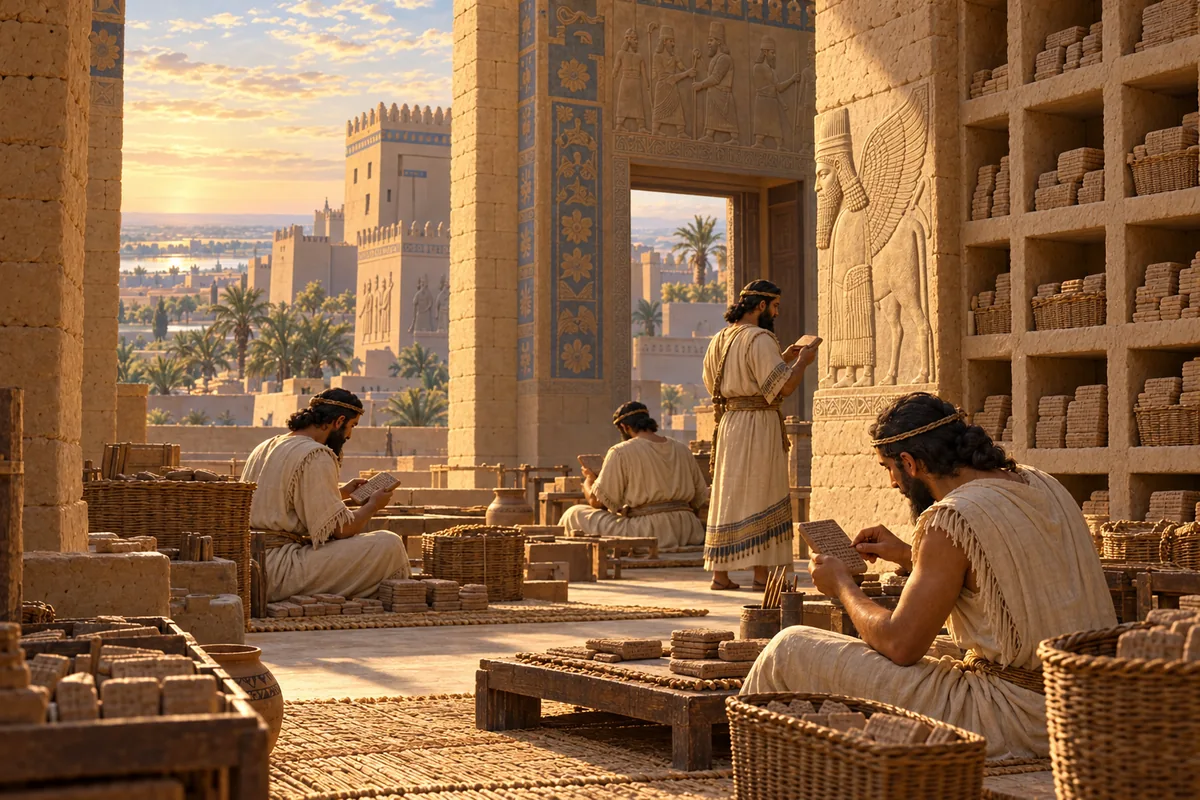
~800 BCE · Reconstructed composite — see ORACC entry for manuscript witnesses
Adad-nerari III 10
In plain English
Adad-nārārī III, king of Assyria and son of Šamšī-Adad V, who was also king of Assyria, dedicated this object to the goddess Bēlet-parṣē, his lady, for the sake of his own life.
AI-generated reading paraphrase; compare with the translation below.
“(1) For the goddess Bēlet-parṣē, his lady: Adad-nārārī (III), king of Assyria, son of Šamšī-Adad (V), (who was) also king of Assyria, dedicated (this) for his life.”
Source: Royal Inscriptions of Assyria online (RIAo), Munich Open-access Cuneiform Corpus Initiative (MOCCI), Ludwig-Maximilians-Universität München; in association with the RINAP Project, University of Pennsylvania. https://oracc.museum.upenn.edu/riao/Q004758/
Read the full tablet entry~800 BCE · Reconstructed composite — see ORACC entry for manuscript witnesses
Adad-nerari III 1001
“(1') No translation warranted. (1'') No translation warranted.”
Source: Royal Inscriptions of Assyria online (RIAo), Munich Open-access Cuneiform Corpus Initiative (MOCCI), Ludwig-Maximilians-Universität München; in association with the RINAP Project, University of Pennsylvania. https://oracc.museum.upenn.edu/riao/Q004778/
Read the full tablet entry~800 BCE · Reconstructed composite — see ORACC entry for manuscript witnesses
Adad-nerari III 11
In plain English
Adad-nārārī III, son of Šamšī-Adad V, dedicated this object to the goddess Bēlet-parṣē, his lady, for the sake of his own life.
AI-generated reading paraphrase; compare with the translation below.
“(1) For the goddess Bēlet-parṣē, his lady: Adad-nārārī (III), son of Šamšī-[Adad] (V), dedicated (this) for his life.”
Source: Royal Inscriptions of Assyria online (RIAo), Munich Open-access Cuneiform Corpus Initiative (MOCCI), Ludwig-Maximilians-Universität München; in association with the RINAP Project, University of Pennsylvania. https://oracc.museum.upenn.edu/riao/Q004759/
Read the full tablet entry~800 BCE · Reconstructed composite — see ORACC entry for manuscript witnesses
Adad-nerari III 12
In plain English
This is the palace label of Adad-nārārī III, king of the world and king of Assyria, son of Šamšī-Adad V — himself king of the world and king of Assyria — and grandson of Shalmaneser III, king of Assyria. The inscription states that it belonged to the facing of the temple of the god Aššur, though the end of that phrase is partially broken.
AI-generated reading paraphrase; compare with the translation below.
“(1) Palace of Adad-nārārī (III), king of the world, king of Assyria, son of Šamšī-Adad (V), king of the world, king of Assyria, (and) son of Shalmaneser (III), king of Assyria: belonging to the facing [of the temple of (the god) Aššur].”
Source: Royal Inscriptions of Assyria online (RIAo), Munich Open-access Cuneiform Corpus Initiative (MOCCI), Ludwig-Maximilians-Universität München; in association with the RINAP Project, University of Pennsylvania. https://oracc.museum.upenn.edu/riao/Q004760/
Read the full tablet entry~800 BCE · Reconstructed composite — see ORACC entry for manuscript witnesses
Adad-nerari III 13
Records Adad-nārārī III completing a palace left unfinished by his father Šamšī-Adad V, attesting the dynastic continuity rhetoric Assyrian kings used to legitimise building projects inherited across reigns.
In plain English
This palace belonged to Šamšī-Adad V — great king, strong king, king of Assyria and of the world, son of Shalmaneser III, son of Ashurnasirpal II. Šamšī-Adad had built the palace but never finished it, so his son Adad-nārārī III, king of Assyria, completed it.
AI-generated reading paraphrase; compare with the translation below.
“(1) Palace of Šamšī-Adad (V), great king, strong king, king of [the world, king of Assyria], son of Shalmaneser (III), king of the four quarters (of the world), son of Ashurnasirpal (II), [king of Assyria]. (3) At that time, (as for) this palace, which Šamšī-Adad (V), king of Assyria, had built, but not completed, I, Adad-nārārī (III), king of Assyria, his son, completed (it).”
Source: Royal Inscriptions of Assyria online (RIAo), Munich Open-access Cuneiform Corpus Initiative (MOCCI), Ludwig-Maximilians-Universität München; in association with the RINAP Project, University of Pennsylvania. https://oracc.museum.upenn.edu/riao/Q004761/
Read the full tablet entry~800 BCE · Reconstructed composite — see ORACC entry for manuscript witnesses
Adad-nerari III 14
Documents Adad-nērārī III's reconstruction of Nabû's Nineveh temple, anchoring the god's growing cult prominence in the Assyrian heartland to a datable early eighth-century royal patron.
In plain English
Adad-nerari III — son of Shamshi-Adad V, grandson of Shalmaneser III, each of them appointee of Enlil and vice-regent of Ashur — rebuilt the temple of Nabû, his lord, in Nineveh from its foundations to its battlements. He did this for his own life, the welfare of his descendants, and the good of his land.
AI-generated reading paraphrase; compare with the translation below.
“(1) Adad-nārārī (III), appointee of the god Enlil, vice-regent of (the god) Aššur, son of Šamšī-Adad (V), appointee of the god Enlil, vice-regent of (the god) Aššur, son of Shalmaneser (III), (who was) also appointee of the god Enlil and vice-regent of (the god) Aššur: (as for) the temple of the god Nabû, his lord, that is in Nineveh, he (re)built (it) from its foundation(s) to its crenellations for his life (and) the well-being of his seed and his land.”
Source: Royal Inscriptions of Assyria online (RIAo), Munich Open-access Cuneiform Corpus Initiative (MOCCI), Ludwig-Maximilians-Universität München; in association with the RINAP Project, University of Pennsylvania. https://oracc.museum.upenn.edu/riao/Q004762/
Read the full tablet entry~800 BCE · Reconstructed composite — see ORACC entry for manuscript witnesses
Adad-nerari III 15
Adad-nerari III's royal titulary chains three successive kings as Enlil's appointees and Aššur's vice-regents, attesting the dynastic legitimation formula the Assyrians used to anchor living rule in divine mandate.
In plain English
Adad-nārārī III identifies himself by his lineage and divine mandate: he is the chosen of Enlil and vice-regent of Aššur, son of Šamšī-Adad V — who held the same titles — and grandson of Shalmaneser III, who was likewise chosen of Enlil and vice-regent of Aššur.
AI-generated reading paraphrase; compare with the translation below.
“(1) Adad-nārārī (III), appointee of the god Enlil, vice-regent of (the god) Aššur, son of Šamšī-Adad (V), appointee of the god Enlil, vice-regent of (the god) Aššur, son of Shalmaneser (III), (who was) also appointee of the god Enlil and vice-regent of (the god) Aššur.”
Source: Royal Inscriptions of Assyria online (RIAo), Munich Open-access Cuneiform Corpus Initiative (MOCCI), Ludwig-Maximilians-Universität München; in association with the RINAP Project, University of Pennsylvania. https://oracc.museum.upenn.edu/riao/Q004763/
Read the full tablet entry~800 BCE · Reconstructed composite — see ORACC entry for manuscript witnesses
Adad-nerari III 16
Royal titulary of Adad-nārārī III anchors his legitimacy in two generations of conquest kings, Šamšī-Adad V and Shalmaneser III, illustrating how Assyrian rulers constructed dynastic authority through inscribed genealogy.
In plain English
This is the palace of Adad-nārārī III, king of the world and king of Assyria, son of Šamšī-Adad V — himself king of the world and king of Assyria — and grandson of Shalmaneser III, king of the four quarters of the world.
AI-generated reading paraphrase; compare with the translation below.
“(1) Palace of Adad-nārārī (III), king of the world, king of Assyria, son of Šamšī-Adad (V), king of the world, king of Assyria, son of Shalmaneser (III), king of the four quarters (of the world).”
Source: Royal Inscriptions of Assyria online (RIAo), Munich Open-access Cuneiform Corpus Initiative (MOCCI), Ludwig-Maximilians-Universität München; in association with the RINAP Project, University of Pennsylvania. https://oracc.museum.upenn.edu/riao/Q004764/
Read the full tablet entry