Chapter 07 · 911 – 609 BCE
Neo-Assyrian
Empire, library, terror, scholarship.
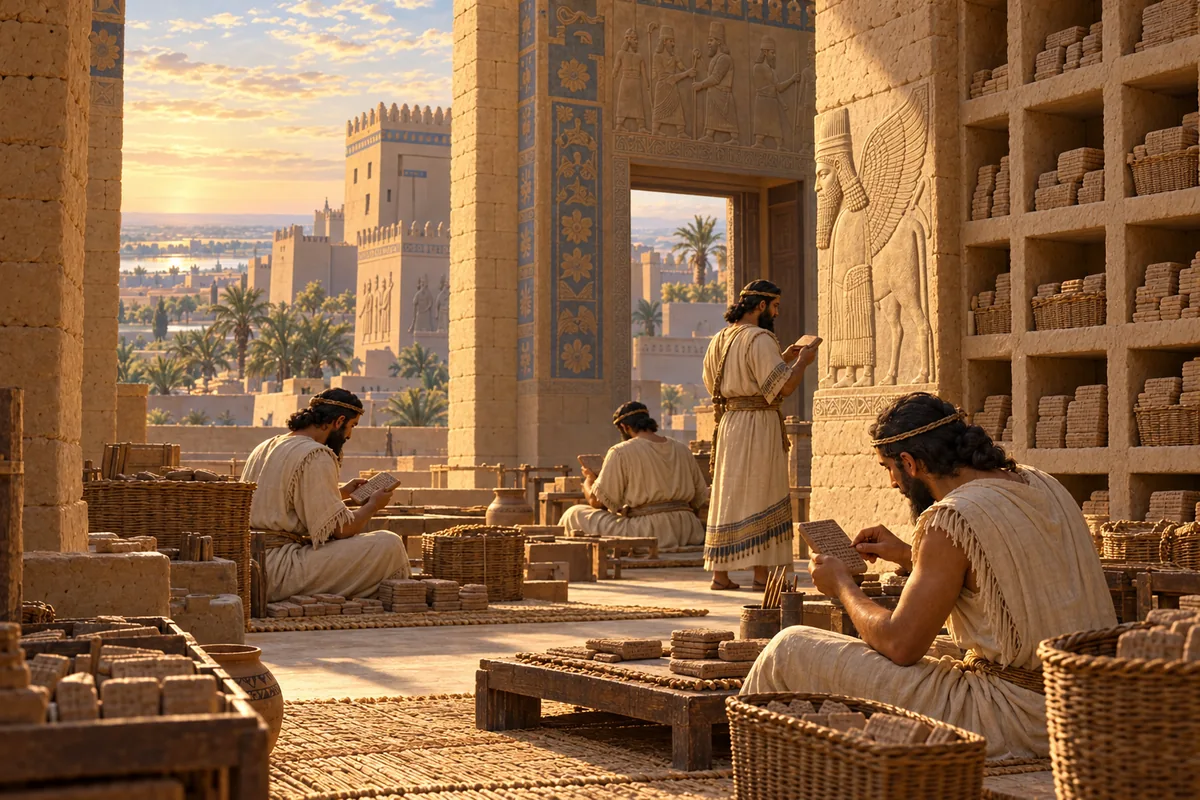
~875 BCE · Reconstructed composite — see ORACC entry for manuscript witnesses
Ashurnasirpal II 085
“(1) Palace of Ashurnasirpal (II), king of the world, king of Assyria, son of Tukultī-Ninurta (II), king of Assyria, son of Adad-nārārī (II), (who was) also king of Assyria: captives of the land Ḫatti.”
Source: Royal Inscriptions of Assyria online (RIAo), Munich Open-access Cuneiform Corpus Initiative (MOCCI), Ludwig-Maximilians-Universität München; in association with the RINAP Project, University of Pennsylvania. https://oracc.museum.upenn.edu/riao/Q004539/
Read the full tablet entry~875 BCE · Reconstructed composite — see ORACC entry for manuscript witnesses
Ashurnasirpal II 086
“(1) Palace of [Ashurnasir]pal (II), king of the world, [king of Assyria, son of Tukultī-Ninurta (II), king of Assyria], son of Adad-nārārī (II), (who was) also king of Assyria: I conquered the city Rug(g)ulitu of Bīt-Adini.”
Source: Royal Inscriptions of Assyria online (RIAo), Munich Open-access Cuneiform Corpus Initiative (MOCCI), Ludwig-Maximilians-Universität München; in association with the RINAP Project, University of Pennsylvania. https://oracc.museum.upenn.edu/riao/Q004540/
Read the full tablet entry~875 BCE · Reconstructed composite — see ORACC entry for manuscript witnesses
Ashurnasirpal II 087
“(1) I conquered the city Y[all]gu (Alligu) [of Bīt]-Adini.”
Source: Royal Inscriptions of Assyria online (RIAo), Munich Open-access Cuneiform Corpus Initiative (MOCCI), Ludwig-Maximilians-Universität München; in association with the RINAP Project, University of Pennsylvania. https://oracc.museum.upenn.edu/riao/Q004541/
Read the full tablet entry~875 BCE · Reconstructed composite — see ORACC entry for manuscript witnesses
Ashurnasirpal II 088
“(1) Palace of Ashurnasirpal (II), king of the world, king of Assyria, son of Tukultī-Ninurta (II), king of Assyria, son of Adad-nārārī (II), (who was) also king of Assyria: tribute of the land Sūḫu.”
Source: Royal Inscriptions of Assyria online (RIAo), Munich Open-access Cuneiform Corpus Initiative (MOCCI), Ludwig-Maximilians-Universität München; in association with the RINAP Project, University of Pennsylvania. https://oracc.museum.upenn.edu/riao/Q004542/
Read the full tablet entry~875 BCE · Reconstructed composite — see ORACC entry for manuscript witnesses
Ashurnasirpal II 090
“(1) I conquered the city U[l(l)]uba of Sa(n)gara, [king of the la]nd Ḫatti.”
Source: Royal Inscriptions of Assyria online (RIAo), Munich Open-access Cuneiform Corpus Initiative (MOCCI), Ludwig-Maximilians-Universität München; in association with the RINAP Project, University of Pennsylvania. https://oracc.museum.upenn.edu/riao/Q004544/
Read the full tablet entry~875 BCE · Reconstructed composite — see ORACC entry for manuscript witnesses
Ashurnasirpal II 091
“(1) Palace of Ashurnasirpal (II), king of the world, king of Assyria, son of Tukultī-Ninurta (II), king of Assyria, son of Adad-nārārī (II), (who was) also king of Assyria: captives of the city Mari[ri o]f the land [Ḫ]atti.”
Source: Royal Inscriptions of Assyria online (RIAo), Munich Open-access Cuneiform Corpus Initiative (MOCCI), Ludwig-Maximilians-Universität München; in association with the RINAP Project, University of Pennsylvania. https://oracc.museum.upenn.edu/riao/Q004545/
Read the full tablet entry~875 BCE · Reconstructed composite — see ORACC entry for manuscript witnesses
Ashurnasirpal II 092
“(1) I slew wild bulls on the Euphrates River.”
Source: Royal Inscriptions of Assyria online (RIAo), Munich Open-access Cuneiform Corpus Initiative (MOCCI), Ludwig-Maximilians-Universität München; in association with the RINAP Project, University of Pennsylvania. https://oracc.museum.upenn.edu/riao/Q004546/
Read the full tablet entry~875 BCE · Reconstructed composite — see ORACC entry for manuscript witnesses
Ashurnasirpal II 094
“(1) Palace of [As]hurnasirpal (II), king of the world, king of [Assyria], son of Tukultī-Ninurta (II), [king of Assyria], son of Adad-nārārī (II), (who was) also king of Assyria: I slew lions on the Baliḫ River.”
Source: Royal Inscriptions of Assyria online (RIAo), Munich Open-access Cuneiform Corpus Initiative (MOCCI), Ludwig-Maximilians-Universität München; in association with the RINAP Project, University of Pennsylvania. https://oracc.museum.upenn.edu/riao/Q004548/
Read the full tablet entry