Chapter 03 · 2334 – 2154 BCE
Akkadian Empire
Sargon brings rival city-states under imperial rule.
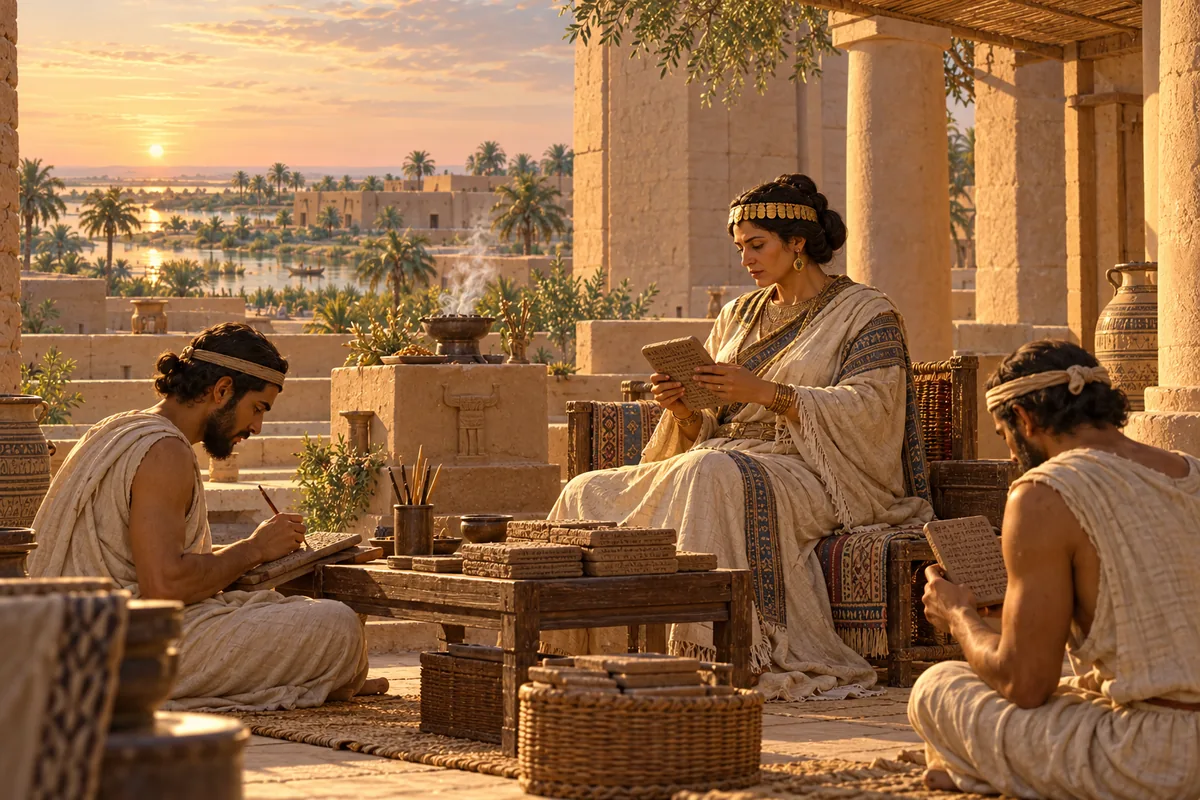
~2130 BCE · Reconstructed composite — see ORACC entry for manuscript witnesses
Ur-Ningirsu I 3
“(1) To Ninmarki, his lady, ... dedicated this (marble tablet) for the well-being of Ur-Ninĝirsu, ruler of Lagaš, and for her/his own well-being.”
Source: Electronic Text Corpus of Sumerian Royal Inscriptions (ETCSRI), University of Vienna, edited by Gábor Zólyomi et al. https://oracc.museum.upenn.edu/etcsri/Q001461/
Read the full tablet entry~2130 BCE · Reconstructed composite — see ORACC entry for manuscript witnesses
Ur-Ningirsu I 4
“(1) To the protective spirit, Bau, his lady, Nin-niĝare-si, (Ur-Ninĝirsu's) spouse, dedicated this (human-headed bull) for the well-being of Ur-Ninĝirsu, ruler of Lagaš, and for her own well-being. The name of this votive gift is “May my lady raise him!””
Source: Electronic Text Corpus of Sumerian Royal Inscriptions (ETCSRI), University of Vienna, edited by Gábor Zólyomi et al. https://oracc.museum.upenn.edu/etcsri/Q001462/
Read the full tablet entry~2130 BCE · Reconstructed composite — see ORACC entry for manuscript witnesses
Ur-Ningirsu I 5
“(1') To ..., Ur-dub, child of ..., dedicated this (mace) for the well-being of Ur-Ninĝirsu, ruler of Lagaš, and for his own well-being.”
Source: Electronic Text Corpus of Sumerian Royal Inscriptions (ETCSRI), University of Vienna, edited by Gábor Zólyomi et al. https://oracc.museum.upenn.edu/etcsri/Q001463/
Read the full tablet entry~2130 BCE · Reconstructed composite — see ORACC entry for manuscript witnesses
Ur-Ningirsu I 6
“(i 1) To Bau, his lady, Ur-lugal-edenaka, the physician, dedicated this (stone plaque) for the well-being of Ur-Ninĝirsu, ruler of Lagaš, and for his own well-being.”
Source: Electronic Text Corpus of Sumerian Royal Inscriptions (ETCSRI), University of Vienna, edited by Gábor Zólyomi et al. https://oracc.museum.upenn.edu/etcsri/Q001464/
Read the full tablet entry~2130 BCE · Reconstructed composite — see ORACC entry for manuscript witnesses
Ur-Ningirsu I 7add
“(1) 2 gun stone (weight), (certified by) Ur-Ninĝirsu, ruler of Lagaš.”
Source: Electronic Text Corpus of Sumerian Royal Inscriptions (ETCSRI), University of Vienna, edited by Gábor Zólyomi et al. https://oracc.museum.upenn.edu/etcsri/Q006336/
Read the full tablet entry~2130 BCE · Reconstructed composite — see ORACC entry for manuscript witnesses
Ur-Ningirsu II 01
“(1) For Ninĝirsu, the powerful warrior of Enlil, his master, Ur-Ninĝirsu, ruler of Lagaš, son of Gudea, ruler of Lagaš, the builder of Ninĝirsu's E-ninnu, fashioned this (door socket).”
Source: Electronic Text Corpus of Sumerian Royal Inscriptions (ETCSRI), University of Vienna, edited by Gábor Zólyomi et al. https://oracc.museum.upenn.edu/etcsri/Q001566/
Read the full tablet entry~2130 BCE · Reconstructed composite — see ORACC entry for manuscript witnesses
Ur-Ningirsu II 02
Attests Ur-Ningirsu II's continuation of his father Gudea's building program at Lagash, anchoring the post-Akkadian Lagashite dynasty's legitimacy through temple patronage of Ningirsu's Eninnu.
“(1) For Ninĝirsu, the powerful warrior of Enlil, his master, Ur-Ninĝirsu, ruler of Lagaš, son of Gudea, ruler of Lagaš, the builder of Ninĝirsu's E-ninnu, built his beloved divine audience chamber from fragrant cedarwood.”
Source: Electronic Text Corpus of Sumerian Royal Inscriptions (ETCSRI), University of Vienna, edited by Gábor Zólyomi et al. https://oracc.museum.upenn.edu/etcsri/Q000928/
Read the full tablet entry~2130 BCE · Reconstructed composite — see ORACC entry for manuscript witnesses
Ur-Ningirsu II 03
“(1) For Ninĝirsu, the powerful warrior of Enlil, his master, Ur-Ningirsu, ruler of Lagaš, son of Gudea, ruler of Lagaš, the builder of Ninĝirsu's E-ninnu, made the temple of Nanše adjacent to the gate of honest speech.”
Source: Electronic Text Corpus of Sumerian Royal Inscriptions (ETCSRI), University of Vienna, edited by Gábor Zólyomi et al. https://oracc.museum.upenn.edu/etcsri/Q000929/
Read the full tablet entry