Chapter 05 · 2000 – 1600 BCE
Old Babylonian
Hammurabi, the Epic of Gilgamesh, mathematics.
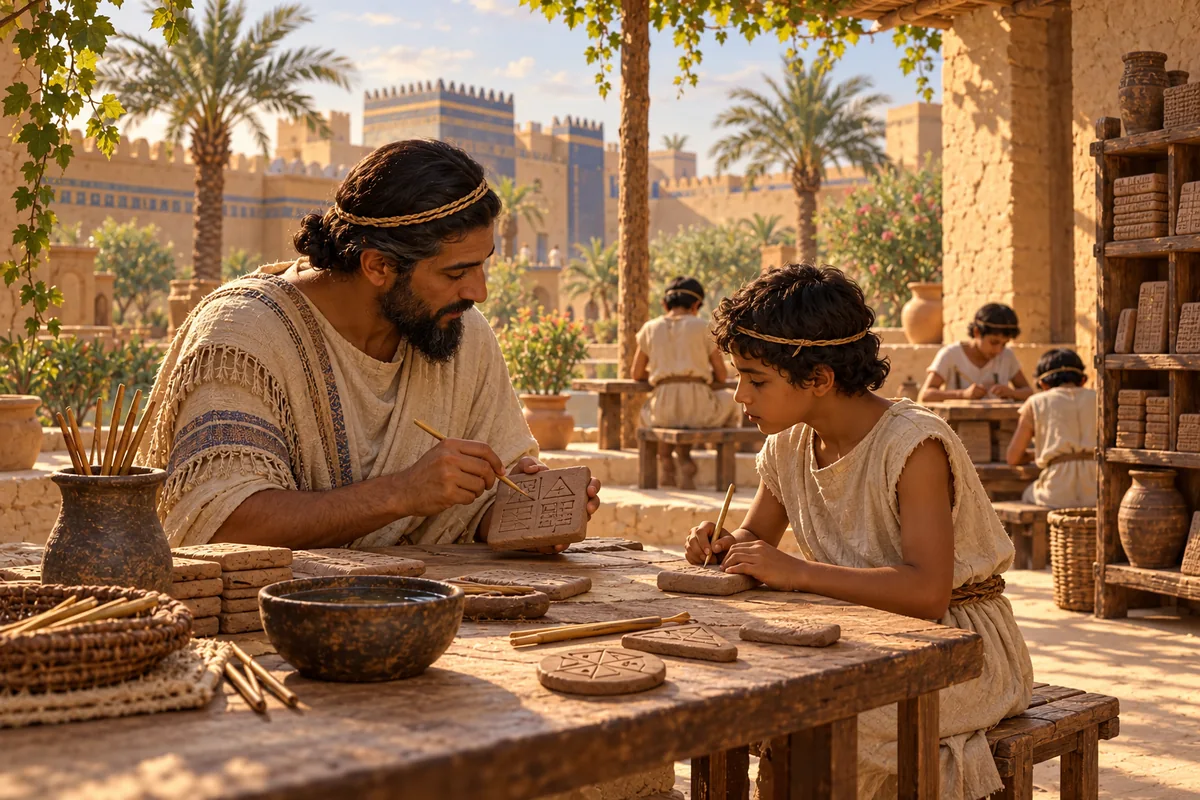
~1800 BCE · Multiple manuscripts across collections; see ETCSL bibliography for witnesses
Dumuzid's dream
“His heart was full of tears as he went out into the countryside. The lad's heart was full of tears as he went out into the countryside. Dumuzid's heart was full of tears as he went out into the countryside. He carried with him his (1 ms. adds: shepherd's) stick on his shoulder, sobbing all the time: "Grieve, grieve, o countryside, grieve! O countryside, grieve! O marshes, cry out! O ...... crabs of the river, grieve! O frogs of the river, cry out! My mother will call to me, my mother, my Durtur, will call to me, my mother will call to me for five things, my mother will call to me for ten things: if she does not know the day when I am dead, you, o countryside, can inform my mother who bore me. Like my little sister may you weep for me."”
Source: ETCSL c.1.4.3: Dumuzid's dream. Black, J.A., Cunningham, G., Robson, E. & Zólyomi, G. (eds.), The Electronic Text Corpus of Sumerian Literature, Faculty of Oriental Studies, University of Oxford. https://etcsl.orinst.ox.ac.uk/cgi-bin/etcsl.cgi?text=c.1.4.3
Read the full tablet entry~1800 BCE · Kress 005 — private: anonymous, Germany
DWJ 2, 019-021
In plain English
Dear Sîn-magir — greetings from Lugal-gubbani. May Enlil keep you in good health, and may everything that has been scattered come back together! I'm writing about someone who has stopped working, and something involving two and a half units of some commodity — but the middle of the letter is too damaged to read. The tablet is stamped with the seal of Lāqīpum, a purification priest of Enlil in royal service, son of Ninurta-nīšu and servant of King Abī-ēšuḫ.
AI-generated reading paraphrase; compare with the translation below.
“(obverse) To Sîn-magir speak: thus (says) Lugal-gubbani: May Enlil keep you in good health! May the scattered be gathered! The one who(?) had ceased(?) (work) for 2½ ... [broken] ... [illegible] ... (seal legend / closing lines) Lāqīpum(?), gudu-priest of Enlil, the king's contract-agent(?), son of Ninurta-nīšu, servant of Abī-ēšuḫ.”
Source: engine:claude-fable-5 (2026-07-12/v7-evolved) · claude-fable-5 · low confidence
Read the full tablet entry~1800 BCE · Multiple manuscripts across collections; see ETCSL bibliography for witnesses
Enki and Ninhursanga
“Pure are the cities -- and you are the ones to whom they are allotted. Pure is Dilmun land. Pure is Sumer -- and you are the ones to whom it is allotted. Pure is Dilmun land. Pure is Dilmun land. Virginal is Dilmun land. Virginal is Dilmun land. Pristine is Dilmun land. He laid her down all alone in Dilmun, and the place where Enki had lain down with his spouse, that place was still virginal, that place was still pristine. He laid her down all alone in Dilmun, and the place where Enki had lain down with Ninsikila, that place was virginal, that place was pristine. In Dilmun the raven was not yet cawing, the partridge not cackling. The lion did not slay, the wolf was not carrying off lambs, the dog had not been taught to make kids curl up, the pig had not learned that grain was to be eaten.”
Source: ETCSL c.1.1.1: Enki and Ninhursanga. Black, J.A., Cunningham, G., Robson, E. & Zólyomi, G. (eds.), The Electronic Text Corpus of Sumerian Literature, Faculty of Oriental Studies, University of Oxford. https://etcsl.orinst.ox.ac.uk/cgi-bin/etcsl.cgi?text=c.1.1.1
Read the full tablet entry~1800 BCE · Multiple manuscripts across collections; see ETCSL bibliography for witnesses
Enki and Ninmah
“In those days, in the days when heaven and earth were created; in those nights, in the nights when heaven and earth were created; in those years, in the years when the fates were determined; when the Anuna gods were born; when the goddesses were taken in marriage; when the goddesses were distributed in heaven and earth; when the goddesses ...... became pregnant and gave birth; when the gods were obliged (?) ...... their food ...... for their meals; the senior gods oversaw the work, while the minor gods were bearing the toil. The gods were digging the canals and piling up the silt in Harali. The gods, dredging the clay, began complaining about this life.”
Source: ETCSL c.1.1.2: Enki and Ninmah. Black, J.A., Cunningham, G., Robson, E. & Zólyomi, G. (eds.), The Electronic Text Corpus of Sumerian Literature, Faculty of Oriental Studies, University of Oxford. https://etcsl.orinst.ox.ac.uk/cgi-bin/etcsl.cgi?text=c.1.1.2
Read the full tablet entry~1800 BCE · Multiple manuscripts across collections; see ETCSL bibliography for witnesses
Enki and the world order
“Grandiloquent lord of heaven and earth, self-reliant, father Enki, engendered by a bull, begotten by a wild bull, cherished by Enlil the Great Mountain, beloved by holy An, king, mes tree planted in the Abzu, rising over all lands; great dragon who stands in Eridug, whose shadow covers heaven and earth, a grove of vines extending over the Land, Enki, lord of plenty of the Anuna gods, Nudimmud, mighty one of the E-kur, strong one of heaven and earth! Your great house is founded in the Abzu, the great mooring-post of heaven and earth. Enki, from whom a single glance is enough to unsettle the…”
Source: ETCSL c.1.1.3: Enki and the world order. Black, J.A., Cunningham, G., Robson, E. & Zólyomi, G. (eds.), The Electronic Text Corpus of Sumerian Literature, Faculty of Oriental Studies, University of Oxford. https://etcsl.orinst.ox.ac.uk/cgi-bin/etcsl.cgi?text=c.1.1.3
Read the full tablet entry~1800 BCE · Multiple manuscripts across collections; see ETCSL bibliography for witnesses
Enki's journey to Nibru
“In those remote days, when the fates were determined; in a year when An brought about abundance, and people broke through the earth like herbs and plants -- then the lord of the abzu, king Enki, Enki, the lord who determines the fates, built up his temple entirely from silver and lapis lazuli. Its silver and lapis lazuli were the shining daylight. Into the shrine of the abzu he brought joy. An artfully made bright crenellation rising out from the abzu was erected for lord Nudimmud. He built the temple from precious metal, decorated it with lapis lazuli, and covered it abundantly with gold. In Eridug, he built the house on the bank. Its brickwork makes utterances and gives advice. Its eaves roar like a bull; the temple of Enki bellows. During the night the temple praises its lord and offers its best for him.”
Source: ETCSL c.1.1.4: Enki's journey to Nibru. Black, J.A., Cunningham, G., Robson, E. & Zólyomi, G. (eds.), The Electronic Text Corpus of Sumerian Literature, Faculty of Oriental Studies, University of Oxford. https://etcsl.orinst.ox.ac.uk/cgi-bin/etcsl.cgi?text=c.1.1.4
Read the full tablet entry~1800 BCE · Multiple manuscripts across collections; see ETCSL bibliography for witnesses
Enlil and Nam-zid-tara
“Nam-zid-tara walked by Enlil, who said to him: "Where have you come from, Nam-zid-tara?" "From Enlil's temple. My turn of duty is finished. I serve at the place of the gudu priests, with their sheep. I am on my way home. Don't stop me; I am in a hurry. Who are you who asks me questions?" "I am Enlil." But Enlil had changed his appearance: he had turned into a raven and was croaking. "But you are not a raven, you really are Enlil!" "How did you recognise that I am Enlil, who decrees the destinies? " "When your uncle En-me-cara was a captive, after taking for himself the rank of Enlil, he said: "Now I shall know the fates, like a lord. " "”
Source: ETCSL c.5.7.1: Enlil and Nam-zid-tara. Black, J.A., Cunningham, G., Robson, E. & Zólyomi, G. (eds.), The Electronic Text Corpus of Sumerian Literature, Faculty of Oriental Studies, University of Oxford. https://etcsl.orinst.ox.ac.uk/cgi-bin/etcsl.cgi?text=c.5.7.1
Read the full tablet entry~1800 BCE · Multiple manuscripts across collections; see ETCSL bibliography for witnesses
Enlil and Ninlil
“There was a city, there was a city -- the one we live in. Nibru was the city, the one we live in. Dur-jicnimbar was the city, the one we live in. Id-sala is its holy river, Kar-jectina is its quay. Kar-asar is its quay where boats make fast. Pu-lal is its fresh-water well. Id-nunbir-tum is its branching canal, and if one measures from there, its cultivated land is 50 sar each way. Enlil was one of its young men, and Ninlil was one its young women. Nun-bar-ce-gunu was one of its wise old women. At that time the maiden was advised by her own mother, Ninlil was advised by Nun-bar-ce-gunu: "The…”
Source: ETCSL c.1.2.1: Enlil and Ninlil. Black, J.A., Cunningham, G., Robson, E. & Zólyomi, G. (eds.), The Electronic Text Corpus of Sumerian Literature, Faculty of Oriental Studies, University of Oxford. https://etcsl.orinst.ox.ac.uk/cgi-bin/etcsl.cgi?text=c.1.2.1
Read the full tablet entry