Chapter 05 · 2000 – 1600 BCE
Old Babylonian
Hammurabi, the Epic of Gilgamesh, mathematics.
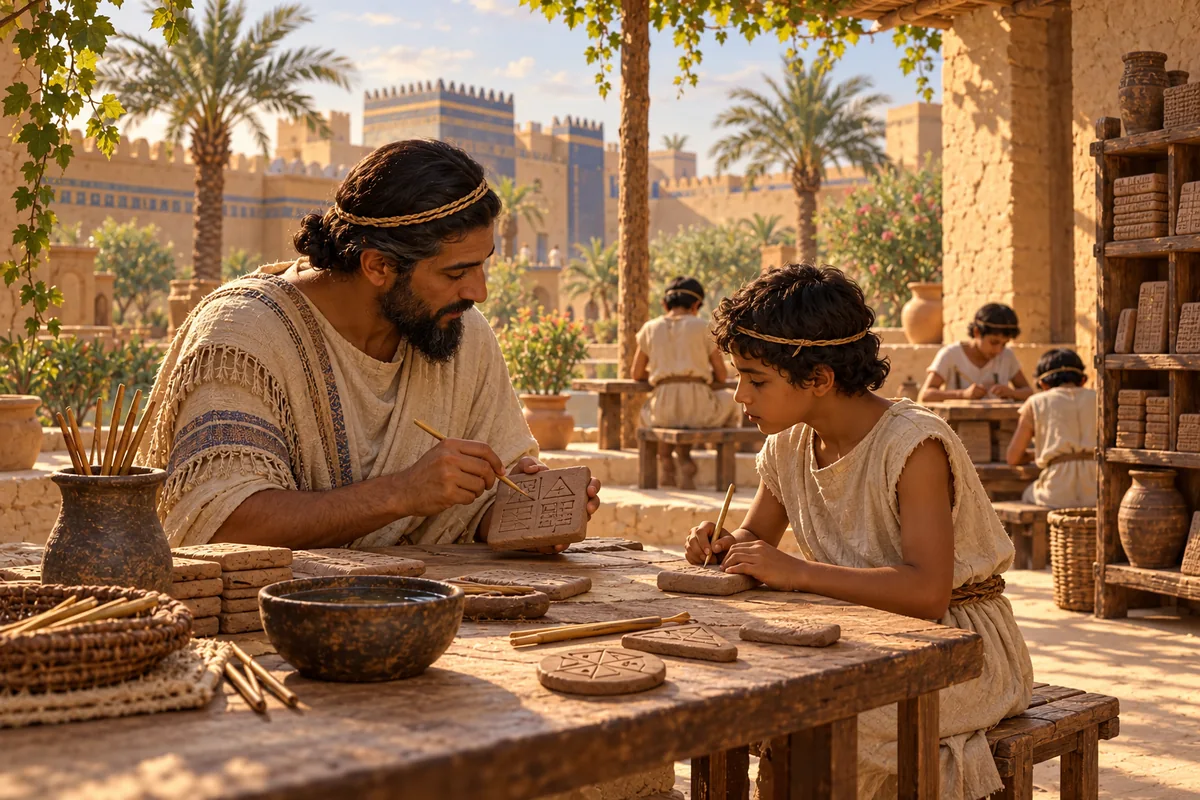
~1800 BCE · Multiple manuscripts across collections; see ETCSL bibliography for witnesses
A hymn to Sadarnuna (Sadarnuna A)
In plain English
Sadarnuna is the just woman who dwells among the great divine powers, unmatched in ladyship and the beloved of An. Her counsel reaches far, and she has set up her majestic dais in the courtyard of Enlil; standing in the holy storehouse Ec-mah — a place whose name is damaged on the tablet — she radiates terrifying awe. She is An's worthy offspring, and her husband is Nuska, the leader of the divine assembly, who serves the great gods of heaven and earth in his temple E-melem-huc. The hymn then breaks down: four lines are too fragmentary to read, and an unknown number of further lines are lost entirely.
AI-generated reading paraphrase; compare with the translation below.
“The just woman dwelling among the great divine powers is the lady unsurpassed in ladyship! Sadarnuna, the just woman of far-reaching and just counsel, is the beloved of An! The great authority (?), the majestic quay, made fitting for the Ec-mah by Enul and Ninul, the just woman has erected her majestic dais in the courtyard of Enlil. As she stands in the holy storehouse Ec-mah, the ...... place, she conveys terrifying awesomeness. The beloved offspring of An the king, as she is worthy of the Pada-nunus (?), ...... the Ec-mah (?). In his E-melem-huc conveying great awesomeness, ...... fear, serving the great gods of heaven and earth, her spouse, the assembly leader Nuska, ....... 4 lines fragmentary unknown no. of lines missing”
Source: ETCSL c.4.33.1: A hymn to Sadarnuna (Sadarnuna A). Black, J.A., Cunningham, G., Robson, E. & Zólyomi, G. (eds.), The Electronic Text Corpus of Sumerian Literature, Faculty of Oriental Studies, University of Oxford. https://etcsl.orinst.ox.ac.uk/cgi-bin/etcsl.cgi?text=c.4.33.1
Read the full tablet entry~1800 BCE · Multiple manuscripts across collections; see ETCSL bibliography for witnesses
A hymn to Shul-pa-ed (Shul-pa-ed A)
In plain English
Shul-pa-ed blazes over the upper city like moonlight — eminent, famous, clothed in glory and great divine powers. He is a lord of battle, a war-club that smashes every enemy, and at the same time the force that makes vegetation shoot up tall across the land. He lifts his great arms in the thick of fighting, and father Enlil himself has spoken his august name, naming him the foremost brother-in-law of the gods. The text breaks off mid-phrase as Shul-pa-ed is called owner of something — the surface ends there.
AI-generated reading paraphrase; compare with the translation below.
“Hero, who shines forth like moonlight over the upper city! Hero Cul-pa-ed, who shines forth like moonlight over the upper city! Eminent and famous Cul-pa-ed, who shines forth like moonlight over the upper city! Lord of great divine powers, god who appears in glory, Cul-pa-ed, of great divine powers, god who appears in glory, lordly in battle, who makes vegetation grow tall in the Land! Lord who raises his great arms, battle-club that smashes all enemies! Pre-eminent brother-in-law of father Enlil, good youth! Enlil has named your august name. Lordly with weapons in the thick of battle! Owner…”
Source: ETCSL c.4.31.1: A hymn to Shul-pa-ed (Shul-pa-ed A). Black, J.A., Cunningham, G., Robson, E. & Zólyomi, G. (eds.), The Electronic Text Corpus of Sumerian Literature, Faculty of Oriental Studies, University of Oxford. https://etcsl.orinst.ox.ac.uk/cgi-bin/etcsl.cgi?text=c.4.31.1
Read the full tablet entry~1800 BCE · Multiple manuscripts across collections; see ETCSL bibliography for witnesses
A hymn to Suen for Ibbi-Suen (Ibbi-Suen E)
In plain English
The hymn addresses Nanna, the moon god, praising his divine powers and holy shrine, though several lines are too damaged to read. When Nanna takes his seat on the great dais he wears a gleaming crown, headdress, and diadem, and when he opens his mouth the divine powers are set in order. He gathers together the throne and those divine powers, seated with his head held high. The surviving lines then turn to Ibbi-Suen, who receives his royal authority from holy An, the lord who sanctifies divine power — but the passage breaks off before this thought is completed.
AI-generated reading paraphrase; compare with the translation below.
“Your divine powers ......, father Nanna, ......, ...... chose from the people ....... Youthful Suen, your holy shrine ....... An, you ...... your good crown and headdress on your head. When you take your seat on the great august dais ....... When you open your holy mouth, ...... the great ...... and the divine powers. ...... the royal crown, the holy headdress and the diadem, gathering together the throne and the divine powers, on the dais with head high ....... Mighty (?) one of the dais, ...... good seed ......, my Ibbi-Suen, ...... from holy An, lord who sanctifies the divine powers, who…”
Source: ETCSL c.2.4.5.5: A hymn to Suen for Ibbi-Suen (Ibbi-Suen E). Black, J.A., Cunningham, G., Robson, E. & Zólyomi, G. (eds.), The Electronic Text Corpus of Sumerian Literature, Faculty of Oriental Studies, University of Oxford. https://etcsl.orinst.ox.ac.uk/cgi-bin/etcsl.cgi?text=c.2.4.5.5
Read the full tablet entry~1800 BCE · Multiple manuscripts across collections; see ETCSL bibliography for witnesses
A hymn to Utu (Utu B)
In plain English
Rising from below and gazing upward, Utu — great physician, father of humanity, wearing a lapis-lazuli beard in his temple the E-babbar — is a great hero, the focal point of the divine assembly, a king, a bison charging across the mountains. He is the son born alongside the city to Ningal in the E-nun-ana: a bull, a cedar nourished by water growing strong among cypresses, holy, patient, playful, blazing with iridescent light. When he comes forth, the heavens tremble and the earth shakes. Several phrases earlier in the passage are too damaged to read, and one line contains an uncertain reading marked by the translators.
AI-generated reading paraphrase; compare with the translation below.
“Emerging ...... below and gazing upwards, Utu, great physician, father of the black-headed, wearing a lapis-lazuli beard in the E-babbar! Utu, great hero, focus of the assembly, king, bison running over the mountains! Utu, bison running over the mountains! A young wild cow ......, a young gazelle (?) caught in a trap, Utu, the son born with the city to Ningal in the E-nun-ana, a bull, a cedar fed with water thriving among cypresses, holy (?), patient-hearted, playful, radiating light, he is iridescent radiance! Then, as my king comes forth, the heavens tremble before him and the earth shakes…”
Source: ETCSL c.4.32.2: A hymn to Utu (Utu B). Black, J.A., Cunningham, G., Robson, E. & Zólyomi, G. (eds.), The Electronic Text Corpus of Sumerian Literature, Faculty of Oriental Studies, University of Oxford. https://etcsl.orinst.ox.ac.uk/cgi-bin/etcsl.cgi?text=c.4.32.2
Read the full tablet entry~1800 BCE · Multiple manuscripts across collections; see ETCSL bibliography for witnesses
A kungar to Inana and Dumuzid (Dumuzid-Inana I)
In plain English
Inana insists that only her family's protection keeps Dumuzid from chasing her through the dark paths of the desert. She names them one by one: her mother, her mother Ningal, Ningikuga, her father Suen, her brother Utu — without any one of them, this young man would be pursuing her through those shadowed desert tracks. The passage breaks off mid-sentence after she begins addressing Dumuzid directly as "young —" and the rest is lost.
AI-generated reading paraphrase; compare with the translation below.
“"If it were not for our mother, he would be chasing me along the dark (?) paths of the desert! If it were not for our mother, this young man would be chasing me along the dark (?) paths of the desert! If it were not for my mother Ningal, he would be chasing me along the dark (?) paths of the desert! If it were not for Ningikuga, he would be chasing me along the dark (?) paths of the desert! If it were not for father Suen, he would be chasing me along the dark (?) paths of the desert! If it were not for my brother Utu, he would be chasing me along the dark (?) paths of the desert! "Young…”
Source: ETCSL c.4.08.09: A kungar to Inana and Dumuzid (Dumuzid-Inana I). Black, J.A., Cunningham, G., Robson, E. & Zólyomi, G. (eds.), The Electronic Text Corpus of Sumerian Literature, Faculty of Oriental Studies, University of Oxford. https://etcsl.orinst.ox.ac.uk/cgi-bin/etcsl.cgi?text=c.4.08.09
Read the full tablet entry~1800 BCE · Multiple manuscripts across collections; see ETCSL bibliography for witnesses
A love song of Shu-Suen (Shu-Suen A)
In plain English
Abi-simti, mother of Shu-Suen, is praised as the one who gave birth to the holy king — she is the speaker's cloth beam, her pleasure and her anchor. The speaker also addresses Kubatum, Shu-Suen's concubine, as the warp beam set for weaving, and hails Shu-Suen himself — son of Shulgi, magnificent to look upon — in words that are partly lost. Because the speaker cried out in joy, the lord rewarded her: he gave her a golden pin, a lapis-lazuli seal, a golden ring, and a silver ring.
AI-generated reading paraphrase; compare with the translation below.
“It was she who gave birth to the holy one, gave birth to the holy one; the queen gave birth to the holy one, Abi-simti (i.e. Cu-Suen's mother) gave birth to the holy one, the queen gave birth to the holy one -- my cloth beam of the cloth of pleasure, my Abi-simti! My warp beam placed for weaving, my queen Kubatum (i.e. Cu-Suen's concubine)! My one suited to a mane of hair, a wonder to behold, my lord Cu-Suen, my one ...... in words, my son of Culgi -- because I uttered, because I uttered, the lord gave me a gift, because I uttered an exclamation of joy, the lord gave me a gift. The lord gave me as a gift a golden pin, a lapis-lazuli seal. The lord gave me as a gift a golden ring, a silver ring.”
Source: ETCSL c.2.4.4.1: A love song of Shu-Suen (Shu-Suen A). Black, J.A., Cunningham, G., Robson, E. & Zólyomi, G. (eds.), The Electronic Text Corpus of Sumerian Literature, Faculty of Oriental Studies, University of Oxford. https://etcsl.orinst.ox.ac.uk/cgi-bin/etcsl.cgi?text=c.2.4.4.1
Read the full tablet entry~1800 BCE · Multiple manuscripts across collections; see ETCSL bibliography for witnesses
A love song of Shu-Suen (Shu-Suen B)
In plain English
A woman addresses the man she desires: his charm is as sweet as honey, and she is captivated — willingly, she says, not under any compulsion. She wants to run away with him to the bedroom, to do the sweetest things to him, to bring him honey. In a bedchamber dripping with honey they will enjoy his sweetness again and again.
AI-generated reading paraphrase; compare with the translation below.
“Man of my heart, my beloved man, your allure is a sweet thing, as sweet as honey. Lad of my heart, my beloved man, your allure is a sweet thing, as sweet as honey. You have captivated me (?), of my own free will I will come to you. Man, let me flee with you -- into the bedroom. You have captivated me (?); of my own free will I shall come to you. Lad, let me flee with you -- into the bedroom. Man, let me do the sweetest things to you. My precious sweet, let me bring you honey. In the bedchamber dripping with honey let us enjoy over and over your allure, the sweet thing. Lad, let me do the sweetest things to you. My precious sweet, let me bring you honey.”
Source: ETCSL c.2.4.4.2: A love song of Shu-Suen (Shu-Suen B). Black, J.A., Cunningham, G., Robson, E. & Zólyomi, G. (eds.), The Electronic Text Corpus of Sumerian Literature, Faculty of Oriental Studies, University of Oxford. https://etcsl.orinst.ox.ac.uk/cgi-bin/etcsl.cgi?text=c.2.4.4.2
Read the full tablet entry~1800 BCE · Multiple manuscripts across collections; see ETCSL bibliography for witnesses
A love song of Shu-Suen (Shu-Suen C)
In plain English
A young woman describes her hair: lush and well-watered like lettuce, its coiled locks tightened and lifted by her nursemaid, adorned with small combs so that everything about her is arranged and beautiful — her hair, she says, is the finest of plants. Shu-Suen, the handsome man, has turned his life-giving gaze on her and chosen her, and her allure, she insists, is endless. Several lines are too damaged to read. What follows is a direct address to Shu-Suen himself: he is their lord, gleaming like silver and lapis lazuli, the farmer who brings forth the finest grain.
AI-generated reading paraphrase; compare with the translation below.
“My hair is lettuce, well watered. It is the sprout of a lettuce, well watered. Its tangled coils (?) have been tightened. My nursemaid has ...... them high and made my hair stag-like. She has tightened its small combs and brought order to my charms; my charms, my hair, the lettuce, is the fairest of plants. The brother has brought me into his life-giving gaze, Cu-Suen, the ...... handsome man, has chosen me. ...... my allure is without end, 1 line fragmentary 5 lines missing You are our lord, you are our lord, of silver and lapis lazuli, you are our lord. You are our farmer who brings superb grain.”
Source: ETCSL c.2.4.4.3: A love song of Shu-Suen (Shu-Suen C). Black, J.A., Cunningham, G., Robson, E. & Zólyomi, G. (eds.), The Electronic Text Corpus of Sumerian Literature, Faculty of Oriental Studies, University of Oxford. https://etcsl.orinst.ox.ac.uk/cgi-bin/etcsl.cgi?text=c.2.4.4.3
Read the full tablet entry