Chapter 05 · 2000 – 1600 BCE
Old Babylonian
Hammurabi, the Epic of Gilgamesh, mathematics.
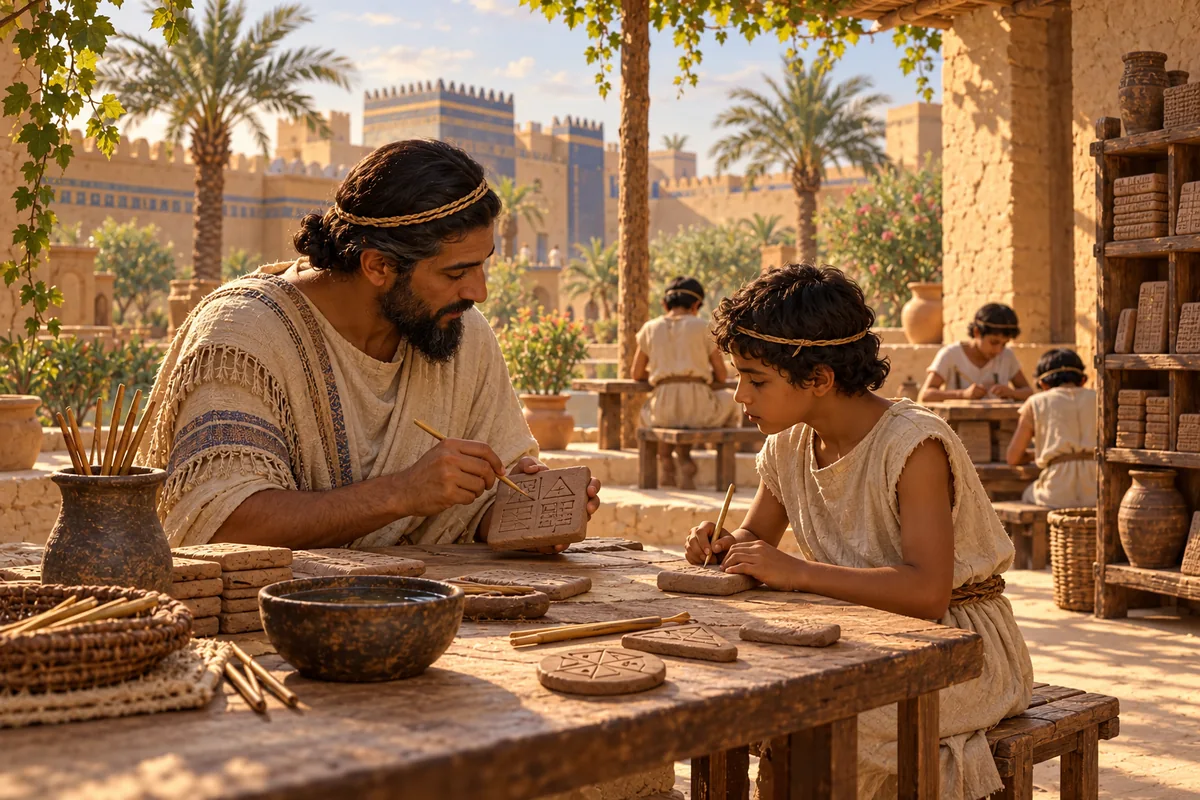
~1900 BCE · Reconstructed composite — see ORACC entry for manuscript witnesses
Šamši-Adad I 02
Claims the Emašmaš temple in Nineveh as a restoration of a structure built by Maništušu of Agade, asserting Assyrian dynastic continuity across seven generations of post-Akkadian history.
In plain English
Šamšī-Adad, strong king, king of the world, chosen by Enlil, vice-regent of Aššur and beloved of Ištar, declares that he had the old structure stripped away — and mentions, in a passage now broken, the temple tower as well. The temple in question is the Emenuè, which stands on the ground of the Emašmaš. That earlier building had been put up by Maništušu, son of Sargon of Agade, and by Šamšī-Adad's day it had fallen into decay. What he did next was recorded in the following lines, but the stone breaks off there.
AI-generated reading paraphrase; compare with the translation below.
“(1) [...] ... (2) [I], (3) [Šam]šī-Adad (I), (4) [king] of the world, (5) I had it cleared away, and (6) [...] ... (7) and the ziqqu[rrat] (8) ... [...] (9) Šamšī-Adad (I), (10) strong (king), (11) king of the world, (12) appointee of the god Enlil, (13) vice-regent of the god Aššur, (14) beloved of the goddess Ištar: (15) (As for) the temple Emenuè, (16) which stands on the site of the Emašmaš, (17) the old temple (18) which Maništušu, (19) son of Sargon, (20) king of Agade, (21) had built — it had become dilapidated, and (22) the temple which … (the text breaks off here)”
Source: engine:claude-opus-5 (2026-07-12/v7-evolved) · claude-opus-5 · medium confidence
Read the full tablet entry~1900 BCE · Reconstructed composite — see ORACC entry for manuscript witnesses
Šamši-Adad I 04
“(1) Šamšī-Adad (I), appointee of the god Enlil, vice-regent of the god Aššur. (4) When the god Itūr-Mēr, my lord, fully entrusted to [me] the ru[le] and control [over] the land Mari and the bank(s) of the Eu[phrates] River, I prayed to hi[m a]nd (then) [I offered up (to him), [(for the splendor of his divinity,)] a throne of light-colored medlar-wood ... [...] that had been perfected with everything pertaining to the goldsmith’s art (lit. “by gold and skilled craftsmen”).”
Source: Royal Inscriptions of Assyria online (RIAo), Munich Open-access Cuneiform Corpus Initiative (MOCCI), Ludwig-Maximilians-Universität München; in association with the RINAP Project, University of Pennsylvania. https://oracc.museum.upenn.edu/riao/Q005648/
Read the full tablet entry~1900 BCE · Reconstructed composite — see ORACC entry for manuscript witnesses
Šamši-Adad I 05
“(1) [Šamšī-Adad (I), appointee of the god Enlil, vice-regent of the god Aššur]. (4) Wh[en] the god Itūr-Mē[r] heard my pray[e]rs and petitions and fully entrusted to me the land Mari, the bank(s) of the Euphr[ates] River, and its domains, I prayed to him and (then) I offered up (to him), for the splendor of his divinity, a great ebony throne that had been methodically made with everything pertaining to the goldsmith’s art (lit. “by gold and skilled craftsmen”).”
Source: Royal Inscriptions of Assyria online (RIAo), Munich Open-access Cuneiform Corpus Initiative (MOCCI), Ludwig-Maximilians-Universität München; in association with the RINAP Project, University of Pennsylvania. https://oracc.museum.upenn.edu/riao/Q005649/
Read the full tablet entry~1900 BCE · Reconstructed composite — see ORACC entry for manuscript witnesses
Šamši-Adad I 06
“(1) For the goddess Ištar-šarrum, the controller of all of heaven and netherworld, the one who favorably receives his prayers (and) goes at his right hand: (6) Šamšī-Adad (I), strong king, king of Agade, conqueror of all of his enemies, dedicated a bronze kettledrum with good sound (and) befitting his being a warrior.”
Source: Royal Inscriptions of Assyria online (RIAo), Munich Open-access Cuneiform Corpus Initiative (MOCCI), Ludwig-Maximilians-Universität München; in association with the RINAP Project, University of Pennsylvania. https://oracc.museum.upenn.edu/riao/Q005650/
Read the full tablet entry~1900 BCE · Reconstructed composite — see ORACC entry for manuscript witnesses
Šamši-Adad I 07
“(1) [Šam]šī-[Adad (I)], strong king, appointee of the god [Enlil], vice-regent of the god Aššur, beloved of the god Dagān, pacifier of the land between the Tigris River and the Euphrates River, ruler of [Mar]i, king of Ekallātum, (and) governor of Šubat-Enlil. (12) [I ...] twin (vases) for the god Dagān and the banquet of [...] the god Aššur fo[r [...]. (r 1) (No translation possible)”
Source: Royal Inscriptions of Assyria online (RIAo), Munich Open-access Cuneiform Corpus Initiative (MOCCI), Ludwig-Maximilians-Universität München; in association with the RINAP Project, University of Pennsylvania. https://oracc.museum.upenn.edu/riao/Q005651/
Read the full tablet entry~1900 BCE · Reconstructed composite — see ORACC entry for manuscript witnesses
Šamši-Adad I 08
“(1) Šamšī-Adad (I), king of the world, appointee of the god Enlil, worshipper of the god Dagān, vice-regent of the god Aššur, builder of Ekisiga — “His Silent Temple,” the temple of the god Dagān in Terqa.”
Source: Royal Inscriptions of Assyria online (RIAo), Munich Open-access Cuneiform Corpus Initiative (MOCCI), Ludwig-Maximilians-Universität München; in association with the RINAP Project, University of Pennsylvania. https://oracc.museum.upenn.edu/riao/Q005652/
Read the full tablet entry~1900 BCE · Reconstructed composite — see ORACC entry for manuscript witnesses
Šamši-Adad I 09
“(1) Šamšī-Adad (I), vice-regent of the god Aššur, son of Ilā-kabkabī, builder of the temple of the god Aššur.”
Source: Royal Inscriptions of Assyria online (RIAo), Munich Open-access Cuneiform Corpus Initiative (MOCCI), Ludwig-Maximilians-Universität München; in association with the RINAP Project, University of Pennsylvania. https://oracc.museum.upenn.edu/riao/Q005653/
Read the full tablet entry~1900 BCE · Reconstructed composite — see ORACC entry for manuscript witnesses
Šamši-Adad I 10
“(1) Šamšī-Ad[ad (I)], beloved of the god Aššur, vice-regent of the god Aššur, [son of] Ilā-kabkabī.”
Source: Royal Inscriptions of Assyria online (RIAo), Munich Open-access Cuneiform Corpus Initiative (MOCCI), Ludwig-Maximilians-Universität München; in association with the RINAP Project, University of Pennsylvania. https://oracc.museum.upenn.edu/riao/Q005654/
Read the full tablet entry